North China Plain
The geology of the North China Plain has fundamentally shaped its development as a center of Chinese civilization. Formed over 25 million years, the plain is…
How has the geology of the North China Plain influenced its development?
The geology of the North China Plain has fundamentally shaped its development as a center of Chinese civilization. Formed over 25 million years, the plain is a massive alluvial fan created by the Huang He (Yellow River) and other rivers depositing vast quantities of silt, sand, and gravel into a shallow sea.12
This geological history has influenced the region in several critical ways:
- Agricultural Foundation: The deep, fertile sedimentary deposits have made the plain one of China’s most important agricultural regions for millennia. However, the high silt load—the highest of any river in the world—has also created significant challenges.324
- Hydrological Instability: Because the rivers deposit sediment, their beds have gradually risen above the surrounding land. This has historically led to frequent, catastrophic flooding and radical shifts in river courses, forcing inhabitants to develop extensive levee and irrigation systems to survive.124
- Human-Environment Interaction: The landscape is a testament to the interplay between natural forces and human engineering. While the plain is densely populated, poor drainage and aridity in some areas have resulted in saline soils, and centuries of intensive cultivation have required constant management of soil nutrients.35
What is the climate like in the North China Plain, and how does it affect agriculture?
The North China Plain experiences a climate characterized by distinct seasonal rhythms and significant environmental challenges. Located north of the Qin Mountains–Huai River line, the region features a mean annual temperature of approximately 50 °F (10 °C). Winters are cold and dry, influenced by northwesterly winds, while summers are hot and receive the majority of the region’s annual precipitation.678
Climate and Agricultural Impact
The climate directly dictates the agricultural potential and risks of the North China Plain:
- Precipitation Variability: Annual rainfall is relatively low, typically ranging from 20 to 25 inches (500 to 650 mm). Crucially, this rainfall is highly erratic, with variability exceeding 50 percent in many areas and reaching over 80 percent near Beijing. This instability makes the region historically prone to both severe droughts and catastrophic flooding.75
- Growing Season: The seasonal rhythm is well-defined, allowing for intensive cultivation. While the region is a major producer of wheat, cotton, sesame, peanuts, and tobacco, the climate limits the number of harvests compared to the warmer south.65
- Water Management: Because precipitation is often insufficient or poorly timed, the development of irrigation and flood control systems has been essential for agricultural survival since ancient times.51
What role did the North China Plain play in ancient Chinese dynasties?
The North China Plain has served as a primary cradle of Chinese civilization and a central focus of Han culture since the earliest times. Its role in ancient dynasties was defined by its status as a major political, economic, and cultural hub.111
Political and Strategic Significance
The plain was the heartland of early dynasties, including the Shang and Zhou. The Zhou dynasty, in particular, consolidated its power by establishing a network of feudal states along the Huang He (Yellow River) valley, using fortified cities to secure control over the region. The area’s dense concentration of cities made it a focal point for interstate power struggles, as states competed for dominance within this saturated landscape.131415
Economic and Agricultural Foundation
The plain’s fertile alluvial soil provided the agricultural base necessary to support large populations and sustain imperial power. As the primary cereal-producing region for centuries, it was essential for the survival of northern capital cities. To manage resources, dynasties eventually developed the Grand Canal, a vital infrastructure project that linked the agricultural wealth of the Yangtze basin to the political centers on the North China Plain.11611
What is the geographical location and extent of the North China Plain?
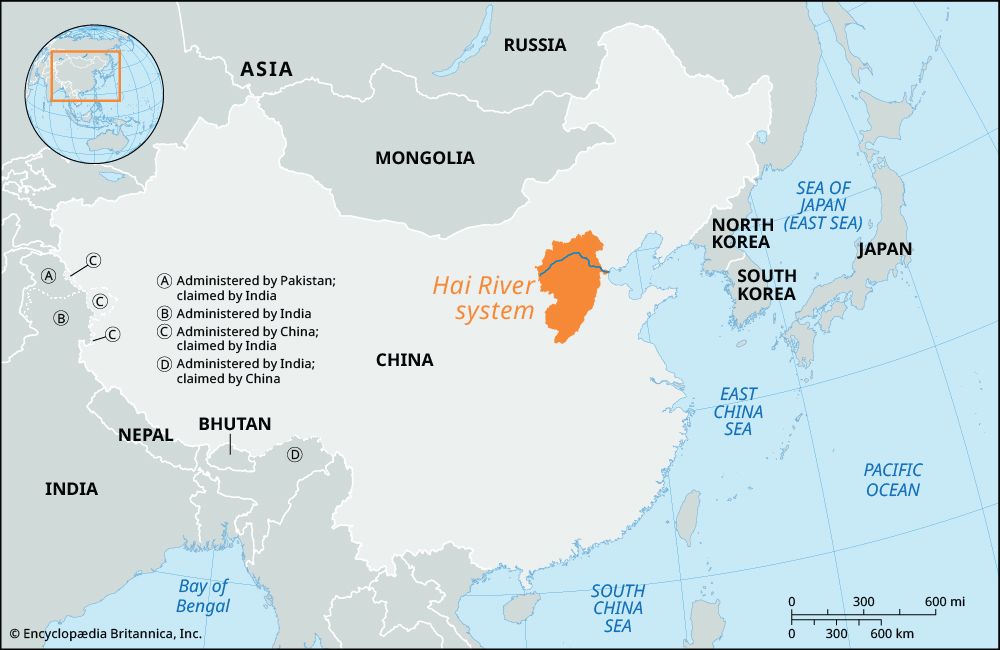
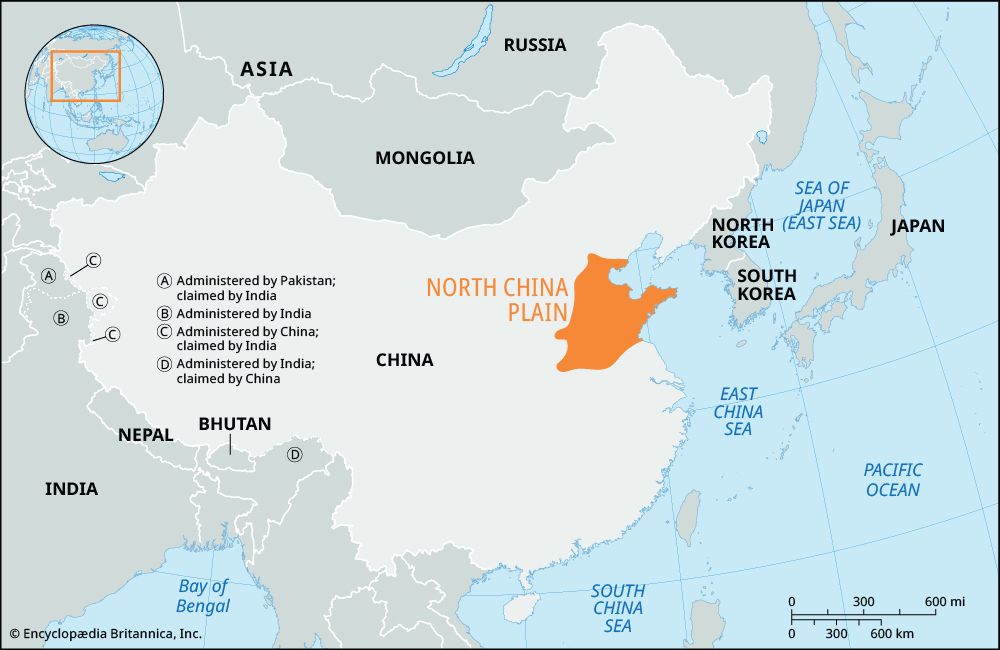
The North China Plain is a vast alluvial plain located in northern China, covering an area of approximately 158,000 square miles (409,500 square km). It was formed by extensive sedimentary deposits from the Huang He (Yellow River), the Huai, the Hai, and other smaller rivers.12
The region is defined by its low-lying, flat relief, with most of the area situated below 160 feet (50 meters) above sea level. Its geographical boundaries are as follows:12
- North: Bordered by the Yan Mountains.1
- West: Bordered by the Taihang Mountains and the Henan highlands.1
- Southwest: Bordered by the Tongbai and Dabie mountains.1
- South: Merges into the Yangtze Plain.1
- Northeast to Southeast: Fronts the Bo Hai, the hills of the Shandong Peninsula, and the Yellow Seainsula), and the Yellow Sea.1
This densely populated region serves as a major center of Chinese culture and maintains the highest proportion of cultivated land in China.12
Sources
- North China Plain — Encyclopædia Britannica
- China - The North China Plain — Encyclopædia Britannica
- Yellow River - The lower course — Encyclopædia Britannica
- Yellow River - Hydrology of the Yellow River — Encyclopædia Britannica
- China - Soils of China — Encyclopædia Britannica
- China - Temperature of China — Encyclopædia Britannica
- Jiangxi - Soils and climate — Encyclopædia Britannica
- China - Precipitation of China — Encyclopædia Britannica
- China - Drainage — Encyclopædia Britannica
- Shaanxi - Agriculture — Encyclopædia Britannica
- Origins of agriculture - The classical-imperial era — Encyclopædia Britannica
- Shanxi - Climate — Encyclopædia Britannica
- Yellow River — Encyclopædia Britannica
- Yangtze River - History of the Yangtze River — Encyclopædia Britannica
- Origins of agriculture - Tools and techniques — Encyclopædia Britannica
- China - Zhou and Shang — Encyclopædia Britannica
- history of China - Zhou and Shang — Encyclopædia Britannica
- China - Urbanization and assimilation — Encyclopædia Britannica
- Northeast Plain — Encyclopædia Britannica
Published on · 4 min read