Aconcagua River
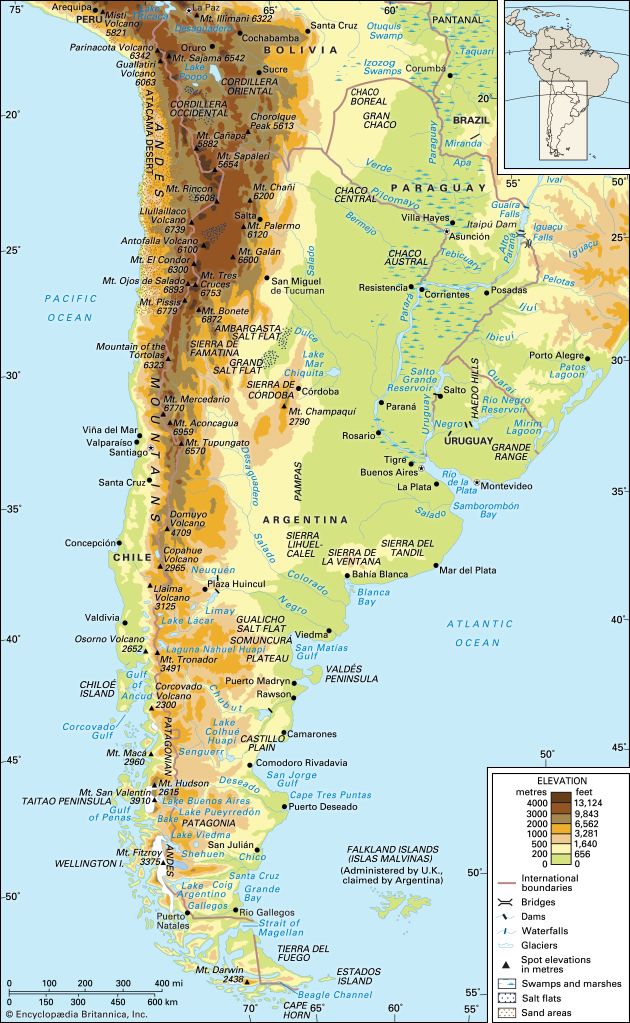
The Aconcagua River is a river located in central Chile. It originates in the northwestern foothills of Mount Aconcagua within the Andes Mountains. From the…
What is Aconcagua River?
The Aconcagua River is a river located in central Chile. It originates in the northwestern foothills of Mount Aconcagua within the Andes Mountains. From the border area of Argentina, the river flows westward for approximately 120 miles (190 km) before emptying into the Pacific Ocean just north of the city of Viña del Mar.1
The river valley is a significant transportation corridor, as it is followed by the highway connecting Los Andes to Mendoza, Argentina, as well as much of the Chilean trackage of the Transandine Railway.1
How do the Andes Mountains influence river systems in Chile?
The Andes Mountains serve as the primary source for most of Chile’s river systems, which generally flow westward toward the Pacific Ocean. Because the Andes are located in close proximity to the coast, these rivers are typically short and possess steep gradients.23
The influence of the Andes on these rivers varies significantly by region:
- Northern Chile: Rivers are fed by summer rains on the Altiplano. Due to the arid climate, most have such small volumes that they evaporate or are absorbed by the soil before reaching the sea, with the Loa River being a notable exception.2
- Central Chile: Rivers benefit from a more regular flow. In late spring, they receive essential runoff from winter snow accumulated in the high Andes, which supports agriculture in the Central Valley. Alluvial deposits from these rivers have created mineral-rich soils that make this region highly productive.245
- South-Central and Southern Chile: Rivers are fed by constant, intense rains and snowmelt. While these rivers are well-fed, their steep descent into the ocean often renders them unsuitable for commercial navigation.2
Beyond their hydrological role, these rivers are vital for hydroelectric power generation, often regulated by dams to manage seasonal flow variations.2
What is the significance of Mount Aconcagua in the region?
Mount Aconcagua is a landmark of immense geographical significance, primarily as the highest peak in the Western Hemisphere. Located in the Andes Mountains on the border between Argentina and Chile, it is often referred to as the “Sentinel of Stone,” a name derived from the Quechua term Ackon Cahuak.67
Beyond its status as a mountaineering destination, the mountain plays a vital role in the region’s hydrology. Its northwestern foothills serve as the source of the Aconcagua River, which flows westward through Chile to the Pacific Ocean. The valley carved by this river provides a critical transportation corridor, hosting the highway and railway connections between Mendoza, Argentina, and the Chilean lowlands.16
While its exact elevation has been a subject of scientific debate, the mountain remains a defining feature of the South American landscape.6
How does the Transandine Railway impact trade between Chile and Argentina?
The Transandine Railway, which connects Los Andes, Chile, and Mendoza, Argentina, serves as one of the few international rail links across the Andes Mountains. Historically, this route was significant for facilitating cross-border movement through the challenging mountainous terrain, with much of the Chilean trackage following the Aconcagua River valley.189
However, the overall impact of railways on trade between the two nations has been limited by the formidable physical barriers of the Andes, which make the construction and maintenance of rail infrastructure both difficult and expensive. Consequently, most railways in the region were originally built to transport mining products rather than general trade goods.8
In modern times, the role of rail in trade has been largely supplanted by road transportation. The most important international connection for the movement of goods between the two countries is now the paved highway that follows the same valley route as the railway. Truck transportation has become the primary and most cost-effective method for moving goods by land across the continent.9110
Sources
- Aconcagua River — Encyclopædia Britannica
- Chile - Drainage — Encyclopædia Britannica
- South America - Rivers of South America — Encyclopædia Britannica
- Chile - The intermediate depression — Encyclopædia Britannica
- Chile - The Chilean Andes — Encyclopædia Britannica
- Mount Aconcagua — Encyclopædia Britannica
- Aconcagua — Merriam-Webster
- Chile - Transportation — Encyclopædia Britannica
- Andes Mountains - Transportation — Encyclopædia Britannica
- Argentina - Transportation and telecommunications — Encyclopædia Britannica
- South America - Roads — Encyclopædia Britannica
Published on · 3 min read