Andes Mountains
The Andes Mountains host a diverse array of species adapted to extreme altitudinal variations and harsh climates.
What unique plant and animal species are endemic to the Andes Mountains?
The Andes Mountains host a diverse array of species adapted to extreme altitudinal variations and harsh climates.
Unique Plant Life
In the high-altitude northern regions, the landscape is defined by the páramo, an alpine meadow ecosystem. A signature plant of this zone is the Espeletia (frailejones), a tall, thick-stemmed member of the aster family crowned with large bouquets of hairy leaves. In the southern Patagonian Andes, the flora is distinctively austral, featuring rain forests dominated by the conifer genus Araucaria, as well as cypress, larch, and the evergreen coigue. The Altiplano is characterized by the tola, a wind-resistant shrub, alongside various cushion and rosette plants.123
Unique Animal Life
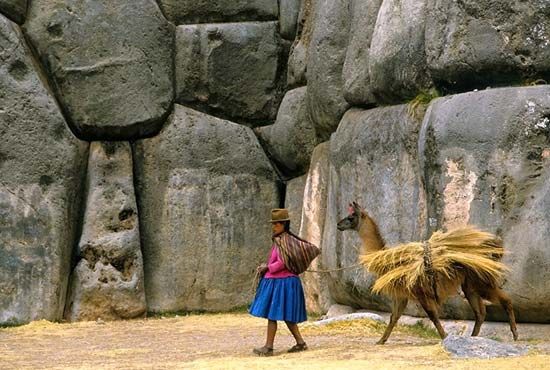
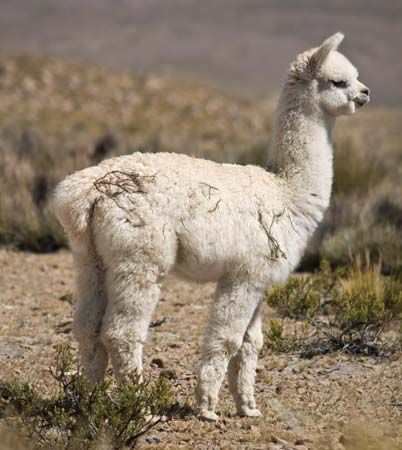
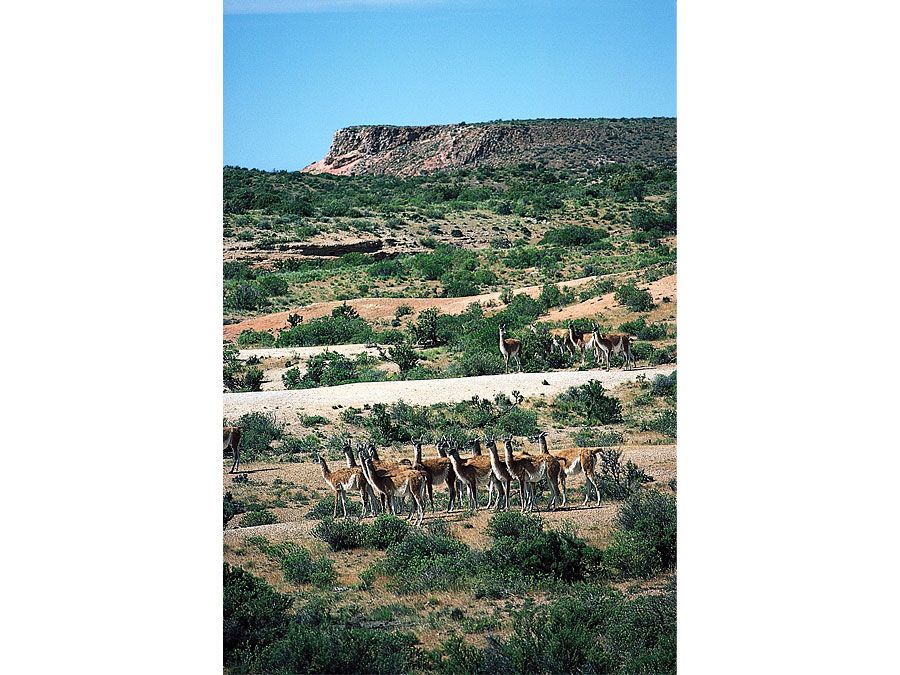
The Andes are home to several iconic species, most notably the camelids: the llama, alpaca, guanaco, and the wild, protected vicuña1. Other notable highland fauna include:45
- Birds: The Andean condor, one of the world’s largest flying birds.45
- Rodents: The chinchilla, viscacha, and the cui (guinea pig).145
- Predators: The spectacled bear, which is the only bear species native to South America.5
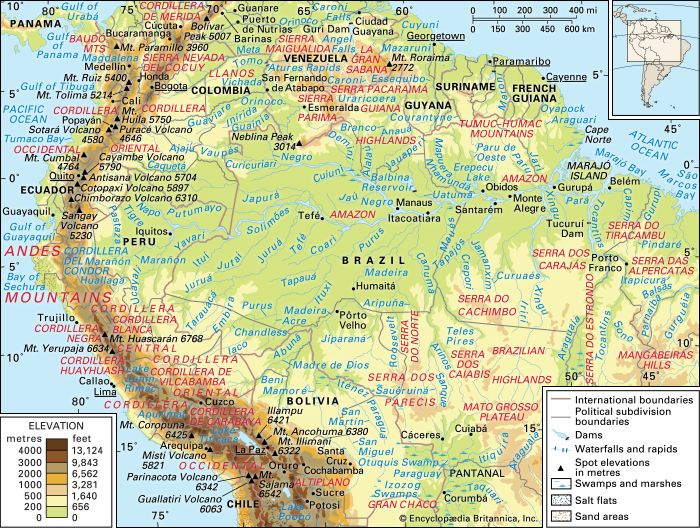
What is the geographical extent of the Andes Mountains in South America?
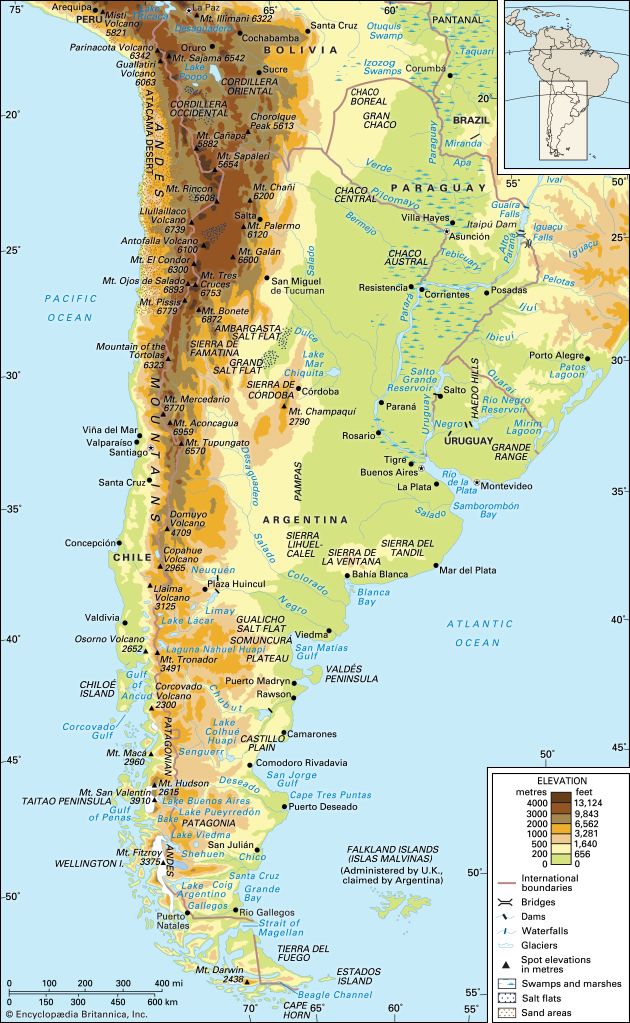
The Andes Mountains form a massive, nearly continuous mountain system that stretches approximately 5,500 miles (8,900 kilometers) along the western edge of South America6. The range acts as an unbroken rampart extending from the continent’s southern tip to its northernmost coast on the Caribbean Sea.67
Geographically, the system is often categorized into three broad, north-south subdivisions:
- Southern Andes: Comprising the Chilean, Fuegian, and Patagonian cordilleras, this section is characterized by a narrow range and significant glacial carving.86
- Central Andes: Including the Peruvian cordilleras, this region is notable for its increased width and the presence of the Altiplano, a vast high-altitude plateau.86
- Northern Andes: Encompassing the Ecuadorian, Colombian, and Venezuelan Andes, the range here diverges into multiple distinct chains.86
The Andes are the highest mountain system outside of Asia, featuring numerous peaks exceeding 20,000 feet (6,100 meters), including Mount Aconcagua, the tallest point in the Western Hemisphere.6
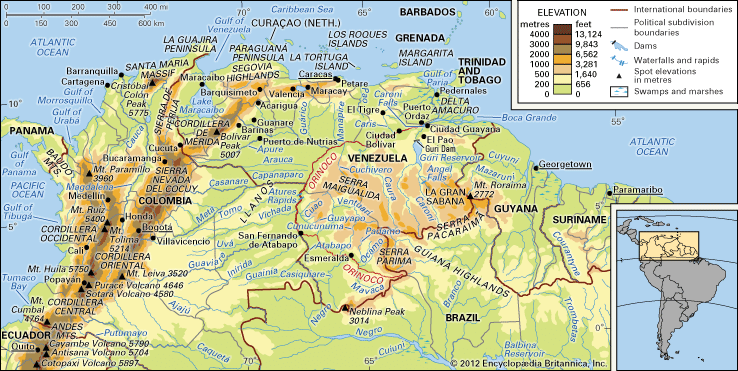
How have the Andes Mountains influenced transportation and communication in South America?
The Andes Mountains have historically served as a formidable barrier to transportation and communication in South America, significantly shaping the region’s economic and cultural development.9
Historical Communication and Transport
Before the Spanish conquest, the Inca overcame the rugged terrain by constructing a sophisticated road system spanning over 15,500 miles. This network included suspension bridges, tunnels, and galleries cut into rock, facilitating travel for foot couriers and llama caravans. Communication was maintained through a relay system using quipu—knotted cords used for record-keeping—and visual signaling from watchtowers.121314
Modern Challenges and Infrastructure
In the modern era, the mountainous landscape makes the construction of railways and roads both difficult and expensive.9
- Railways: Most rail lines were built primarily to support mining operations. While some international and internal lines exist, they are often limited in scope.9
- Roads: Road networks are more suitable for agricultural regions than railways, though many remain unpaved. The Pan-American Highway serves as a vital artery connecting major western cities.915
- Air Travel: Air transport has become essential, effectively reducing the isolation caused by the mountains’ extreme topography, particularly in countries like Peru and Colombia.9
How do the Andes Mountains affect the climate and ecosystems of South America?
The Andes Mountains act as a primary climatic and ecological determinant in South America, functioning as a massive orographic barrier that dictates regional weather patterns and biodiversity.1819
Climatic Influence
The Andes exert a profound influence on the continent’s climate through several mechanisms:
- Orographic Precipitation and Rain Shadows: As moisture-laden winds—particularly the mid-latitude westerlies—rise over the mountains, they release most of their moisture as orographic precipitation. This creates a significant rain shadow on the leeward side, resulting in arid regions like Patagonia. Similarly, the Andes block water vapor from leaving the Amazon Basin, contributing to the high rainfall on the eastern Andean flanks.1920
- Vertical Climatic Zones: Temperature in the Andes is primarily governed by altitude rather than latitude. The range is divided into distinct zones: tierra caliente (hot) at the base, tierra templada (temperate) at mid-levels, tierra fría (cool) in the highlands, and tierra helada (freezing) at the glacial summits.19
- Microclimates: The interplay of aspect, wind exposure, and topography creates a complex array of highly localized microclimates, particularly in Peru, which hosts one of the world’s most diverse sets of habitats.18
Ecological Impact
The mountains create distinct altitudinal bands that dictate the distribution of plant and animal life:5
- Habitation Limits: The permanent snow line serves as the upper limit for life, while specific species are adapted to narrow elevation ranges, such as camelids on the Altiplano.5
- Vegetation Diversity: The eastern slopes, influenced by the Amazon, support lush tropical forests, while the western slopes—especially in the south—are often dry and desertlike, contributing to the formation of the Atacama Desert.18521
Sources
- Exploring 7 of Earth’s Great Mountain Ranges - Andes — Encyclopædia Britannica
- South America - Mountain vegetation — Encyclopædia Britannica
- Bolivia - Animal life — Encyclopædia Britannica
- South America - The high Andes — Encyclopædia Britannica
- Andes Mountains - Plant and animal life — Encyclopædia Britannica
- Andes Mountains: Top Questions — Encyclopædia Britannica
- Andes Mountains - Physical features — Encyclopædia Britannica
- mountain - The Andes — Encyclopædia Britannica
- South America - The Andes Mountains — Encyclopædia Britannica
- Argentina - The Northwest — Encyclopædia Britannica
- Andes Mountains - Physiography of the Central Andes — Encyclopædia Britannica
- Pre-Columbian civilizations - Inca technology and intellectual life — Encyclopædia Britannica
- Andes Mountains - Transportation — Encyclopædia Britannica
- road - Inca roads of South America — Encyclopædia Britannica
- South America - Roads — Encyclopædia Britannica
- Inca: Top Questions — Encyclopædia Britannica
- Andes Mountains - Study and exploration — Encyclopædia Britannica
- Andes Mountains - Climate — Encyclopædia Britannica
- Amazon River - Climate — Encyclopædia Britannica
- South America - Factors influencing climate — Encyclopædia Britannica
- Atacama Desert — Encyclopædia Britannica
- Atacama Plateau — Encyclopædia Britannica
Published on · 4 min read