Al-Harūj al-Aswad
The Al-Harūj al-Aswad is a vast, hilly basaltic plateau located in central Libya. Its geological origin is volcanic, characterized by an expansive field of…
What is the geological origin of the Al-Harūj al-Aswad plateau?
The Al-Harūj al-Aswad is a vast, hilly basaltic plateau located in central Libya. Its geological origin is volcanic, characterized by an expansive field of ancient lava streams that flow in various directions across the landscape.
The plateau rises to approximately 2,600 feet (800 meters) above the surrounding desert and is crowned by numerous volcanic features, including the Qārat al-Sabʿah volcanoes, which reach elevations of up to 3,900 feet (1,200 meters). Further volcanic activity is evident in the south, where the ʿUnqūd al-Yāsirāt consists of two distinct lines of 40 volcanoes. Additionally, the region features the notable crater of Wāw al-Nāmūs, a deep volcanic depression that hosts swampy lakes and unique ecological pockets within the otherwise arid terrain.1
Where is Al-Harūj al-Aswad located in Libya, and what are its main geographical features?
Al-Harūj al-Aswad is a vast, hilly basaltic plateau situated in central Libya. Covering approximately 15,500 square miles (40,150 square km), it is a striking black landscape that rises about 2,600 feet (800 meters) above the surrounding desert.1
Key geographical features include:
- Volcanic Formations: The plateau is crowned by the Qārat al-Sabʿah volcanoes, which reach heights of 3,900 feet (1,200 meters). The southern boundary is marked by the ʿUnqūd al-Yāsirāt, consisting of two lines of 40 volcanoes.1
- Terrain: The surface is defined by ancient lava streams interspersed with sandy basins. The western edge features a sharp drop-off, while the eastern side is characterized by wadis that extend into the desert.1
- Wāw al-Nāmūs: Located in an outcrop to the southeast, this is a deep volcanic crater (330 feet deep) containing three swampy lakes that support unique vegetation and wildlife, including palms and migrating birds.1
- Vegetation: Following rainfall, the area supports grasses, bushes, and acacia groves.1
How large is the Al-Harūj al-Aswad plateau, and how does it compare to other similar formations in Africa?
The Al-Harūj al-Aswad is a vast, hilly basaltic plateau located in central Libya, covering an area of approximately 15,500 square miles (40,150 square km).1
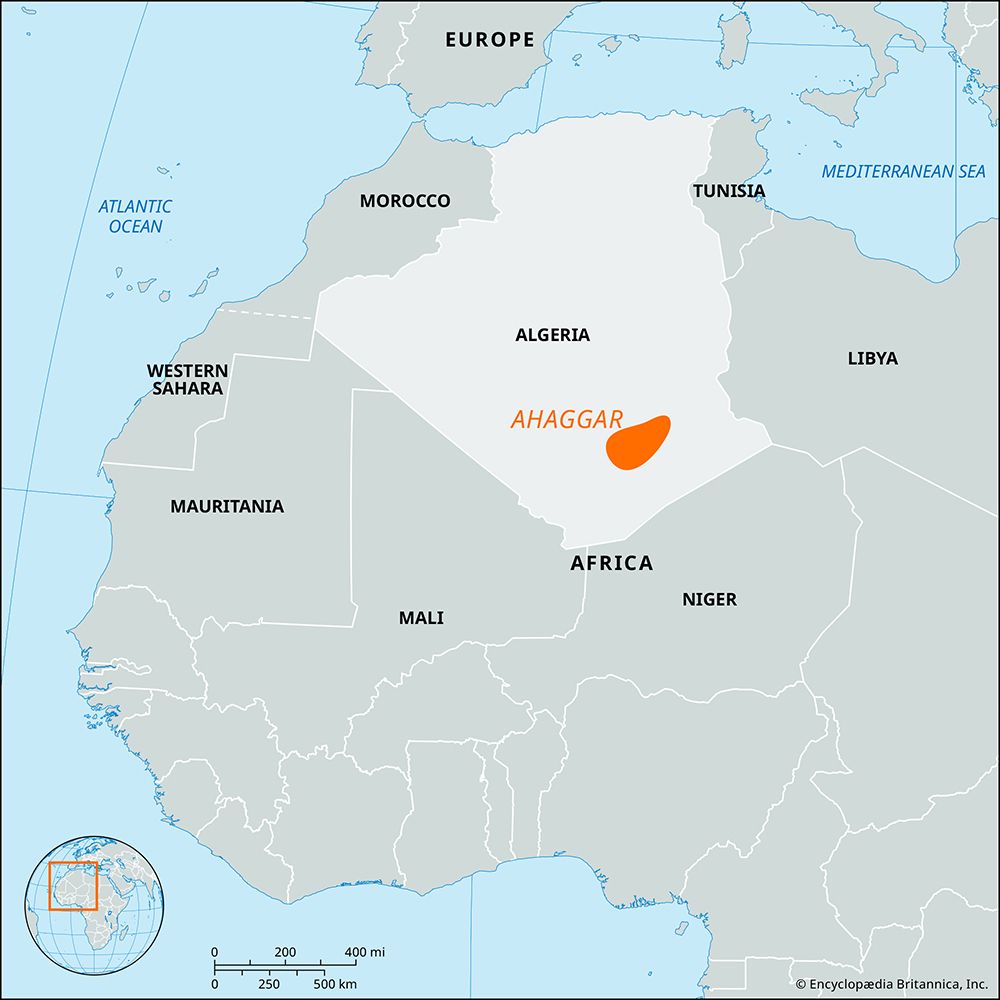
When compared to other geological formations in Africa, the Al-Harūj al-Aswad is distinguished by its specific volcanic origin and its status as a prominent volcanic massif within the central Sahara. While the Sahara contains various types of plateaus—such as the rock-strewn hammadas (like the Tademaït Plateau in Algeria) and other massifs like the Ahaggar and Tibesti mountains—the Al-Harūj al-Aswad is uniquely characterized by its extensive, black basaltic lava streams and its specific concentration of volcanic cones, such as the Qārat al-Sabʿah and the ʿUnqūd al-Yāsirāt.12
Unlike the East African mountains, which are often associated with the tectonic activity of the rift valleys and complex structures like Kilimanjaro, the Al-Harūj al-Aswad represents a distinct volcanic field within the stable African Shield.32
What types of volcanic features can be found in the Al-Harūj al-Aswad region?
The Al-Harūj al-Aswad region is a significant volcanic field characterized by several distinct geological features:
- Volcanic Cones: The plateau is crowned by the Qārat al-Sabʿah, a series of volcanoes that reach elevations of up to 3,900 feet (1,200 meters). Additionally, the southern boundary is defined by the ʿUnqūd al-Yāsirāt, which consists of two distinct lines of 40 volcanoes.1
- Lava Streams: The landscape is covered by ancient lava streams that flow in various directions, creating a rugged, black basaltic surface interspersed with sandy basins.1
- Volcanic Craters: The region includes notable crater formations, most notably at the oasis of Wāw al-Nāmūs. This site features a deep volcanic crater measuring 330 feet in depth and approximately 2 to 2 1/2 miles (3 to 4 km) in diameter, which contains three swampy lakes.1
Sources
- Al-Harūj al-Aswad — Encyclopædia Britannica
- East African mountains - Geology — Encyclopædia Britannica
- world’s major volcanoes — Encyclopædia Britannica
- Sahara - Physiography — Encyclopædia Britannica
Published on · 3 min read