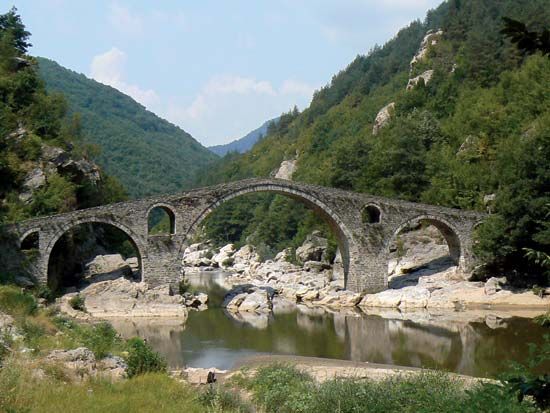
Arda River
The Arda River is a 180-mile (290-kilometre) river located primarily in Bulgaria. It originates in the central Rhodope Mountains near the town of Smolyan.
What is Arda River?
The Arda River is a 180-mile (290-kilometre) river located primarily in Bulgaria. It originates in the central Rhodope Mountains near the town of Smolyan.
The river flows eastward, passing through Kürdzhali and Ivaylovgrad. After traversing a 23-mile (37-kilometre) section in Greece, it joins the Maritsa River just west of Edirne, Turkey.
The Arda is significant for several reasons:
- Infrastructure: The Bulgarian portion of the river features three major hydroelectric and irrigation dams, which rank among the largest in the country.
- Economy: The upper valley is home to mining towns such as Rudozem, Madan, and Smolyan, while the broader valley is well-known for its tobacco production.
What are the Rhodope Mountains known for?
The Rhodope Mountains are a significant mountain system in the Balkan Peninsula, primarily located in Bulgaria with extensions into Greece. They are known for several distinct characteristics:
- Geographic Significance: As an ancient, eroded massif, the range acts as a vital climatic barrier, protecting the Aegean lowlands from cold northern winds and shielding the Thracian Plain from warm southern air.2
- Cultural Heritage: The mountains served as a crucial refuge for Slavic peoples during the period of Ottoman rule (15th–19th century), allowing many ancient customs to survive to the present day.2
- Economic Resources: The region is known for its mining industry, particularly the extraction of lead and zinc in the southeastern volcanic areas near Madan and Rudozem. Additionally, the Arda River is heavily utilized for hydroelectric power.2
- Tourism: The area’s picturesque river valleys, lakes, and extensive forests support a robust tourist industry, including popular winter sports centers like Borovets.23
How do hydroelectric dams benefit the local economy?
Hydroelectric dams serve as multipurpose infrastructure that can significantly bolster local and regional economies. By providing a reliable source of hydroelectric power, these facilities often offer a cost-effective energy advantage over fossil-fueled units, especially when construction costs are prorated across multiple utilities.56
Beyond electricity generation, dams provide several key economic benefits:
- Irrigation: Reservoirs allow for large-scale agricultural development in previously arid regions, transforming land that was once unsuitable for farming into productive acreage.5
- Water Management: Dams facilitate the storage of drinking water and provide essential flood control, protecting downstream communities and infrastructure.67
- Navigation: Large dams equipped with navigation locks support commercial transport, which can be vital for regional trade and logistics.5
- Revenue Generation: The sale of generated power often helps offset the high initial costs required for dam and reservoir construction, and surplus energy can be sold to neighboring regions to create additional revenue streams.56
However, these economic gains are often balanced against significant social and environmental costs, including the displacement of local populations, the loss of cultural heritage sites, and the disruption of aquatic ecosystems.78
What makes the Maritsa River system important to the region?
The Maritsa River (also known as the Evros or Meriç) is a vital geographic and economic feature of the Balkan Peninsula. Spanning approximately 300 miles, it flows through Bulgaria, Greece, and Turkey, serving as a critical international frontier.1011
The river system is important to the region for several reasons:
- Agricultural Productivity: The fertile valley soils support extensive fruit and vegetable cultivation, which is a significant source of agricultural exports for the region.10
- Infrastructure and Transport: The river valley provides a strategic corridor for the Sofia–Istanbul railway, facilitating regional connectivity and trade.10
- Energy and Water Management: The river and its major tributaries—such as the Arda River—are essential for large-scale hydroelectric and irrigation schemes that support local power needs and farming.101
- Geographic Relief: The river’s alluvial deposits separate the region’s mountain massifs, creating distinct plains that have been transformed into productive agricultural land.12
Sources
- Arda River — Encyclopædia Britannica
- Rhodope Mountains — Encyclopædia Britannica
- Rhodope — Merriam-Webster
- Bulgaria - Tourism — Encyclopædia Britannica
- Did you know? — Merriam-Webster
- Columbia River - Economy of the Columbia River — Encyclopædia Britannica
- turbine - Cost of hydroelectric power — Encyclopædia Britannica
- dam - Rise of environmental and economic concerns — Encyclopædia Britannica
- Jinping-I Dam: Top Questions — Encyclopædia Britannica
- Maritsa River — Encyclopædia Britannica
- Maritsa — Merriam-Webster
- Greece - Northeastern Greece: Makedonía and Thráki — Encyclopædia Britannica
Published on · 3 min read