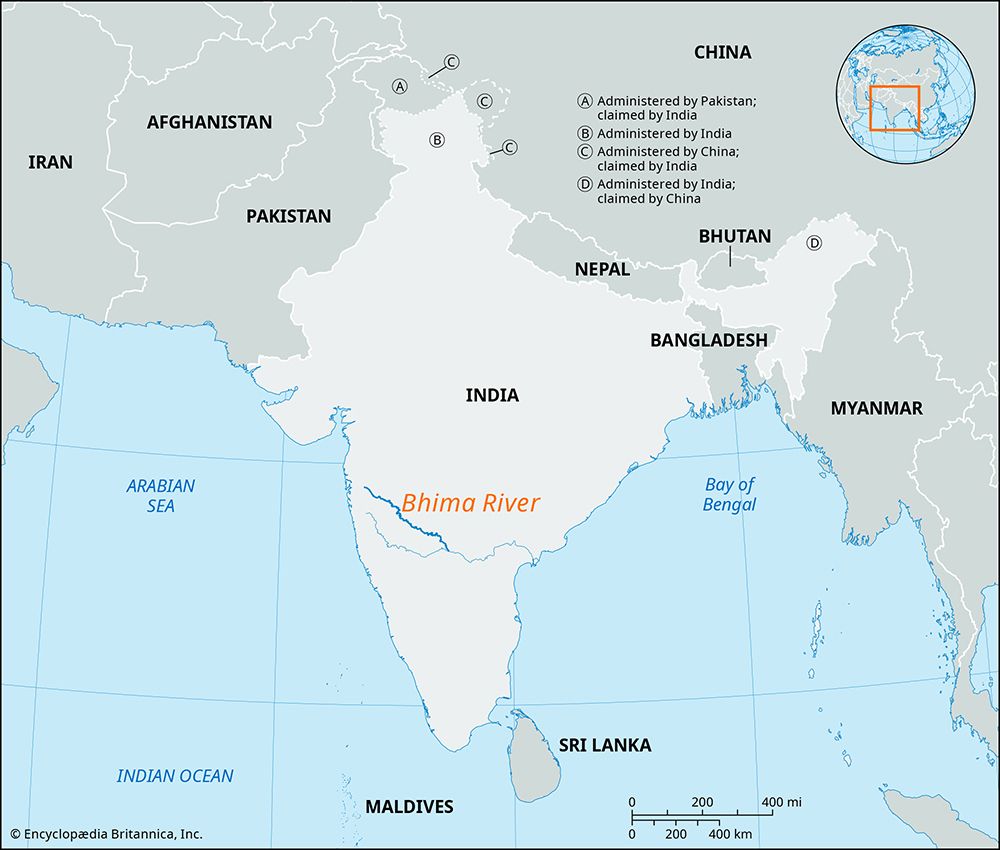
Bhima River
The Bhima River is a major tributary of the Krishna River located in western India. It originates in the Bhimashankar heights of the Western Ghats and flows…
What is Bhima River?
The Bhima River is a major tributary of the Krishna River located in western India. It originates in the Bhimashankar heights of the Western Ghats and flows southeastward for 450 miles (725 km) through the states of Maharashtra and Karnataka.1
The river’s flow is heavily influenced by the monsoon; it experiences flooding in August and becomes nearly stagnant during the dry months of March and April. The receding floodwaters create fertile alluvial terraces that support significant agricultural activity, including the cultivation of jowar, pearl millet, oilseeds, and sugarcane. The river’s drainage basin is bounded by the Balaghat Range to the north and the Mahadeo Hills to the south.1
What are the Western Ghats?
The Western Ghats are a north–south mountain range in western India that forms the crest of the western edge of the Deccan plateau, running parallel to the Malabar Coast of the Arabian Sea. Stretching from the Tapti River in the north to Cape Comorin in the south, the range passes through several states, including Maharashtra, Karnataka, and Kerala.234
Recognized as a UNESCO World Heritage site, the region is a critical biodiversity hot spot. It serves as peninsular India’s principal watershed, trapping moisture from the monsoon winds and influencing weather patterns across the subcontinent. The range is home to diverse ecosystems, ranging from tropical evergreen forests to montane grasslands, and supports a vast array of flora and fauna, including significant populations of tigers and Asian elephants. The highest point in the range is Anai Peak, reaching 8,842 feet (2,695 meters).234
How do monsoons affect rivers in India?
The monsoon system is the primary driver of water availability for rivers across India, creating a highly seasonal flow regime. During the southwest monsoon (mid-June to early October), moisture-laden winds from the Indian Ocean bring heavy rainfall, often causing rivers to swell and leading to considerable flooding. Conversely, during the dry season, many rivers experience significantly reduced flow or become nearly stagnant.56
The impact of these rains varies by region:
- Himalayan Rivers: Rivers originating in the Himalayas generally maintain a more even flow throughout the year, as they are fed by both monsoon rains and mountain water sources.67
- Peninsular Rivers: In peninsular India, surface-water availability is almost entirely dependent on the highly seasonal monsoon rainfall. Because these rivers lack the consistent glacial or snowmelt sources of the north, they are prone to extreme fluctuations, ranging from flood conditions during the wet season to severe water scarcity during the dry months.657
This reliance on the “fickle” nature of the annual monsoon makes water management a critical challenge for agriculture and economic stability across the country.67
What is the Krishna River system?
The Krishna River is one of the longest rivers in south-central India, spanning approximately 800 miles (1,290 km). It originates in the Western Ghats near Mahabaleshwar in Maharashtra and flows eastward across Karnataka, Telangana, and Andhra Pradesh before emptying into the Bay of Bengal.13
Tributaries and Infrastructure
The river system is supported by two primary tributaries:
- Bhima River: Rising in the Bhimashankar heights, it flows southeast through Maharashtra and Karnataka to join the Krishna.1
- Tungabhadra River: Located to the south, it features a major dam at Hospet that supports hydroelectric power generation.13
Economic and Environmental Context
While the river is not navigable, it is vital for irrigation and power. Large-scale hydroelectric installations are situated at Srisailam and Nagarjuna Sagar. However, because the system relies on seasonal monsoon rains, flow levels fluctuate significantly, which limits its year-round agricultural utility.131
Sources
- Bhima River — Encyclopædia Britannica
- Western Ghats — Encyclopædia Britannica
- Ghats — Encyclopædia Britannica
- Western Ghats — Merriam-Webster
- climate of India - The monsoons — Encyclopædia Britannica
- South Asia: Top Questions — Encyclopædia Britannica
- Indian monsoon — Encyclopædia Britannica
- climate of India - The southwest monsoon — Encyclopædia Britannica
- Climate - Interannual variability — Encyclopædia Britannica
- climate of India: Top Questions — Encyclopædia Britannica
- India - Agriculture — Encyclopædia Britannica
- economy of India - Agriculture — Encyclopædia Britannica
- Krishna River — Encyclopædia Britannica
Published on · 3 min read