Artibonite River
The Artibonite River is vital to the region's economy, serving as the primary water source for the fertile Artibonite Plain. Agricultural development in the…
How does the Artibonite River impact agriculture and hydroelectric power in the region?
The Artibonite River is vital to the region’s economy, serving as the primary water source for the fertile Artibonite Plain. Agricultural development in the valley was significantly expanded through the Artibonite Valley Agricultural Project, which utilized the Péligre Dam for irrigation and flood control1.1
Regarding hydroelectric power, the dam’s facility—completed in 1971—was once a major source of electricity for Haiti. However, its capacity has been severely compromised by several factors:1
- Siltation: Extensive forest clearing in the valley has caused soil erosion, leading to significant silt buildup in the reservoir, which reduces both agricultural and energy efficiency.1
- Infrastructure and Climate: The plant has struggled with poor infrastructure, a reliance on imported petroleum, and frequent droughts.1
By the late 1990s, the dam’s contribution to the national power supply had dropped to only about one-third of Haiti’s requirements.1
How has the Artibonite River been affected by environmental challenges or natural disasters?
The Artibonite River has faced significant degradation due to human-induced environmental challenges, primarily stemming from deforestation. The widespread clearing of forests in the Artibonite valley has led to severe soil erosion, which causes heavy siltation in the reservoir created by the Péligre Dam. This accumulation of sediment has substantially diminished the river’s capacity to support both agricultural irrigation and hydroelectric power generation.1
Beyond these long-term environmental shifts, the river’s utility has been further strained by natural and operational factors. Periodic droughts have negatively impacted the water levels necessary for consistent power production. These environmental pressures, compounded by aging infrastructure and economic limitations, have significantly reduced the dam’s ability to meet the energy needs of Haiti, falling to only a fraction of its original output by the late 1990s.1
What historical significance does the Artibonite River hold for Haiti and the Dominican Republic?
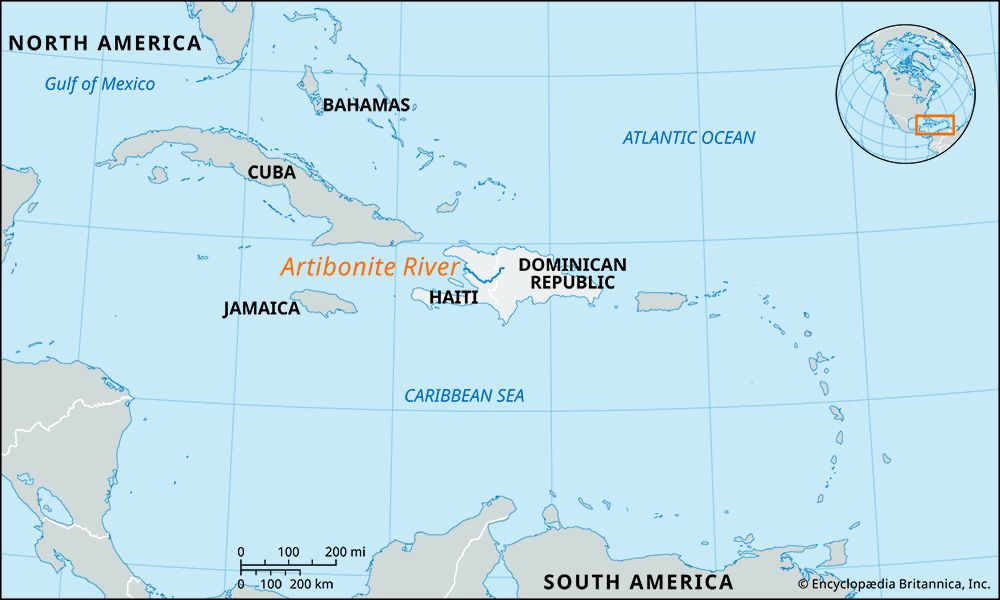
The Artibonite River holds significant historical and economic importance as the longest river on the island of Hispaniola. Rising in the Cordillera Central of the Dominican Republic, it flows along the border with Haiti before traversing the fertile Artibonite Plain, serving as a vital geographic link between the two nations.1
Its historical significance is primarily defined by its role in 20th-century development projects aimed at modernization and resource management:
- Agricultural Expansion: The Artibonite Valley Agricultural Project transformed the region into a major agricultural hub. This initiative relied on the construction of the Péligre Dam, which was originally conceived in 1930 as a flood-control measure.1
- Energy Production: Upon the completion of the dam’s hydroelectric facility in 1971, the river became a cornerstone of Haiti’s energy infrastructure, supplying a substantial portion of the country’s electricity for years.1
While the river remains a critical resource, its historical utility has been challenged by deforestation and subsequent siltation, which have hampered both its agricultural and energy-generating potential in recent decades.1
Are there any notable bridges or dams built along the Artibonite River, and what purpose do they serve?
The most notable infrastructure project on the Artibonite River is the Péligre Dam.
The dam serves several critical purposes:
- Flood Control: The project was originally initiated in 1930 to manage flooding along the river, which flows through the fertile Artibonite Plain.1
- Irrigation: The dam supports the Artibonite Valley Agricultural Project, which was designed to develop large tracts of irrigated land for farming.1
- Hydroelectric Power: Completed in 1971, the facility was built to generate electricity for Haiti. For many years, it served as a primary source of the country’s power.1
While the dam created the large Péligre Lake, its effectiveness has been significantly hampered over time. Severe soil erosion—caused by deforestation in the valley—has led to heavy siltation in the reservoir, which has reduced its capacity for both irrigation and energy production. By the late 1990s, the plant’s output had dropped to roughly one-third of the country’s needs due to this siltation, aging infrastructure, and periodic droughts.1
Sources
- Artibonite River — Encyclopædia Britannica
- Hispaniola — Encyclopædia Britannica
Published on · 3 min read