Aube River
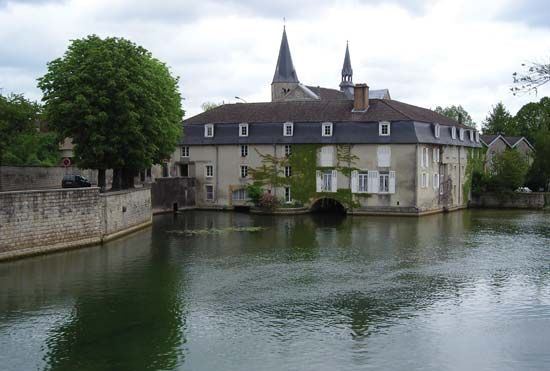
The Aube River is a navigable river located in north-central France. It serves as a tributary to the Seine, joining it above the town of Romilly.
What is Aube River?
The Aube River is a navigable river located in north-central France. It serves as a tributary to the Seine, joining it above the town of Romilly.1
Rising on the Langres Plateau, the Aube flows northwest for approximately 154 miles (248 km). Its course begins in trenchlike valleys carved through limestone, eventually opening into broader valleys as it transitions into clay terrain. The river joins its own tributary, the Aujon, at Clairvaux before continuing past Brienne and across the flat alluvial landscape of the Champagne chalk platform.1
What is the Langres Plateau?
The Langres Plateau (Plateau de Langres) is a Jurassic limestone formation located in the extreme southeast of the Paris Basin in eastern France.2
Geographically, the plateau serves as a critical watershed, separating the Seine and Rhône-Saône river systems. It is situated along a major drainage divide that runs through the eastern part of the country, and it acts as a lowland corridor that is crossed by significant transportation routes linking Paris with the south.23
At the northern end of this plateau sits the historic, medieval fortified town of Langres, which is perched on a promontory 1,529 feet (466 meters) above sea level. The region is characterized by its geological composition of Jurassic rocks, which are typical of the outer rim of the Paris Basin.423
How do rivers shape limestone landscapes?
Rivers shape limestone landscapes primarily through chemical dissolution rather than traditional mechanical erosion, creating a distinct topography known as karst.56
Because limestone (calcium carbonate) is highly soluble in slightly acidic water, rivers and groundwater do not merely carve channels; they dissolve the rock and carry it away in solution. This process leads to several unique landscape features:6
- Internal Drainage: Surface streams often disappear into sinkholes or closed depressions, shifting the drainage system underground.56
- Conduit Systems: As water flows through cracks and joints, it widens them into complex cave systems and underground stream channels.56
- Jagged Terrain: The removal of surface material creates grooved, rocky ground, often characterized by lapiés and bare bedrock ledges.56
- Springs: Underground rivers frequently re-emerge at the surface as large springs, where they may flow briefly before disappearing again.56
Unlike typical river valleys formed by mechanical downcutting, karst landscapes are defined by this integrated underground plumbing, which fundamentally alters how water moves across and through the earth.56
What is the importance of the Seine River to France?
The Seine River is of immense importance to France, serving as a vital economic, historical, and natural artery. As one of Europe’s great historic rivers, its drainage network carries the majority of French inland waterway traffic, functioning as a major highway that links Paris to the sea and the maritime port of Le Havre.9
Key aspects of its significance include:
- Economic Hub: The river is essential for industry and commerce. It facilitates the transport of heavy goods like petroleum and building materials, and its water is a critical resource for thermal and nuclear power stations. Furthermore, it provides a substantial portion of the water supply for the Paris region and the area between Rouen and Le Havre.9
- Historical Heart: The fertile Île-de-France region, centered around the river, served as the cradle of the French monarchy and the nucleus of the nation-state. The Île de la Cité remains the historic heart of Paris.910
- Navigability: Known for its regular flow, the Seine is the most naturally navigable of France’s major rivers, supporting consistent transport and infrastructure.910
Sources
- Aube River — Encyclopædia Britannica
- France - The Paris Basin — Encyclopædia Britannica
- Langres — Encyclopædia Britannica
- France - Drainage of France — Encyclopædia Britannica
- cave — Encyclopædia Britannica
- karst — Encyclopædia Britannica
- river - Valley evolution — Encyclopædia Britannica
- river - Valleys and canyons — Encyclopædia Britannica
- Seine River — Encyclopædia Britannica
- France - The Seine system — Encyclopædia Britannica
Published on · 3 min read