Becard
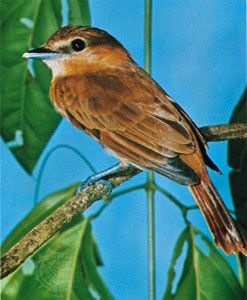
A becard is any of several small, tropical American birds belonging to the family Cotingidae, though some authorities classify them within the family…
What is Becard?
A becard is any of several small, tropical American birds belonging to the family Cotingidae, though some authorities classify them within the family Tyrannidae1.1
These birds are characterized by their thick, hooked bills and generally plain appearance. They are known for their unique nesting behavior, typically constructing large, ball-shaped nests on exposed branches, often near colonies of stinging wasps for protection. Becards feed primarily on fruit and insects, such as caterpillars, which they often capture while hovering in the treetops.2
The group consists of 15 species across the genera Platypsaris and Pachyramphus. The rose-throated becard (Platypsaris aglaiae) is the northernmost representative of the family, with a range extending from Costa Rica to the U.S.–Mexican border.2
Why do becards build nests near stinging wasps?
Becards build their large, ball-shaped nests near colonies of stinging wasps primarily for the protection that the wasps provide against potential predators. By nesting in close proximity to these aggressive insects, the birds benefit from a natural defense system that deters threats to their eggs and young.13
What are the main characteristics of the Cotingidae bird family?
The Cotingidae family consists of approximately 90 species of birds within the order Passeriformes. Native to tropical America, these birds are closely related to manakins and are part of the suborder Tyranni.45
Physical Characteristics
Cotingids are generally defined by the following features:
- Bill Structure: They possess a broad bill with a slightly hooked tip.4
- Body and Wings: They have rounded wings and short legs.4
- Plumage: Many species exhibit some of the most vivid and bizarre male ornamentation found in the avian world. Some species feature peculiar wing feathers that are narrowed, twisted, or curly.4
Behavior and Habitat
- Diet: Most are solitary forest dwellers that feed primarily on fruit or insects, typically foraging in the treetops.4
- Vocalization: They are known for their unusual calls, which have inspired common names such as bellbird, piha, and chatterer. These sounds can mimic the ringing of a bell, the lowing of a calf, or the tapping of a hammer.4
- Classification: While many are distinct, some forms, such as those in the genus Attila, resemble tyrant flycatchers in appearance and habit, leading some authorities to classify them within the family Tyrannidae instead.46
How do tyrant flycatchers differ from becards?
Distinguishing between tyrant flycatchers and becards is complex because their family boundaries are poorly defined, and some authorities classify them within the same family, Tyrannidae. However, they are traditionally separated by their primary family classification and certain behavioral traits.71
Key Differences
- Family Classification: Tyrant flycatchers belong to the family Tyrannidae, while becards are traditionally classified within the family Cotingidae.71
- Nesting Behavior: A defining characteristic of becards is their habit of building large, ball-shaped nests on exposed branches near colonies of stinging wasps for protection. In contrast, tyrant flycatchers build a variety of nests, including open cups, domed structures, and hanging bags, and some species nest in holes.17
- Foraging Habits: Many tyrant flycatchers are known for darting from perches to seize insects on the wing, similar to Old World flycatchers. Becards typically forage in the treetops, plucking fruit and capturing insects—particularly caterpillars—often by hovering.71
Sources
- Becard — Encyclopædia Britannica
- becard — Merriam-Webster
- Passeriform - Nesting — Encyclopædia Britannica
- Cotingidae — Encyclopædia Britannica
- Cotingidae — Merriam-Webster
- Tyrannidae — Merriam-Webster
- tyrant flycatcher — Encyclopædia Britannica
Published on · 2 min read
