Chipko Movement
The Chipko movement emerged in the 1970s as a nonviolent response to government-backed logging that threatened the livelihoods of rural villagers in the…
What were the main environmental issues that the Chipko movement aimed to address?
The Chipko movement emerged in the 1970s as a nonviolent response to government-backed logging that threatened the livelihoods of rural villagers in the Indian Himalayas. The movement primarily addressed the following environmental issues:
- Deforestation and Resource Depletion: Commercial logging practices led to the clear-cutting of forests, which deprived local communities of essential resources like food and fuel.1
- Soil and Water Degradation: The removal of forest cover caused severe erosion and the depletion of water resources, which were critical for the region’s water purification and soil stabilization.1
- Increased Natural Hazards: Mismanaged logging was directly linked to catastrophic monsoon floods and increased flooding throughout the region, which resulted in significant loss of life and lower agricultural yields.1
- Industrial Encroachment: Beyond logging, the movement later expanded to oppose large-scale infrastructure projects, such as the construction of dams and limestone mining operations, which further threatened the regional ecology.1
Who were the key figures involved in initiating and leading the Chipko movement?
The Chipko movement was driven by several key figures who utilized nonviolent resistance to protect Himalayan forests. The primary leaders and activists included:
- Chandi Prasad Bhatt: An environmentalist and Gandhian social activist who founded the Dasholi Gram Swarajya Sangh (DGSM) in 1964. He led the first Chipko protest near the village of Mandal in 1973, successfully preventing logging by embracing trees.1
- Sunderlal Bahuguna: A local environmentalist who helped spread Chipko’s tactics throughout the region. He was instrumental in the movement’s national profile, notably fasting for two weeks in 1974 and marching 5,000 km across the Himalayas. His direct appeal to Prime Minister Indira Gandhi in 1980 secured a 15-year ban on commercial logging in the Uttarakhand Himalayas.1
- Gaura Devi: A courageous village woman who led the 1974 protest in Reni. When men from the village were lured away by authorities, she and other women stood their ground, forcing loggers to withdraw and prompting a government investigation into deforestation.1
- Dhoom Singh Negi: A dedicated activist who fasted in 1978 to protest the auctioning of the Advani forest.1
What was the Chipko movement and when did it originate in India?
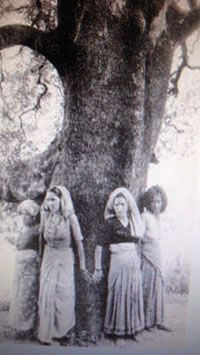
The Chipko movement was a nonviolent social and ecological campaign in India led primarily by rural villagers, including many women, to protect forests from government-sanctioned logging. The movement originated in the Himalayan region of Uttarakhand in 1973.
The name Chipko is derived from a Hindi word meaning “to hug” or “to cling to,” reflecting the protesters’ signature tactic of embracing trees to physically prevent them from being felled. This grassroots effort emerged as a response to the negative environmental and economic impacts of commercial logging, which had led to deforestation, soil erosion, and increased flooding in the region. By utilizing techniques rooted in Mahatma Gandhi’s philosophy of satyagraha, the movement successfully challenged industrial exploitation and eventually secured significant bans on commercial logging in the Himalayas.
How did the Chipko movement’s non-violent protest methods work?
The Chipko movement employed nonviolent resistance, or satyagraha, to protect forests from commercial exploitation. Their methods were rooted in the belief that direct, peaceful action could effectively challenge government-backed logging practices.1
Key protest techniques included:
- Tree Hugging: The movement’s namesake tactic involved villagers physically embracing trees to prevent loggers from felling them.1
- Fasting: Activists like Sunderlal Bahuguna and Dhoom Singh Negi utilized hunger strikes to draw public and political attention to forest policy and specific logging auctions.1
- Symbolic Actions: In the Advani forest, women tied sacred threads around trees and read from the Bhagavadgita to emphasize the spiritual and cultural value of the ecosystem.1
- Direct Intervention: Protesters sometimes bandaged trees that had been tapped for resin to protest exploitation, or confiscated loggers’ tools, leaving receipts for their return upon the loggers’ withdrawal.1
These decentralized, autonomous actions forced government investigations into deforestation and ultimately led to significant regional logging bans.1
Sources
- Chipko movement — Encyclopædia Britannica
Published on · 3 min read