Calculating Dog Years
The term "dog years" refers to a method of comparing a dog's age to human years. While a popular rule of thumb suggests a 7:1 ratio, this is a significant…
What does the term “dog years” mean?
The term “dog years” refers to a method of comparing a dog’s age to human years. While a popular rule of thumb suggests a 7:1 ratio, this is a significant oversimplification.12
Veterinarians and animal behaviorists note that dogs do not age in a linear fashion. Instead, they mature rapidly during their early life—a one-year-old dog is generally comparable to a 15-year-old human, and a two-year-old dog to a 24-year-old. After age three, the aging process begins to level off, and the rate of aging varies significantly based on the dog’s size and breed.12
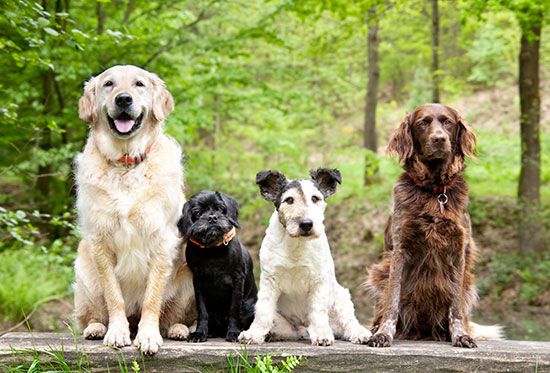
Smaller dogs typically have longer lifespans and age more slowly than larger breeds. For instance, large breeds may be considered geriatric by age 5 or 6, whereas small breeds may not reach that stage until age 10 or older. Factors such as genetics, metabolic rate, and susceptibility to age-related health issues contribute to these differences in longevity.13
Why do people compare dog years to human years?
The comparison of “dog years” to human years has been a subject of interest for centuries, though the reasons for its popularity have shifted over time.
The widely recognized 7:1 ratio emerged as a popular rule of thumb in the 1950s, largely due to basic arithmetic. During that era, the average human life expectancy in the United States was approximately 70 years, while the average dog lived to be about 10; thus, a 7:1 ratio provided a simple, intuitive comparison. Some experts also suggest that the ratio served as a marketing tool to encourage pet owners to bring their animals in for annual veterinary check-ups, emphasizing the speed at which dogs age relative to humans.1
Historically, other methods have been used to estimate these ratios. For example, a 13th-century inscription on the Cosmati Pavement in Westminster Abbey suggested a 9:1 ratio.1
Today, veterinarians and researchers recognize that these linear ratios are inaccurate because dogs do not age at a constant rate. They mature rapidly in their first two years and then experience a leveling off, with the aging process heavily influenced by the dog’s size, breed, and genetics.123
What is the traditional rule for calculating how many dog years equal a human year?
The traditional rule for calculating a dog’s age is the 7:1 ratio, which has been a popular rule of thumb since at least the 1950s. This ratio was likely popularized as a simple mathematical comparison based on the average human life expectancy of 70 years and an average dog lifespan of 10 years at the time. Some experts also suggest it served as a marketing tool to encourage pet owners to schedule annual veterinary check-ups.13
However, this linear ratio is considered a significant oversimplification by veterinarians and animal behaviorists. Dogs do not age at a constant rate; they mature rapidly during their first two years of life, after which the aging process levels off and varies significantly based on the dog’s size, breed, and genetics.13
Because of these complexities, modern experts emphasize that a dog’s “human age” is not uniform. For example, a one-year-old dog is generally comparable to a 15-year-old human, while a two-year-old dog is closer to a 24-year-old. Beyond age three, the aging process continues to diverge based on whether a dog is small, medium, large, or huge.1
How does a dog’s size or breed affect how quickly it ages?
A dog’s size and breed are primary factors in determining its aging process and overall longevity. Unlike most mammals, where larger size typically correlates with a longer life, dogs follow an inverse pattern: smaller dogs generally live longer than larger breeds.21
Physiological and Genetic Factors
- Metabolic Rate: Smaller dogs possess a higher mass-specific metabolic rate, allowing them to burn energy more efficiently. This results in slower cellular growth and a more gradual aging process compared to larger dogs, which have lower metabolic rates and faster rates of maturity.2
- Health Risks: Large-breed dogs are at a higher risk for cancer and other disorders linked to abnormal cellular growth, often attributed to their accelerated maturation. They are also more prone to age-related issues like joint and heart conditions, which can appear as early as age 5 or 6.21
- Genetic Diversity: Genetic makeup significantly influences lifespan. Mixed-breed dogs often benefit from greater genetic diversity, whereas purebred dogs may inherit disorders due to practices like inbreeding, which can shorten their life expectancy.21
Aging and Size
Because aging is not linear, a dog’s size dictates when it enters its senior years. While small dogs may not be considered geriatric until age 10 or older, large dogs often reach this stage by age 5. Researchers have even estimated that a dog may lose approximately one month of life for every 4.4 pounds (2 kg) of body mass.1
Sources
- Calculating dog years — Encyclopædia Britannica
- Why do small dogs live longer? — Encyclopædia Britannica
- dog: Top Questions — Encyclopædia Britannica
Published on · 4 min read