Great Escarpment
The Great Escarpment is a major topographic feature in southern Africa that serves as the edge of the region’s highland interior plateau, separating it from…
What is Great Escarpment?
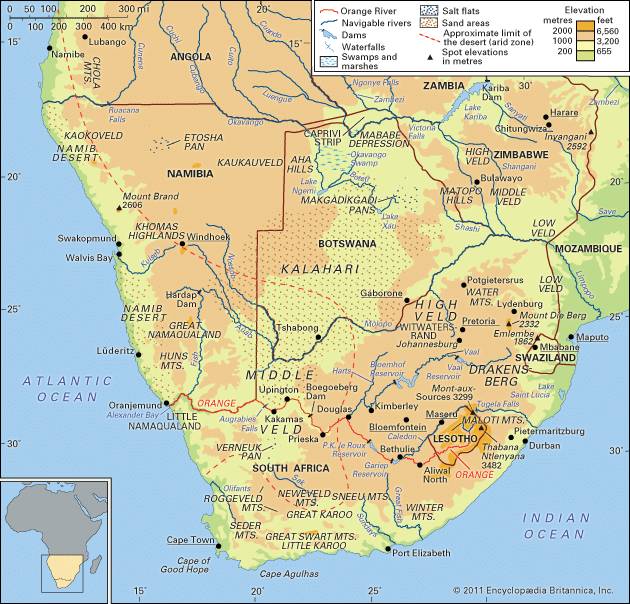
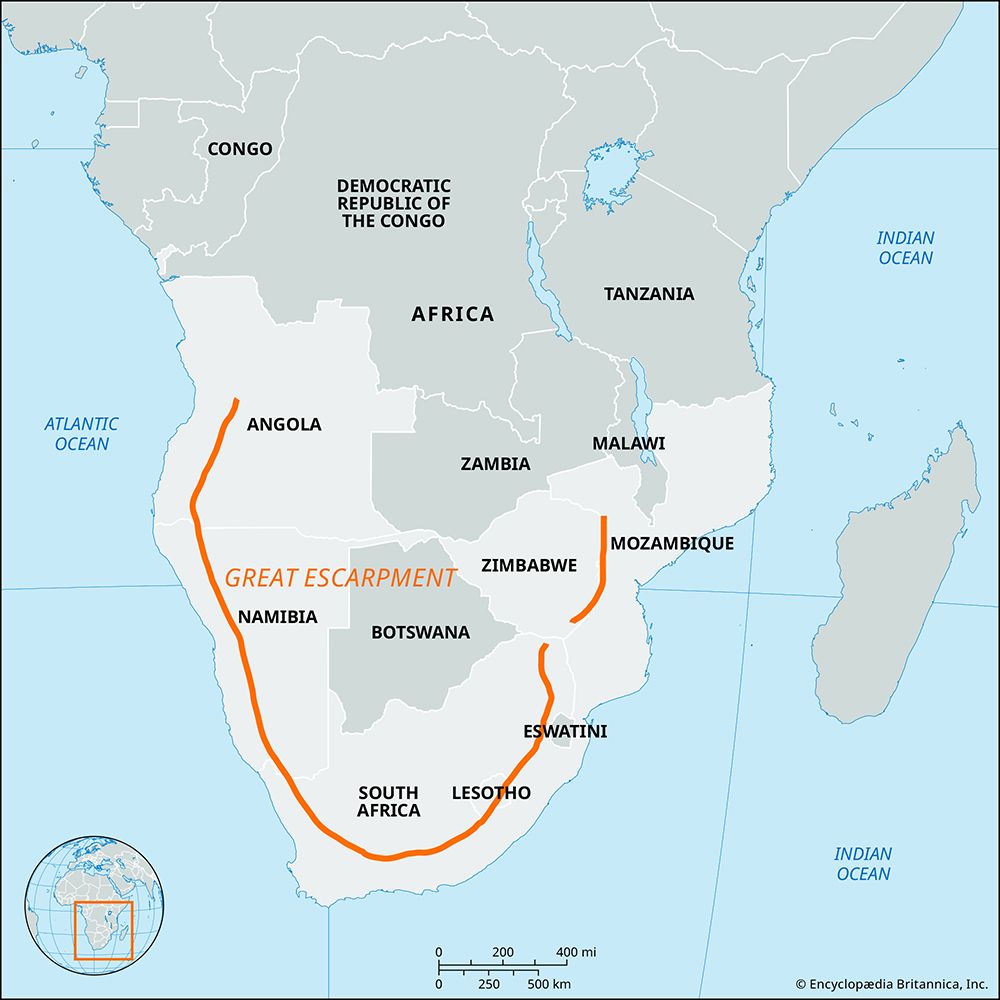
The Great Escarpment is a major topographic feature in southern Africa that serves as the edge of the region’s highland interior plateau, separating it from the narrow coastal strip. It is primarily located within South Africa and Lesotho, though it extends northeast into Zimbabwe and northwest into Namibia and Angola.12
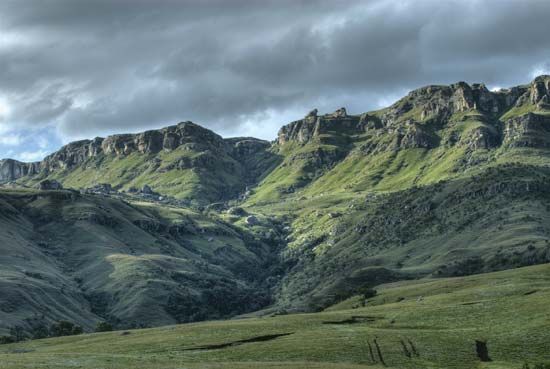
Formed largely by the headwater erosion of coastal rivers, the escarpment’s definition varies based on the underlying rock composition. Its most prominent section is the Drakensberg, where basalt lavas overlie softer sandstones. In South Africa, this feature forms the longest continuous topographic boundary in the country, reaching elevations of nearly 11,000 feet (3,300 meters) in the east before tapering off in the west. The area is renowned for its scenic beauty and includes the uKhahlamba/Drakensberg Park, a designated World Heritage site2.12
What is the significance of the Drakensberg mountains within the Great Escarpment?
The Drakensberg mountains are the most prominent and elevated section of the Great Escarpment, serving as a critical topographic boundary in southern Africa. Their significance is defined by several key roles:
- Geographic Barrier: The range acts as the primary divide between the extensive high plateaus of the South African interior and the lower-lying coastal lands. It forms the longest continuous topographic feature in South Africa, stretching roughly 700 miles5.52
- Hydrological Importance: The Drakensberg serves as the main watershed for South Africa and is the source of the Orange River5.
- Geological Landmark: In its most striking section along the border of Lesotho and KwaZulu-Natal, the range features basalt lavas capping a sandstone base, creating steep, rugged scarps that reach elevations exceeding 11,000 feet.51
- Cultural and Ecological Value: The region is home to ancient cave art and numerous game reserves. The uKhahlamba/Drakensberg Park was designated a UNESCO World Heritage site in 2000 for its natural and cultural significance.52
How does the Great Escarpment affect rainfall patterns in Southern Africa?
The Great Escarpment plays a significant role in shaping the climate of southern Africa by acting as a physical barrier that influences moisture distribution. In regions like the Namib, the escarpment marks a transition in precipitation levels; while the coastal plains are nearly rainless, annual rainfall increases as one moves inland toward the foot of the escarpment.1
Furthermore, the escarpment influences regional wind patterns, specifically through the creation of “berg” (mountain) winds. These winds originate in the interior and blow eastward across the Great Escarpment toward the coast. As they descend, they bring hot, dry air and dust, which significantly impacts the arid conditions of the coastal regions. While the escarpment helps define the boundary between the highland interior and the coastal strip, its presence is a key factor in the stark climatic contrast between the moisture-starved coast and the more varied interior plateau.71
What role does headwater erosion play in shaping landforms like escarpments?
Headwater erosion is a primary geological process responsible for the formation and recession of escarpments. By acting as the plateau edge, the Great Escarpment has been shaped largely by the headward erosion of rivers originating on the coastal plain.8
This process often involves sapping, where groundwater outflow or surface water flow undermines resistant rock layers. When a resistant “cap rock” overlies a less-resistant material, the erosion of the softer base leads to slope instability and collapse, causing the cliff face to retreat backwearing. The intensity of this erosion is frequently concentrated at valley heads, where flow convergence accelerates chemical weathering and mechanical removal of material.1
The resulting definition of an escarpment—whether it appears sharp or indistinct—depends on the hardness of the plateau edge rocks. Where hard basalt lavas distinctly overlie soft sandstones, such as in the Drakensberg, the escarpment is particularly bold and well-defined. Over time, this continuous process of headward retreat and valley branching carves the rugged, elevated topography characteristic of these major landforms.81
Sources
- Great Escarpment — Encyclopædia Britannica
- South Africa - Relief of South Africa — Encyclopædia Britannica
- escarpment — Merriam-Webster
- escarpments — Merriam-Webster
- Drakensberg — Encyclopædia Britannica
- Drakensberg — Merriam-Webster
- Namib - Climate — Encyclopædia Britannica
- valley - Sapping — Encyclopædia Britannica
- mountain - Tectonic processes that create and destroy mountain belts and their components — Encyclopædia Britannica
- cliff — Encyclopædia Britannica
Published on · 3 min read