Muridae
Scientists study and classify members of the Muridae family—the largest family of rodents—by analyzing their evolutionary relationships, physical…
How do scientists study and classify members of the Muridae family?
Scientists study and classify members of the Muridae family—the largest family of rodents—by analyzing their evolutionary relationships, physical characteristics, and ecological roles. Currently, these animals are organized into 18 subfamilies, though classification remains a subject of ongoing scientific debate.1
Methods of Classification
Researchers often categorize these species based on whether they form a monophyletic group, meaning they share a common ancestor. While many groups, such as hamsters, voles, and gerbils, are clearly defined, others are more difficult to classify and may represent a mix of unrelated genera.1
Because some lineages lose their distinct traits when traced back through fossil evidence, some specialists prefer to group these animals under the larger superfamily Muroidea rather than a single family, Muridae. This approach allows for flexibility as new data emerges regarding the evolutionary affinities of “problem groups” like New World rats and mice.1
Diversity in Form and Function
Beyond genetic analysis, scientists study the diverse body forms of murids, which have adapted to various environments. These include:
- Fossorial (burrowing): Species like blind mole rats possess cylindrical bodies and powerful claws for digging.12
- Terrestrial leaping: Species such as gerbils feature long, powerful hind limbs for balance and movement.2
- Arboreal: Some species have evolved specialized traits for life in trees.2
How many species are included in the Muridae family, and what are some examples?
The family Muridae is the largest extant family of rodents and the largest of all mammalian families, encompassing more than 1,383 species of “true” mice and rats. It is important to note that this family is distinct from Muricidae, which refers to a family of gastropod mollusks.13
Because Muridae contains such a vast array of animals, classification is complex. While there are approximately 300 genera organized into 18 subfamilies, scientists sometimes debate the exact boundaries of the family, as some groups are occasionally classified under the larger superfamily Muroidea.1
Examples of Muridae
The family includes a wide variety of species, many of which are familiar to humans:
- Old World rats and mice (Subfamily Murinae): Includes the house mouse (Mus musculus), the brown rat (Rattus norvegicus), and the Old World harvest mouse.14
- Gerbils (Subfamily Gerbillinae): Includes various species of gerbils and the sand rat.14
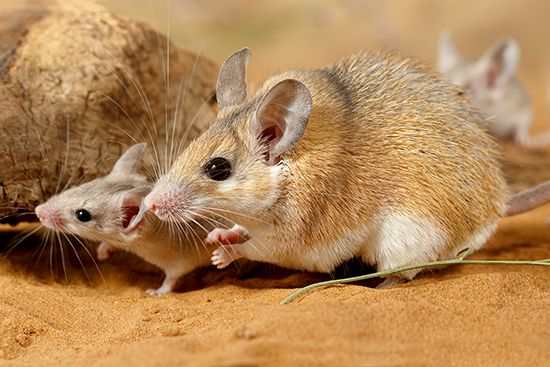
- Other notable members: The family also includes the African spiny mouse, bandicoot rats, cloud rats, and various water rats.14
How do Muridae compare to other rodent families in terms of size and diversity?
The family Muridae stands as the largest family within the order Rodentia and is the most diverse of all mammalian families. With more than 1,383 recognized species, Muridae accounts for approximately two-thirds of all known rodent species and genera.15
Comparison in Size and Diversity
While the order Rodentia as a whole comprises 27 living families and over 2,050 species, the dominance of Muridae is striking. To put this into perspective:65
- Scale: Muridae contains roughly 300 genera, whereas other rodent families are significantly smaller. For example, the family Sciuridae (squirrels) contains 272 species, and the family Dipodidae (jumping mice and jerboas) contains only 51 species.6
- Subfamily Structure: The immense diversity within Muridae is organized into 18 subfamilies, though the vast majority of its species—nearly 1,000—are concentrated in just two: the Murinae (Old World rats and mice) and the Sigmodontinae (New World rats and mice).1
- Ecological Range: Murids exhibit an extraordinary range of variation in body form, locomotion, and ecology, adapting to environments ranging from subterranean burrows to arboreal habitats.1
What are the key differences between the subfamilies within Muridae?
The family Muridae is characterized by immense diversity, with its 18 subfamilies exhibiting significant variation in body form, locomotion, and ecological niche. While specialists sometimes debate the exact classification—with some preferring to group these subfamilies under the superfamily Muroidea—they are currently recognized as a single family due to their close evolutionary relationships.1
Key Differences and Groupings
The subfamilies are primarily distinguished by their geographic distribution, specialized adaptations, and evolutionary lineages:
- Dominant Subfamilies: The vast majority of murid species belong to just two groups:
- Ecological Specialists: Other subfamilies are defined by unique environmental adaptations:
- Arvicolinae: Includes voles, lemmings, and muskrats, restricted to the Northern Hemisphere), and muskrats, restricted to the Northern Hemisphere.1
- Gerbillinae: Adapted to arid environments, ranging from Africa through the Middle East to Central Asia1.
- Subterranean Groups: Subfamilies such as Spalacinae (blind mole rats) and Rhizomyinae (bamboo rats) have evolved distinct physical traits for life underground.1
- Geographically Isolated Groups: Some subfamilies are highly localized, such as the Nesomyinae (Malagasy rats and mice), which are found exclusively on Madagascar.1
Sources
- Muridae — Encyclopædia Britannica
- rodent - Form and function — Encyclopædia Britannica
- list of rodents — Encyclopædia Britannica
- Muricidae — Merriam-Webster
- rodent - Evolution and classification — Encyclopædia Britannica
- rodent — Encyclopædia Britannica
- mouse — Encyclopædia Britannica
Published on · 4 min read