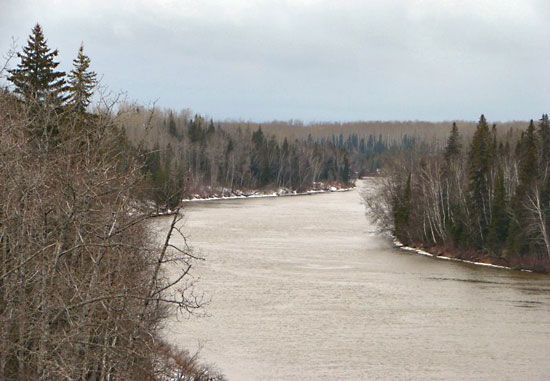
Abitibi River
The Abitibi River is a waterway located in northeastern Ontario, Canada. It originates at Abitibi Lake—which straddles the Ontario-Quebec border—and flows…
What is Abitibi River?
The Abitibi River is a waterway located in northeastern Ontario, Canada. It originates at Abitibi Lake—which straddles the Ontario-Quebec border—and flows northward for approximately 340 miles (547 km) before joining the Moose River and emptying into James Bay.1
The name “Abitibi” is derived from Algonquian terms meaning “middle” and “water,” reflecting the lake’s historical role as a midpoint on a canoe route between the Ottawa Valley and James Bay. The river’s heavily forested valley is economically significant, supporting a major pulp and paper industry centered at Iroquois Falls, as well as gold mining and tourism.1
What is the significance of James Bay to the surrounding environment?
James Bay, the shallow southern extension of Hudson Bay, plays a vital role in the surrounding environment through its unique hydrological and biological characteristics.
Hydrological Significance
The bay is fed by numerous major rivers, including the Moose, Albany, and Eastmain rivers. This significant freshwater influx results in low salinity levels compared to the rest of the bay. The surrounding region is defined by the Hudson Bay Lowland, a vast wetland area characterized by tundra, peat plateaus, and muskeg, which acts as a critical interface between the terrestrial landscape and the marine environment.34
Biological Importance
The bay’s nutrient-rich waters support a complex food web. Unicellular algae thrive in the illuminated upper layers, providing a foundation for small crustaceans, which in turn support various invertebrates, fish, and marine mammals. The forested shores and coastal islands serve as essential habitats for approximately 200 bird species, including geese, swans, and loons, while the seasonal ice provides hunting grounds for polar bears and seals.5
How does the pulp and paper industry impact the Abitibi River valley?
The pulp and paper industry has been a defining force in the development of the Abitibi River valley. This sector serves as a primary economic pillar for the region, with operations heavily concentrated in the town of Iroquois Falls.71
The industry’s presence is deeply integrated into the local infrastructure and landscape:
- Economic Foundation: The town of Iroquois Falls was established as a company town between 1912 and 1913 specifically to support the Abitibi Power and Paper Company.7
- Energy Utilization: The river itself provides essential hydroelectric power generated by the falls, which directly fuels the massive pulp, paper, newsprint, and sulfite mills located in the valley.7
- Resource Integration: The industry relies on the heavily forested nature of the valley, utilizing the surrounding timber resources to sustain large-scale manufacturing operations.1
While the industry has historically driven the region’s growth and urbanization, it remains the central engine of the local economy alongside other activities like gold mining and tourism.71
What are some other major rivers in Ontario?
Ontario is home to a diverse network of rivers that are essential to the province’s geography, history, and economy. These waterways are generally divided into two major drainage systems: the northern system flowing toward Hudson Bay and the southern system draining into the Great Lakes.8
Major Rivers in Ontario
- Ottawa River: Serving as the chief tributary of the St. Lawrence River, it forms much of the border between Ontario and Quebec. Historically a vital route for fur traders and lumber, it is now a significant source of hydroelectric power.5
- Albany River: A primary river of the northern drainage system, it flows into James Bay, contributing to the bay’s low salinity levels.98
- Severn River: Another key river in the northern system, it also serves as part of the Trent Canal route, which connects Georgian Bay to Lake Ontario.810
- Winisk River: A major river within the northern drainage basin that flows toward the Hudson Bay.8
- French River: A significant river in the southern drainage system, flowing into Georgian Bay.8
- Trent River: Part of the Trent Canal system, this river flows toward the Bay of Quinte and Lake Ontario, supporting tourism and hydroelectricity.10
Sources
- Abitibi River — Encyclopædia Britannica
- Abitibi — Merriam-Webster
- Hudson Bay — Encyclopædia Britannica
- Hudson Bay Lowland — Encyclopædia Britannica
- James Bay — Encyclopædia Britannica
- Eastmain River — Encyclopædia Britannica
- Iroquois Falls — Encyclopædia Britannica
- Ottawa River — Encyclopædia Britannica
- Ontario - Drainage — Encyclopædia Britannica
- Ontario - Relief — Encyclopædia Britannica
- St. Lawrence River — Encyclopædia Britannica
- Trent Canal — Encyclopædia Britannica
Published on · 3 min read