Bay of Quinte
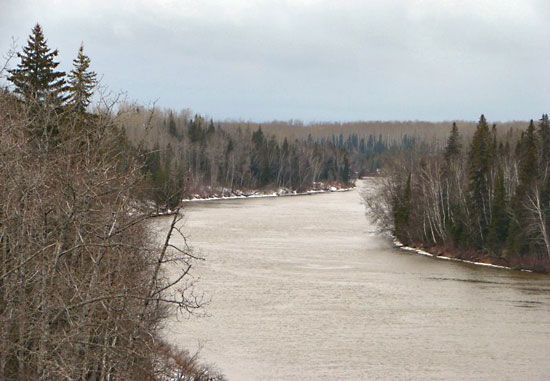
The Bay of Quinte is a narrow arm of Lake Ontario located in southeastern Ontario, Canada.
What is the geographical location and size of the Bay of Quinte?
The Bay of Quinte is a narrow arm of Lake Ontario located in southeastern Ontario, Canada.1
Regarding its size and dimensions, the bay extends for 75 miles (121 km) from its entrance near Amherst Island to the Murray Canal at its western end. It is characterized by its narrow shape, with a width that ranges from one to six miles. The area is known for its scenic landscape, featuring numerous small inlets and receiving water from several rivers, including the Trent, Moira, Salmon, and Napanee.1
What historical significance does the Bay of Quinte hold for the region and Canada?
The Bay of Quinte holds significant historical importance as a site of early European exploration and subsequent colonial settlement in Canada.
Early Exploration and Indigenous History
The bay’s name is derived from Kenté, an Indigenous village that was situated at its western end. In 1615, the French explorers Étienne Brûlé and Samuel de Champlain became the first Europeans to enter the region. Following this, French missionaries maintained a presence near the site of present-day Trenton between 1668 and 1680. Today, the Tyendinaga Mohawk Territory remains a significant cultural and historical fixture along the bay’s northern shore.
Loyalist Settlement and Development
The region became a focal point for Loyalist settlement following the American Revolution. Communities such as Picton were founded by Loyalists as early as 1786, while Trenton (originally settled as Trent Port in 1792) also traces its origins to this period. These settlements evolved into vital commercial and transportation hubs, leveraging the bay’s deepwater access for industries like lumber, milling, and shipping.
How does the Bay of Quinte connect to the larger Great Lakes system?
The Bay of Quinte serves as a vital link within the Great Lakes system through two primary water routes:
- The Murray Canal: This 8-mile (12-km) channel connects the western end of the bay directly to Presqu’ile Bay and Lake Ontario, providing a more sheltered passage for navigation.14
- The Trent Canal: This extensive 240-mile (386-km) waterway links the Bay of Quinte at Trenton to Georgian Bay on Lake Huron. The route traverses the Trent River, Rice Lake, the Kawartha Lakes, and Lake Simcoe before reaching the Severn River.14
While the canal system was historically significant for the lumber trade, it now functions primarily as a recreational waterway that facilitates travel between the interior lakes of Ontario and the larger Great Lakes basin.4
What major cities and towns are located along the shores of the Bay of Quinte?
Several major settlements are located along the shores of the Bay of Quinte, an arm of Lake Ontario in southeastern Ontario. These communities include:
- Belleville: Serving as the seat of Hastings County, this city is situated at the mouth of the Moira River and functions as a significant service and transportation hub.15
- Trenton: Now part of the city of Quinte West, this port of entry is located at the mouth of the Trent River and serves as the southern terminus of the Trent Canal system.12
- Picton: Located on Picton Bay, an arm of the Bay of Quinte, this community acts as the administrative and commercial centre for Prince Edward County.13
- Deseronto: A historic settlement situated along the northern shore of the bay.1
Additionally, the Tyendinaga Mohawk Territory is a significant cultural and historical presence located along the northern shore of the bay.1
Sources
- Bay of Quinte — Encyclopædia Britannica
- Trenton — Encyclopædia Britannica
- Picton — Encyclopædia Britannica
- Trent Canal — Encyclopædia Britannica
- Belleville — Encyclopædia Britannica
Published on · 3 min read