Abyssal Zone
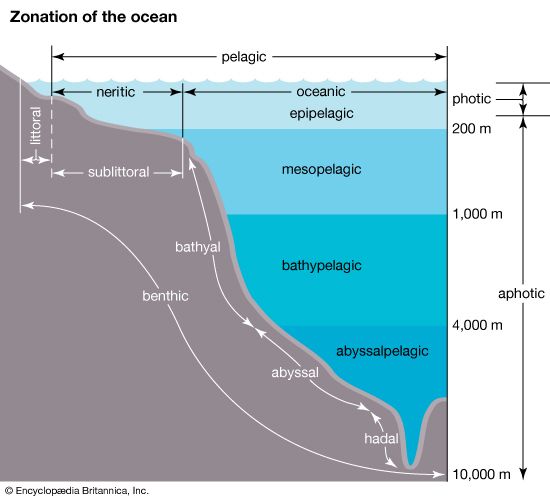
Organisms in the abyssal zone have evolved specialized adaptations to thrive in an environment characterized by extreme hydrostatic pressure, total darkness…
How do organisms adapt to survive in the extreme conditions of the abyssal zone?
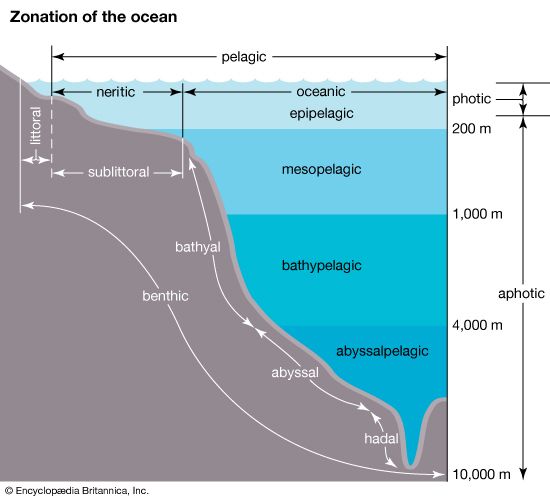
Organisms in the abyssal zone have evolved specialized adaptations to thrive in an environment characterized by extreme hydrostatic pressure, total darkness, near-freezing temperatures, and limited food resources.1
Physical and Physiological Adaptations
- Pressure Tolerance: Unlike surface-dwelling animals that may possess air-filled cavities, abyssal organisms lack air compartments such as lungs or swim bladders, which would otherwise compress or collapse under immense pressure. Because the internal pressures of their bodies match the external environment, pressure does not pose a significant physiological challenge to them.12
- Morphology: Abyssal fauna are often delicately structured and unstreamlined, frequently appearing gray or black. To navigate the soft sediment bottoms, mobile species often possess long legs, while sessile organisms use stalks to elevate themselves above the seafloor, where oxygen levels may be critically low. Many species are also blind.1
Survival Strategies
- Bioluminescence: In the absence of sunlight, many deep-sea organisms utilize bioluminescence to survive. This chemically generated light is used to attract mates, communicate, startle predators, or lure prey, as seen in the anglerfish.134
- Feeding Habits: Due to the scarcity of food, many abyssal animals are scavengers or mud swallowers that process organic material settling from upper ocean zones.15
What types of sediments are found in the abyssal zone, and how do they form?
Sediments in the abyssal zone are primarily categorized based on their origin and composition. These deposits accumulate on the abyssal plain through two main processes: the slow settling of particles from the water column and the episodic arrival of material from continental margins.89
Primary Sediment Types
- Pelagic Sediments: Covering roughly 75 percent of the deep seafloor, these sediments accumulate very slowly—often only a few millimeters per 1,000 years—as particles settle through the water column. They include:109
- Biogenic Oozes: Composed of the skeletal remains of microorganisms, such as calcium carbonate from foraminiferans or silica from diatoms and radiolarians. These form in fertile surface waters where biological productivity is high.1011
- Deep-sea Clays: Often called “red clay” or brown mud, these deposits form where biogenic constituents make up less than 30 percent of the total material.10
- Turbidites: These are coarser sediments, including sands, silts, and occasionally gravels, transported to the abyssal plains by turbidity currents. These currents are dense, sediment-laden slurries triggered by underwater slumping at continental slopes.109
- Authigenic Sediments: These form directly on the seafloor through chemical precipitation from seawater, often associated with deep-sea vents.812
The accumulation of biogenic carbonate is limited by the calcite compensation depth, below which cold, high-pressure water dissolves carbonate shells faster than they can accumulate.1311
What role does the abyssal zone play in ocean chemistry and nutrient cycling?
The abyssal zone serves as a critical reservoir for the global ocean, playing a fundamental role in nutrient cycling and chemical regulation.
Nutrient Reservoir and Cycling
Abyssal waters act as a long-term storage site for essential nutrient salts, including nitrogen, phosphorus, and silica. These nutrients accumulate in the deep ocean as biological debris—the “rain” of organic matter—settles from the sunlit upper layers and decomposes. Because sunlight is absent at these depths, photosynthesis cannot occur, preventing the immediate uptake of these nutrients. Through large-scale oceanic circulation, these nutrient-rich deep waters are eventually transported back to the surface, fueling biological productivity in regions where they upwell.11311
Chemical Regulation
- Oxygen Dynamics: The abyssal zone is replenished by cold, dense, oxygen-rich waters that sink at polar sites, particularly in the Antarctic. While biological respiration consumes oxygen, the sparse animal populations at these depths generally do not deplete it faster than it is replenished by these deep-water currents.111
- Carbonate Chemistry: The abyssal zone influences the ocean’s carbon cycle through the dissolution of calcium carbonate. Below the calcite compensation depth, high-pressure and cold conditions cause carbonate shells to dissolve, which helps buffer the ocean’s pH levels.11413
- Chemosynthesis: In areas of tectonic activity, deep-sea vents introduce chemical energy into the system. Bacteria at these sites oxidize sulfur to produce organic carbon, supporting unique ecosystems that are entirely independent of solar energy.159
How does the pressure in the abyssal zone affect the physical properties of water?
In the abyssal zone, the extreme hydrostatic pressure—ranging from 200 to 600 atmospheres—significantly influences the physical properties of seawater, primarily through its effect on density and sound propagation.17
Density and Compressibility
While water is often considered incompressible, it is actually slightly compressible under the immense weight of the overlying water column. As depth increases, the pressure causes seawater to become denser. For example, at a depth of 10,000 meters, the density of seawater is notably higher than at the surface. If seawater were truly incompressible, the ocean’s volume would be larger, and sea levels would be significantly higher.18
Acoustic Properties
Pressure is a primary factor controlling the speed of sound in the deep ocean. While temperature and salinity dominate sound velocity in surface layers, pressure becomes the controlling factor at greater depths. Specifically, the speed of sound increases by approximately 1.7 meters per second for every 100 meters of depth. This pressure-driven increase in sound velocity, combined with temperature and salinity gradients, creates the SOFAR (sound fixing and ranging) channel at depths of about 1,000 meters, which allows sound to travel vast distances through the ocean.5
Sources
- abyssal zone — Encyclopædia Britannica
- How do sea otters stay warm? — Encyclopædia Britannica
- Marine bioluminescence — Encyclopædia Britannica
- Bioluminescence: Top Questions — Encyclopædia Britannica
- Biosphere - Hydrostatic pressure — Encyclopædia Britannica
- echinoderm - Food and feeding habits — Encyclopædia Britannica
- Mechanoreception - Generalized hydrostatic pressure — Encyclopædia Britannica
- ocean basin - Sediment types — Encyclopædia Britannica
- marine sediment — Encyclopædia Britannica
- abyssal plain — Encyclopædia Britannica
- ocean basin - Sedimentation patterns — Encyclopædia Britannica
- sedimentary rock - Origin of limestones — Encyclopædia Britannica
- deep-sea vent — Encyclopædia Britannica
- Marine ecosystem - Organisms of the deep-sea vents — Encyclopædia Britannica
- seawater - Dissolved inorganic substances — Encyclopædia Britannica
- Atlantic Ocean - Deepwater currents — Encyclopædia Britannica
- seawater - Acoustic properties — Encyclopædia Britannica
- fluid mechanics - Hydrostatics — Encyclopædia Britannica
- ocean current - Pressure gradients — Encyclopædia Britannica
- seawater - Density of seawater and pressure — Encyclopædia Britannica
Published on · 4 min read