Bathyal Zone
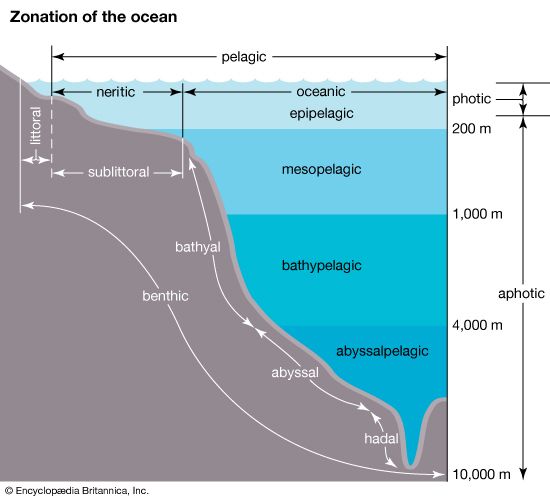
The bathyal zone—the region typically extending from 200 to 2,000 meters below the ocean surface—plays a critical role in the global carbon cycle by acting…
What role does the bathyal zone play in the ocean’s carbon cycle?
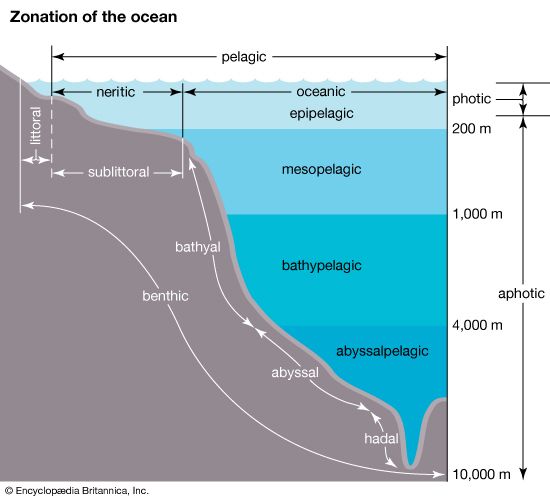
The bathyal zone—the region typically extending from 200 to 2,000 meters below the ocean surface—plays a critical role in the global carbon cycle by acting as a long-term storage reservoir for organic carbon.
While photosynthesis is generally absent in these dark waters, the zone receives a continuous “rain” of biological debris, including the remains of phytoplankton that sink from the sunlit surface layers. As these organisms die, the carbon they assimilated during their lifetimes is transported to depth. Although some decomposition occurs, it proceeds more slowly than on land, effectively sequestering this carbon away from the atmosphere for hundreds of years.12
Furthermore, the deep ocean serves as a site for the remineralization of biological debris, where nutrients are returned to solution. In specific areas like deep-sea hydrothermal vents, chemoautotrophic bacteria facilitate primary production by oxidizing sulfides, providing an alternative source of organic carbon in the aphotic zone.34
How does the bathyal zone differ from the abyssal zone?
The bathyal zone and the abyssal zone are distinct ecological realms defined primarily by depth, temperature, and proximity to land.
Key Differences
Feature
Bathyal Zone
Abyssal Zone
Typical Depth
200 to 2,000 meters
2,000 to 6,000 meters
Temperature
Variable (typically 5° to 15° C, except in high latitudes)
Extremely uniform (0° to 4° C)
Proximity to Land
Extends from the edge of the [continental shelf]
Far removed from land masses
Sediment Source
Terrestrial (clays/silts) and pelagic
Primarily microscopic plankton remains
Environmental Characteristics
- Boundary: The upper boundary of the abyssal zone is often defined by the 4° C isotherm, which separates it from the overlying bathyal waters.51
- Conditions: The bathyal zone is influenced by its proximity to the continental slope, receiving terrestrial sediments and experiencing variable temperatures based on currents. In contrast, the abyssal zone is characterized by extreme environmental stability, high pressure, and a lack of seasonal or diurnal change.15
- Biological Activity: While both zones are generally aphotic, the bathyal zone may support more diverse faunal assemblages due to its proximity to nutrient-rich continental runoff. The abyssal zone, covering about 60 percent of the Earth’s surface, is a vast, calm environment where life is sparse and highly specialized to survive in deep, cold, and high-pressure conditions.15
What types of organisms are commonly found in the bathyal zone?
The bathyal zone supports a diverse range of marine life, though the total number of individuals is generally lower than in shallow-water environments. Because the zone experiences relatively constant environmental conditions, it often exhibits high species diversity.
Commonly found organisms and biological groups include:
- Bottom Dwellers: In areas with adequate water circulation, the seafloor supports abundant populations of suspension feeders and mud-eating organisms that are well-adapted to local substrate conditions.
- Corals: Cold-water corals are found throughout the bathyal zone, ranging from sub-Arctic to equatorial regions.
- Fish and Other Aquatic Life: While faunal levels can be impoverished in stagnant, low-oxygen waters deeper than 1,000 meters, upwelling and countercurrents in middle- to high-latitude areas can create favorable conditions for various fish and other aquatic species.
- Bathypelagic Inhabitants: In the deeper reaches of the bathyal and bathypelagic zone, researchers have identified a wide variety of marine forms, including eels, various species of fish, and mollusks.
What is the average temperature range in the bathyal zone?
The temperature range in the bathyal zone varies significantly based on geographic location and depth:
- High Latitudes: Temperatures typically range from about -1° to 3° C (30° to 37° F).1
- Other Regions: In most other areas, temperatures generally range between 5° and 15° C (41° and 59° F).1
These variations are influenced by oceanic currents; western margins tend to be warmer due to equatorial currents, while eastern margins are often cooler due to boreal currents and upwelling. The lower boundary of the bathyal zone is generally defined by the depth where the water temperature reaches 4° C (39° F), which serves as the transition point to the underlying abyssal zone.15
Sources
- bathyal zone — Encyclopædia Britannica
- Marine ecosystem - Organisms of the deep-sea vents — Encyclopædia Britannica
- decarbonization - Natural carbon removal — Encyclopædia Britannica
- seawater - Dissolved inorganic substances — Encyclopædia Britannica
- abyssal zone — Encyclopædia Britannica
- Marine ecosystem - Geography, oceanography, and topography — Encyclopædia Britannica
- bathypelagic zone — Encyclopædia Britannica
- Atlantic Ocean - Temperature — Encyclopædia Britannica
Published on · 3 min read