African Wildcat
The African wildcat (Felis silvestris libyca) is a small, tabby-like member of the Felidae family found across Africa and Asia. Widely considered the…
What is African wildcat?
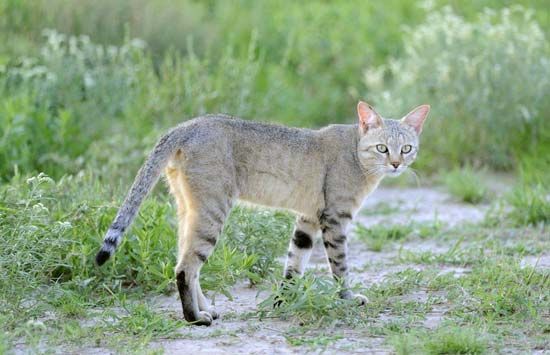
The African wildcat (Felis silvestris libyca) is a small, tabby-like member of the Felidae family found across Africa and Asia. Widely considered the ancestor of the domestic cat, it is believed to be the first cat species to have been domesticated by humans.123
Physically, the African wildcat is slightly larger and stockier than a typical house cat, measuring about 70 cm in length (excluding its 40-cm tail) and weighing approximately 3.5 kg. Its coat is generally light or orange-brown with narrow dark stripes. As a solitary, nocturnal hunter, it primarily preys on birds and small mammals. Because it is closely related to domestic cats, the two readily interbreed.12
How did the domestication of the African wildcat begin in ancient Egypt?
The domestication of the African wildcat in ancient Egypt began approximately 4,000 years ago. This process was driven by a relationship of mutual benefit: as humans transitioned to settled agricultural societies, they established grain storage facilities that attracted rodents. The wildcats were drawn to these granaries to hunt the mice, providing humans with a natural form of pest control.45
Over time, this functional partnership evolved into a deeper social and cultural bond. Cats transitioned from being useful predators to becoming revered symbols of divinity and cherished companions. Their significance in Egyptian society is evidenced by their prominent role in art, the practice of mummification, and the establishment of cat cults and temple worship. While earlier evidence of human-cat associations exists—such as a 9,500-year-old burial in Cyprus—the Egyptian period is recognized as a pivotal era for the integration of the species into human domestic life.54
What are the main physical differences between an African wildcat and a European wildcat?
The African wildcat (Felis silvestris lybica) and the European wildcat (Felis silvestris silvestris) exhibit distinct physical characteristics that reflect their different environments and evolutionary paths.
Physical Comparison
Feature
African Wildcat
European Wildcat
Head Shape
Generally smaller and less distinct
Larger and flatter
Leg Length
Proportionally shorter
Longer
Tail
Longer (approx. 40 cm)
Shorter (25–35 cm) with a rounded tip
Shoulder Height
Averages 23 cm
35–40 cm
Weight
Approximately 3.5 kg
3–10 kg
Coat Pattern
Light or orange-brown with narrow stripes
Yellowish gray with dark stripes and black-ringed tail
While both are solitary, nocturnal hunters that prey on birds and small mammals, the European wildcat is notably more robust, standing taller and possessing a heavier build than its African counterpart. Additionally, the African wildcat is recognized as the ancestor of the domestic cat, whereas the European wildcat is a distinct subspecies adapted to the forested regions of Eurasia.31
Why is interbreeding between wildcats and domestic cats a concern for conservationists?
Interbreeding between wildcats and domestic cats is a significant concern for conservationists because it threatens the genetic integrity and purity of wild populations. Specifically, experts believe that the distinct characteristics and genetic identity of the European wildcat are being compromised by frequent hybridization with domestic cats.6
From a conservation perspective, the loss of a species’ unique genetic makeup is a critical issue. When wild populations are small or isolated, the introduction of genes from domestic animals can lead to the dilution of traits that have allowed wildcats to adapt to their natural environments over millennia. This process is similar to the broader conservation challenge of maintaining genetic variability, where the loss of distinct genetic lines can reduce a population’s long-term resilience and survival prospects.3
While hybridization is a natural biological phenomenon, in the case of the wildcat, it is viewed as a threat to the survival of a recognized subspecies, potentially leading to the eventual disappearance of the “pure” wildcat through genetic assimilation.6
Sources
- African wildcat — Encyclopædia Britannica
- African wildcat — Merriam-Webster
- wildcat — Encyclopædia Britannica
- cat - Domestication — Encyclopædia Britannica
- 6 Domestic Animals and Their Wild Ancestors — Encyclopædia Britannica
- conservation - Genetic intervention — Encyclopædia Britannica
- bobcat — Encyclopædia Britannica
Published on · 3 min read