Alaska Blackfish
The Alaska blackfish (Dallia pectoralis) is an Arctic freshwater fish typically classified within the family Umbridae, though some authorities place it in…
What is Alaska blackfish?
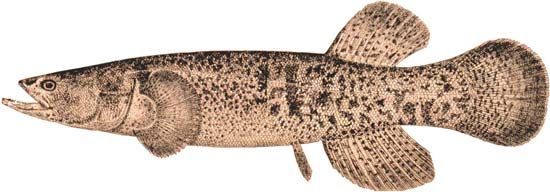
The Alaska blackfish (Dallia pectoralis) is an Arctic freshwater fish typically classified within the family Umbridae, though some authorities place it in its own family, Dalliidae.1
Measuring approximately 20 cm (8 inches) in length, this species features a dark, streamlined body, a protruding lower jaw, and two large, opposed fins positioned near the tail. It inhabits shallow streams and ponds throughout North America and Siberia, where it serves as a locally important food source. While it is often claimed that the Alaska blackfish can survive being frozen solid, this ability has never been scientifically substantiated. It is one of several species commonly referred to as a blackfish, a name applied to various dark-colored fish and even certain marine mammals.12
What other fish species live in Arctic freshwater?
Freshwater fish species in the Arctic are relatively limited in number, as these environments present significant challenges for survival. Notable species found in Arctic freshwater include:
- Arctic char: A circumpolar, anadromous species that is considered the most northerly occurring of any freshwater fish.456
- Trout and Salmonids: Various members of the family Salmonidae inhabit these regions, including lake trout and brook trout (often referred to as speckled trout).45
- Arctic grayling: A characteristic species of northern freshwater systems.5
- Whitefish: Found in various Arctic freshwater habitats.5
- Sticklebacks: Two species of these small fish are known to inhabit the region.5
- Alaska blackfish: A species adapted to shallow streams and ponds in North America and Siberia.57
- Other species: In some regions, burbot and northern pike are known to penetrate north of the tree line.5
These fish have evolved various physiological adaptations to survive in cold environments, such as the ability to rest near the bottom of water bodies during winter or the use of biochemical strategies to prevent freezing.8
How do fish adapt to living in extremely cold environments?
Fish have evolved several physiological and behavioral strategies to survive in extremely cold environments, where they must manage the risk of freezing and the impact of low temperatures on their metabolism.
Biochemical Adaptations
To prevent the formation of ice crystals within their cells and tissues, many fish species utilize biochemical strategies.
- Antifreeze Compounds: Polar marine fish often produce specialized glycoproteins that act as antifreeze. These substances lower the freezing point of body fluids and inhibit the growth of ice crystals.71011
- Internal Salt Concentrations: Some ray-finned fishes in polar regions maintain high internal salt concentrations, which further helps to inhibit freezing.7
Behavioral and Sensory Adaptations
- Activity and Positioning: While most fish remain active year-round, some species may limit their activity during cold periods by resting near the bottom of a body of water or in mud.712
- Temperature Sensitivity: Many bony fish possess a high degree of sensitivity to small temperature changes, allowing them to detect and navigate toward more favorable thermal environments. For instance, elasmobranchs like sharks and rays use specialized organs called ampullae of Lorenzini to detect cooling, which helps them respond to their environment.13
What are the main differences between the Umbridae and Dalliidae families?
The classification of the Alaska blackfish (Dallia pectoralis) is a subject of taxonomic debate, which directly relates to the relationship between the Umbridae and Dalliidae families.
Most authorities classify the Alaska blackfish within the family Umbridae, a group of small, bottom-dwelling freshwater fishes that includes the genus Umbra. However, some researchers argue that the Alaska blackfish is distinct enough to be placed in its own separate family, Dalliidae.114
Because the Dalliidae family is often considered a subset or a proposed alternative classification for the Alaska blackfish within the broader context of the Umbridae, there is no consensus on distinct morphological or biological “differences” between the two as separate families. Instead, the distinction is primarily a matter of taxonomic preference regarding how to categorize the unique traits of Dallia pectoralis, such as its specific body shape, jaw structure, and its ability to inhabit shallow, cold Arctic waters.1
Sources
- Alaska blackfish — Encyclopædia Britannica
- Alaska blackfish — Merriam-Webster
- blackfish — Encyclopædia Britannica
- char — Encyclopædia Britannica
- Arctic - Animals of the land and fresh water — Encyclopædia Britannica
- protacanthopterygian - Distribution and abundance — Encyclopædia Britannica
- Ectotherm — Encyclopædia Britannica
- fish - Distribution and abundance — Encyclopædia Britannica
- Arctic - Marine fauna — Encyclopædia Britannica
- antifreeze — Encyclopædia Britannica
- Dormancy - Fishes and amphibians — Encyclopædia Britannica
- antifreeze — Merriam-Webster
- Thermoreception - Fish — Encyclopædia Britannica
- Umbridae — Merriam-Webster
Published on · 3 min read