Paddlefish
The paddlefish is an archaic freshwater fish belonging to the family Polyodontidae. Characterized by a smooth-skinned body and a cartilaginous skeleton…
What is paddlefish?
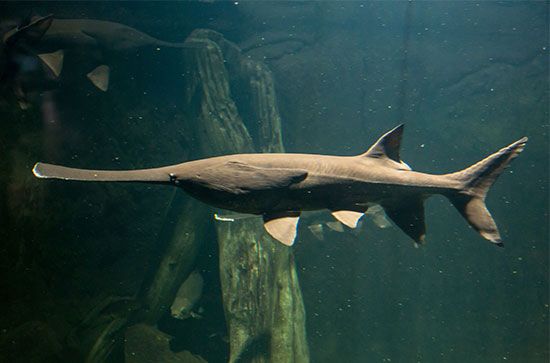
The paddlefish is an archaic freshwater fish belonging to the family Polyodontidae. Characterized by a smooth-skinned body and a cartilaginous skeleton, these fish are closely related to the sturgeon1.1
The most distinctive feature of the paddlefish is its elongated, paddle-shaped snout, which can account for up to half of its total body length. This snout is highly sensitive, as it is covered with electroreception organs. Paddlefish feed by swimming with their mouths open, using comblike gill rakers to strain plankton from the water.12
There are two primary species:
- American paddlefish (Polyodon spathula): Found in the Mississippi River basin and parts of Canada, this species is currently classified as vulnerable.2
- Chinese paddlefish (Psephurus gladius): Formerly of the Yangtze River basin, this larger species was declared extinct in 2020.2
How do paddlefish use electroreception to find food?
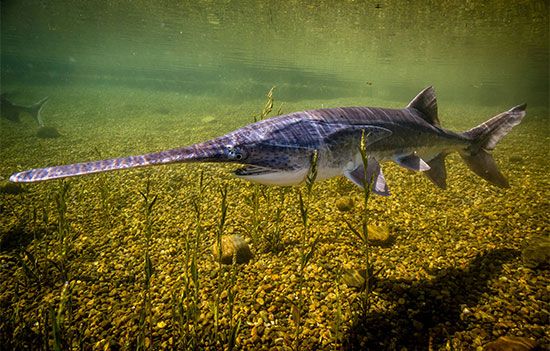
Paddlefish utilize their highly sensitive, elongated snouts to locate food through electroreception, an ability to detect weak, naturally occurring electrostatic fields in their environment.34
The snout, which can comprise up to half of the fish’s total body length, is covered with specialized electroreceptor organs. These organs function by providing a low-resistance pathway for electric currents to flow from the water to sensory epithelial cells. When these cells are stimulated by voltage, ion channels in their membranes trigger a change in polarization, generating an action potential that sends nerve impulses to the brain.43
While some fish use electroreception for active electrolocation—emitting their own electric signals to map their surroundings—paddlefish primarily rely on this sense to detect the weak electric fields produced by the neuromuscular activity of their prey. This passive sensing allows them to locate food particles even in murky water where visual cues are limited. Once food is detected, the paddlefish feeds by swimming with its mouth open, using comblike gill rakers to strain plankton from the water.234
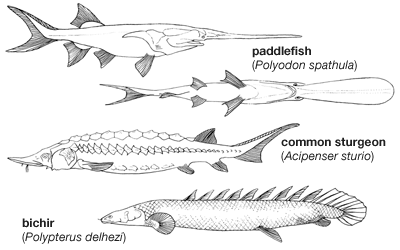
What are the main differences between sturgeons and paddlefish?
While sturgeons and paddlefishes both belong to the order Acipenseriformes and share a largely cartilaginous skeleton, they exhibit distinct physical and behavioral differences.26
Physical Characteristics
- Body Armor: Sturgeons are characterized by thick bony plates on the head and five rows of enlarged scales, known as scutes, along their bodies. In contrast, paddlefish have smooth skin, with only a few vestigial scales near the tail (though the Chinese paddlefish possesses tiny, deeply embedded scales).2
- Snout and Mouth: Sturgeons have a subterminal mouth preceded by four fleshy barbels used for tactile sensing. Paddlefish are defined by an elongated, paddle-shaped snout that can reach up to half their body length and is covered in electroreception organs.2
Feeding Habits
- Sturgeons: These are primarily bottom feeders that use their barbels to forage for small invertebrates and other fish along the river or sea floor.27
- Paddlefish: The American paddlefish is a filter feeder that strains plankton through its gill rakers, acting as a living plankton net. The Chinese paddlefish, however, is more carnivorous.7
Why did the Chinese paddlefish go extinct?
The Chinese paddlefish (Psephurus gladius) was declared extinct by ecologists in 2020. While the provided search results confirm its status as a critically endangered species following its last confirmed sighting in the early 2000s, they do not explicitly detail the specific environmental or human-driven causes that led to its extinction.19
Historically, this species inhabited the Yangtze River basin and was known for its significant size, reaching lengths of up to 3 metres (9.8 feet). Its decline followed decades of being classified as critically endangered by the International Union for Conservation of Nature (IUCN) starting in 1996.1
Sources
- paddlefish — Encyclopædia Britannica
- chondrostean - Form and function — Encyclopædia Britannica
- Senses - Electric sense — Encyclopædia Britannica
- Electroreception — Encyclopædia Britannica
- Animal communication - Signal reception — Encyclopædia Britannica
- chondrostean - Evolution — Encyclopædia Britannica
- chondrostean — Encyclopædia Britannica
- chondrostean - Ecology — Encyclopædia Britannica
- chondrostean - Distribution — Encyclopædia Britannica
Published on · 3 min read