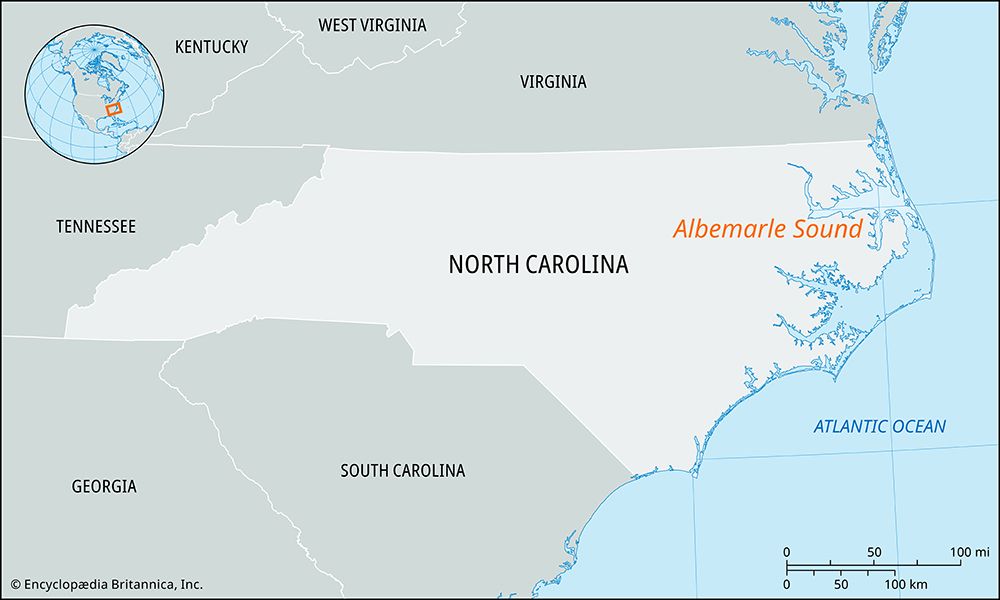
Albemarle Sound
Albemarle Sound is a shallow coastal inlet situated in the northeastern region of North Carolina, United States. Protected from the Atlantic Ocean by the…
What is Albemarle Sound and where is it located in North Carolina?
Albemarle Sound is a shallow coastal inlet situated in the northeastern region of North Carolina, United States. Protected from the Atlantic Ocean by the Outer Banks, the sound stretches approximately 50 miles (80 km) from east to west, with a width ranging from 5 to 14 miles (8 to 23 km) and a maximum depth of 25 feet (8 meters).12
The sound serves as a vital waterway, receiving freshwater from the Pasquotank, Alligator, Chowan, and Roanoke rivers. It discharges into Pamlico Sound and is linked to the Chesapeake Bay via the Intracoastal Waterway. Historically significant, the area was explored in 1586 and hosted the state’s earliest European settlements. Elizabeth City currently serves as its primary port.1
How was Albemarle Sound formed and what are its main geographical features?
The provided search results do not contain information regarding the geological formation of Albemarle Sound.
Regarding its geographical features, the sound is a shallow coastal inlet in northeastern North Carolina that is protected from the Atlantic Ocean by the Outer Banks. It extends approximately 50 miles (80 km) from east to west, with a width varying between 5 and 14 miles (8 to 23 km) and a maximum depth of 25 feet (8 meters).1
The sound acts as a basin for several rivers, including the Pasquotank, Alligator, Chowan, and Roanoke rivers. Its waters discharge into Pamlico Sound at its southeastern end via the Roanoke and Croatan sounds. Additionally, it is linked to the Chesapeake Bay through the Intracoastal Waterway, which includes the Albemarle and Chesapeake Canal and the Dismal Swamp Canal.12
What role did Albemarle Sound play in the early colonial history of North Carolina?
Albemarle Sound played a pivotal role in the early colonial history of North Carolina. Initially explored in 1586 by Ralph Lane from the Roanoke Island colony, the inlet was first referred to as the Sea of Rawnocke (Roanoke Sea) before eventually being renamed for George Monck, 1st duke of Albemarle.1
While earlier attempts at colonization in the 1580s—such as the famous “Lost Colony”—focused on the coastal islands, the region around the sound became the site of the state’s earliest permanent European settlements. In the 1650s, farmers and traders migrating from Virginia established themselves along the shores of the sound. This influx of settlers eventually led to the 1663 grant from King Charles II that formally created the Carolina colony.14
How does the Outer Banks affect Albemarle Sound’s connection to the Atlantic Ocean?
The Outer Banks act as a protective barrier that shields Albemarle Sound from the direct influence of the Atlantic Ocean. Because of this barrier, Albemarle Sound does not have a direct opening to the ocean.3
Instead, the sound’s connection to the Atlantic is indirect. It discharges its water at its southeastern end through the Roanoke and Croatan sounds into Pamlico Sound. From there, the water reaches the Atlantic Ocean through specific inlets, such as Ocracoke and Hatteras, which cut through the barrier islands of the Outer Banks.13
Sources
- Albemarle Sound — Encyclopædia Britannica
- Albemarle Sound — Merriam-Webster
- Pamlico Sound — Encyclopædia Britannica
- North Carolina - The proprietary and royal colony — Encyclopædia Britannica
- Roanoke River — Encyclopædia Britannica
Published on · 2 min read