Biscayne Bay
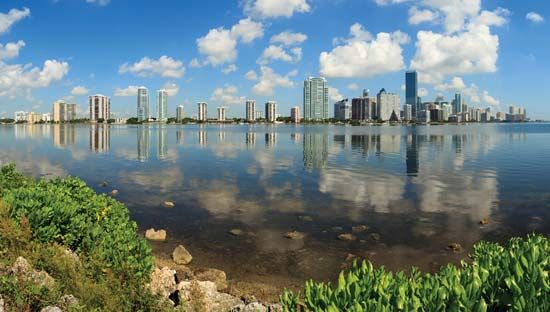
Biscayne Bay has been central to the development of southeastern Florida, serving as the geographic anchor for the growth of Miami and Miami Beach.
What is the historical significance of Biscayne Bay in the development of Florida?
Biscayne Bay has been central to the development of southeastern Florida, serving as the geographic anchor for the growth of Miami and Miami Beach.12
Historically, the bay provided a vital setting for human activity, from the ancient village of the Tequesta people to its role as a focal point for modern urban expansion. The bay’s proximity to the Atlantic Ocean facilitated the development of Miami as a major port and transportation hub. Its significance was further cemented in the late 19th century when Henry M. Flagler extended the Florida East Coast Railway to the area, dredging the harbor and promoting tourism that transformed the region.23
The bay also enabled the rise of Miami Beach, where developers bridged the water to convert mangrove swamps into a premier resort destination. Today, the bay remains a cornerstone of the region’s economy, supporting tourism, international commerce, and marine research, while much of its southern portion is preserved within Biscayne National Park.312
Where is Biscayne Bay located, and what are its geographical features?
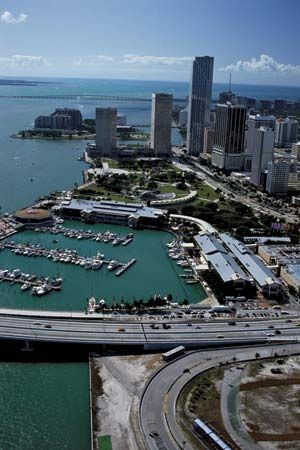
Biscayne Bay is a shallow inlet of the Atlantic Ocean located along the southeastern coast of Florida, U.S. It spans approximately 40 miles (65 km) in length and up to 10 miles (16 km) in width, covering roughly 220 square miles (570 square km).1
Geographically, the bay is bordered by Miami to the northwest and Miami Beach to the northeast. Its eastern boundary is defined by a chain of islands, including the northernmost Florida Keys, which separate the bay from the Atlantic. To the south, it connects to Florida Bay through a series of sounds.14
Key features include:
- Depth: It is a shallow body of water with a maximum depth of approximately 12 feet (4 metres).4
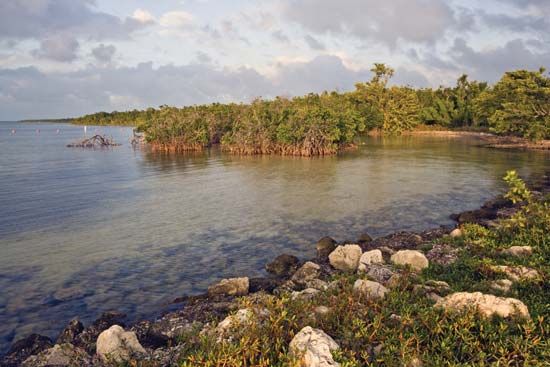
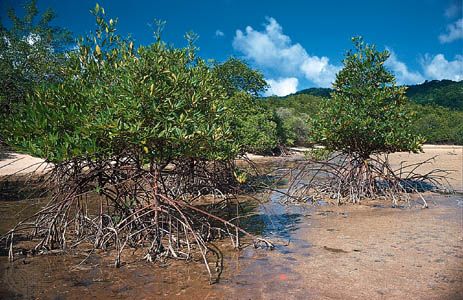
- Ecosystems: The shoreline is characterized by dense mangrove swamps, while the bay floor contains extensive sea grass beds that support diverse marine life, including manatees, sea turtles, and various fish species.14
- Connectivity: It forms part of the Intracoastal Waterway and connects to the ocean via a passage known as the Safety Valve.1
Much of the area is protected within Biscayne National Park.1
What is the role of Biscayne National Park in protecting the bay and its surroundings?
Biscayne National Park plays a critical role in the preservation of the Biscayne Bay ecosystem and its surrounding marine environments. Established as a national monument in 1968 and a national park in 1980, the park encompasses 270 square miles, 95 percent of which is water, providing a protected sanctuary for a diverse range of habitats.4
The park’s protective efforts focus on several key areas:
- Habitat Conservation: It safeguards the northernmost group of living coral reefs in the United States, along with the bay’s extensive sea grass beds and mangrove-covered shorelines. These areas serve as essential nurseries and shelters for numerous species, including manatees, sea turtles, lobsters, and over 200 types of fish.4
- Ecosystem Integrity: By managing the bay’s shallow waters and the chain of keys that separate it from the Atlantic Ocean, the park helps maintain the ecological balance necessary for these sensitive marine environments to thrive.4
- Public Stewardship: The park facilitates public engagement through controlled access, allowing for recreation such as boating and camping while educating visitors on the importance of preserving these natural resources.46
What types of marine life can be found in Biscayne Bay?
Biscayne Bay supports a rich variety of marine life, thriving within its shallow waters, sea grass beds, and mangrove-lined shores. The ecosystem serves as a vital habitat for numerous species, including:
- Marine Mammals and Reptiles: The bay is home to manatees and sea turtles, which utilize the protected waters and sea grass beds.41
- Crustaceans: The bay’s sea grass beds provide essential shelter for shrimp and lobsters.4
- Fish: The bay supports a wide array of fish species. Additionally, the nearby coral reefs—protected within Biscayne National Park—are home to more than 200 types of fish, including colorful species such as wrasse, angelfish, and goby.4
- Birds: The shoreline and shallow waters are abundant with bird life, which finds shelter in the dense mangrove swamps.41
The diversity of these habitats, ranging from the mainland’s mangrove swamps to the offshore coral reefs, ensures that the bay remains a productive environment for these marine populations.4
Sources
- Biscayne Bay — Encyclopædia Britannica
- Miami — Encyclopædia Britannica
- Miami Beach — Encyclopædia Britannica
- Biscayne National Park — Encyclopædia Britannica
- Florida Bay — Encyclopædia Britannica
- Everglades - Development of the Everglades — Encyclopædia Britannica
Published on · 3 min read