Atlantic Ocean
The Atlantic Ocean has served as a vital oceanic highway for human civilization, facilitating trade, migration, and exploration for centuries.

What role has the Atlantic Ocean played in human history, trade, and exploration?
The Atlantic Ocean has served as a vital oceanic highway for human civilization, facilitating trade, migration, and exploration for centuries.1
Exploration and Settlement
During the Age of Discovery, European nations sought new maritime routes to Asia after traditional overland and Mediterranean paths became insecure or controlled by others. Explorers like Christopher Columbus utilized the Atlantic’s natural clockwise current and wind patterns to reach the Americas. This era initiated over 200 years of transatlantic voyages, leading to the colonization of the Americas and the Caribbean by European powers.23
Trade and Commerce
The Atlantic has been central to global commerce, particularly since 1500 CE. Historically, it supported the world’s largest volume of shipping until after World War II. The ocean also facilitated the horrific transatlantic slave trade, which forcibly transported millions of Africans to the Americas. Today, the Atlantic remains a critical network for moving bulk commodities and manufactured goods between major industrial centers in Europe and North America.14
Strategic Significance
The ocean has been a theater of major conflict, most notably the Battle of the Atlantic, where control of sea routes was essential for Allied victory in World War II.5
What are the major currents in the Atlantic Ocean and how do they affect climate?
The Atlantic Ocean features a complex system of currents that play a critical role in regulating global and regional climates by transporting heat from the tropics toward the poles.78
Major Atlantic Currents
- Gulf Stream: A powerful, warm current that flows northeastward from the Gulf of Mexico along the North American coast. It is a key component of the North Atlantic’s clockwise-rotating gyre.910
- North Atlantic Current: An extension of the Gulf Stream that carries warm, saline water toward northwestern Europe.97
- Labrador Current: A cold, low-salinity current flowing southward from the Arctic Ocean along the coasts of Greenland and Canada. Its meeting with the warm Gulf Stream near the Grand Banks creates significant fog and turbulence.910
- Canary Current: A relatively cool current that branches off the North Atlantic Current and flows southwestward along the coast of northwestern Africa.910
Impact on Climate
The movement of heat is driven by both wind-driven circulation and thermohaline circulation, a large-scale overturning process where warm surface water moves north, cools, and sinks to form North Atlantic Deep Water.7
This heat transport significantly moderates the climate of northwestern Europe, keeping it much warmer than other regions at similar latitudes. Prevailing westerly winds further distribute this warmth and moisture deep into the continent. Additionally, the thermal gradients between warm and cold currents help position the jet stream, which steers weather systems across the hemisphere.11128
What are some of the most important ports and coastal cities along the Atlantic Ocean?
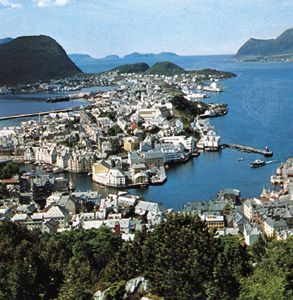
The Atlantic Ocean has long served as a primary global highway, with its ports acting as essential hubs for trade, industry, and migration. These cities have historically functioned as gateways for the exchange of raw materials and manufactured goods between the Americas, Europe, and Africa.114
Major Atlantic Ports
The following cities are among the most significant ports along the Atlantic coast, serving as critical nodes in modern container operations and global commerce:
- North America:
- New York City: A preeminent center for trade and commerce, serving as a major hub for the Port Authority of New York and New Jersey.1
- Charleston: A vital South Carolina port known for its extensive container operations.1
- Hampton Roads: A key maritime gateway in Virginia.1
- New Orleans: A crucial exporter of agricultural products and oil from the Mississippi River hinterland.15
- Houston: A busy port specializing in oil and chemical products.15
- Europe:
Historically, cities like Boston, Philadelphia, and Savannah were also foundational to the colonial economy, acting as essential funnels for raw materials moving to Europe and manufactured goods returning to the interior.14
What are the differences between the North Atlantic and South Atlantic?
The North and South Atlantic oceans exhibit significant differences in their geography, climate patterns, and biological characteristics.
Geographic and Physical Differences
- Coastline and Islands: The North Atlantic is characterized by a highly varied coastline and is rich in islands and tributary seas, including the Caribbean Sea, the Gulf of Mexico, and the Mediterranean Sea. In contrast, the South Atlantic features simpler, more uniform coasts with very few islands.18
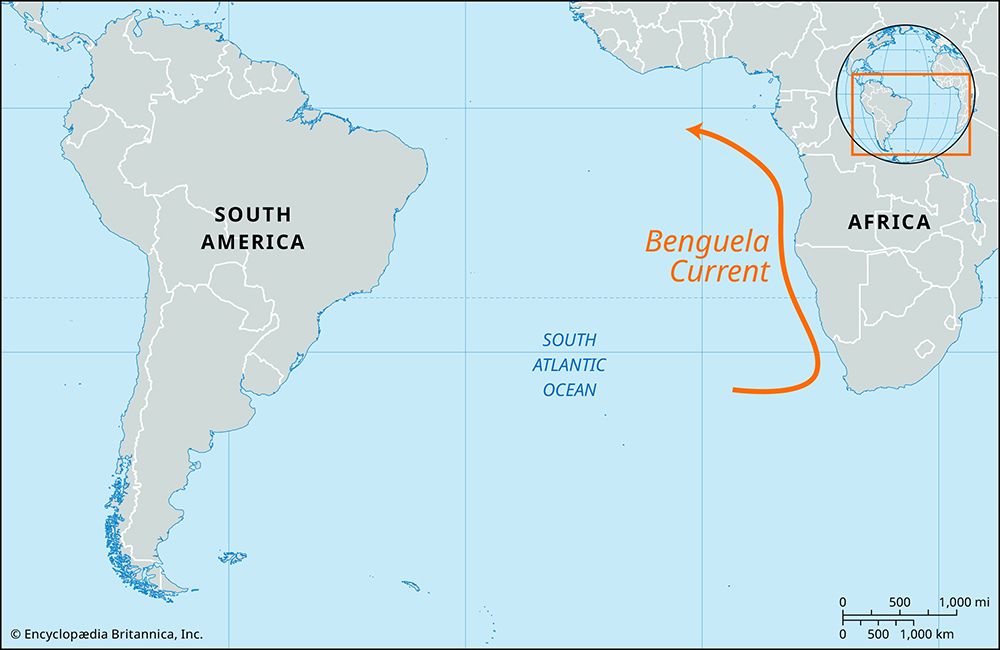
- Ocean Currents: While both basins share similar circulation patterns, their specific currents differ. The North Atlantic is dominated by the Gulf Stream, which transports warm water toward Europe. The South Atlantic features the Brazil Current and the Benguela Current, the latter of which is noted for intense coastal upwelling of cold, nutrient-rich water.19
Climate and Atmospheric Patterns
- Storm Systems: The North Atlantic is a primary region for the development of extratropical cyclones and hurricanes, which are heavily influenced by temperature contrasts between cold air from North America and warm tropical waters. In the South Atlantic, storminess in the higher latitudes is driven primarily by the temperature contrast between the Antarctic continent and the open sea.2021
- Wind Systems: Due to the Coriolis force, wind circulation around high-pressure systems rotates in opposite directions in the two hemispheres, leading to distinct patterns for the trade winds and westerlies.21
Biological Productivity
The North Atlantic generally supports higher concentrations of plankton and a greater variety of seaweeds along its extensive continental margins. While the South Atlantic also hosts productive areas, its biological richness is often tied to the upwelling of deep, nutrient-rich waters near the Antarctic and along the African coast.2223
Sources
- Atlantic Ocean - Trade and transportation — Encyclopædia Britannica
- European exploration - The Age of Discovery — Encyclopædia Britannica
- Atlantic Ocean - European voyages and settlement — Encyclopædia Britannica
- Western Africa - Anglo-French competition — Encyclopædia Britannica
- Atlantic Ocean — Merriam-Webster
- Battle of the Atlantic — Encyclopædia Britannica
- Atlantic Ocean - The North Atlantic — Encyclopædia Britannica
- Atlantic Meridional Overturning Circulation: Top Questions — Encyclopædia Britannica
- Gulf Stream — Encyclopædia Britannica
- Climate - Thermohaline circulation — Encyclopædia Britannica
- Climate - Circulation, currents, and ocean-atmosphere interaction — Encyclopædia Britannica
- Marine ecosystem - Ocean currents — Encyclopædia Britannica
- How Do Ocean Currents Affect the Biosphere? — Encyclopædia Britannica
- North America - Coastal sites — Encyclopædia Britannica
- history of Europe - Trade and the “Atlantic revolution” — Encyclopædia Britannica
- North America - The United States segment — Encyclopædia Britannica
- United States - Classic patterns of siting and growth — Encyclopædia Britannica
- Atlantic Ocean - The South Atlantic — Encyclopædia Britannica
- Atlantic Ocean - The North Atlantic — Encyclopædia Britannica
- Atlantic Ocean - Extent — Encyclopædia Britannica
- Atlantic Ocean — Encyclopædia Britannica
- Atlantic Ocean - Biological resources — Encyclopædia Britannica
- Atlantic Ocean - The South Atlantic — Encyclopædia Britannica
- Atlantic Meridional Overturning Circulation — Encyclopædia Britannica
- Atlantic Ocean - Deepwater currents — Encyclopædia Britannica
Published on · 5 min read