Alderney
Following the aftermath of World War II, the economy of Alderney required significant reconstruction. The island's modern economic activities are primarily…
What are the main economic activities on Alderney?
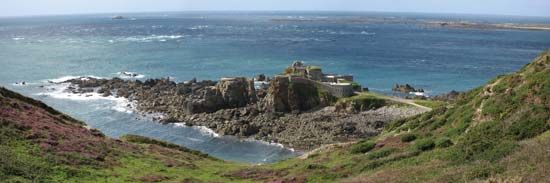
Following the aftermath of World War II, the economy of Alderney required significant reconstruction. The island’s modern economic activities are primarily based on dairy farming and tourism.1
While the island was historically famous for its native breed of dairy cattle, the original line was lost when the community and their livestock were evacuated during the German occupation; none of the cattle were returned after the war. Today, the island leverages its fine scenery and mild maritime climate to attract visitors, maintaining its status as a popular resort area.12
What is the geographical location and size of Alderney?
Geographical Location and Size of Alderney
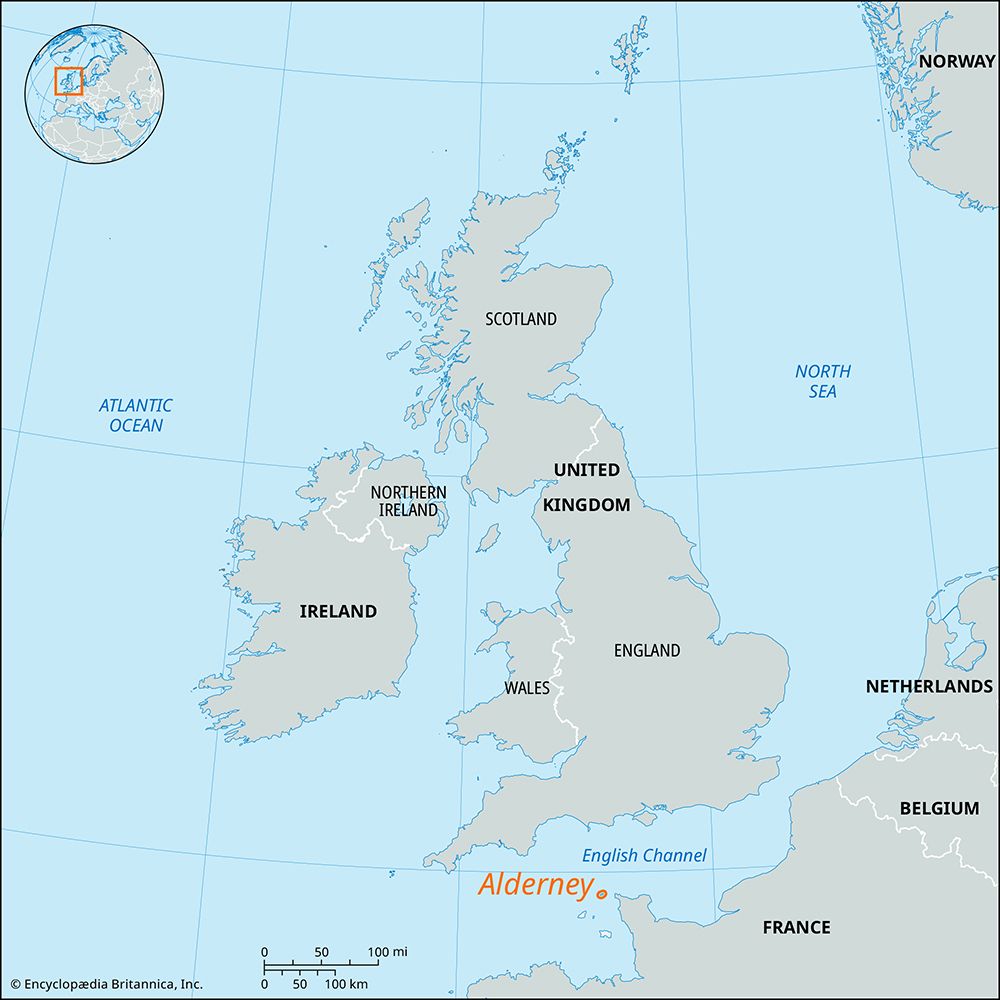
Alderney is one of the Channel Islands situated in the English Channel. It is located approximately 10 miles (16 km) from the Normandy coast, separated by the Race of Alderney, and lies about 55 miles (88 km) north of the English coast.1
The island is a tableland characterized by steep cliffs that reach heights of up to 275 feet (83 metres) on its southern and western coasts. It covers a total area of 3 square miles (8 square km).1
What unique wildlife or natural features can be found on Alderney?
Sorry, the Britannica knowledge base does not contain specific information regarding the unique wildlife found on Alderney.
However, the island is characterized by distinct natural features, including a tableland landscape that is mostly above 200 feet (60 metres) in elevation. Its coastline features steep cliffs reaching up to 275 feet (83 metres) on the south and west, while the north and east coasts are marked by old cliffs rising behind raised beaches. Additionally, the island is surrounded by a labyrinth of rocks and islets, such as the uninhabited Burhou, Ortac, and the notorious Casquets, which are known for their jagged rock formations.12
How does Alderney’s history differ from the other Channel Islands?
Alderney’s history is distinct from the other Channel Islands in several key ways, particularly regarding its governance and economic development:
- Separate Governance: While Alderney is part of the Bailiwick of Guernsey, its administrative history differs significantly. From the Restoration until 1825, its government was entirely separate from Guernsey’s. It was held by various private owners, including the Le Mesurier family, rather than being under the direct administrative evolution seen in Guernsey. Today, while it remains a dependency of the Bailiwick, it maintains its own local administration, including a popularly elected president and States of Alderney, and its own court system.
- Military Focus: During the 19th century, Alderney was heavily fortified by the British, who maintained a permanent garrison on the island until 1930, a feature not shared to the same extent by the other islands.
- Economic Shifts: Unlike other islands that maintained their famous cattle breeds, Alderney’s native line of dairy cattle was lost after the entire community was evacuated to England during World War II. Following the war, the island had to completely re-create its economy, focusing on tourism and dairy farming without the original breed.
Sources
- Alderney — Encyclopædia Britannica
- Channel Islands — Encyclopædia Britannica
- Guernsey — Encyclopædia Britannica
Published on · 2 min read