Bahrain
For centuries, pearling was the cornerstone of Bahrain’s economy, establishing the island as the chief center for the pearl trade in the Persian Gulf. This…

How has Bahrain’s pearl diving history shaped its economy and culture?
For centuries, pearling was the cornerstone of Bahrain’s economy, establishing the island as the chief center for the pearl trade in the Persian Gulf. This industry, which involved harvesting from the region’s rich oyster beds, was a primary source of wealth until the early 20th century, when the rise of Japanese cultured pearls and the global economic depression led to its decline. While pearling is now practiced only on a small scale, it remains a vital part of the national identity.12
Culturally, the legacy of pearling is deeply embedded in Bahraini life. It is preserved through:
- Music: Fidjeri, the traditional songs once sung by pearl divers, remains a significant element of Bahrain’s folk music heritage.3
- Heritage Sites: The site of “Pearling, Testimony of an Island Economy” in Al-Muḥarraq is recognized as a UNESCO World Heritage site.4
- Museums: The country maintains institutions specifically dedicated to the history of pearl diving.5
How has Bahrain adapted to modernization while preserving its traditional heritage?
Bahrain has navigated the path of modernization by embracing a cosmopolitan outlook while actively safeguarding its Arab-Islamic heritage. Historically more open to outside influences due to its island geography, the country has adopted a more moderate social climate than many of its neighbors, facilitating a blend of Western-style development and traditional values.2
The state supports this balance through several key initiatives:
- Cultural Preservation: Traditional crafts, such as ceramics in ‘Ālī and basket weaving, receive state support, while shipyards in Manama and Al-Muḥarraq continue the respected art of dhow building. The government also maintains museums dedicated to pearl diving and petroleum production, alongside institutions like the Bahrain National Museum.39
- Social Customs: While Western-style clothing is common, traditional attire like the thawb and hijab remains prevalent, particularly in conservative communities. Culinary traditions, including dishes like machbous, continue to be central to social life.10
- Economic Diversification: To thrive in a post-petroleum era, Bahrain has promoted Islamic banking, tourism, and industrial sectors like aluminum processing, while implementing political reforms to guarantee civil and property rights10.11
What is the geographical location and size of Bahrain?
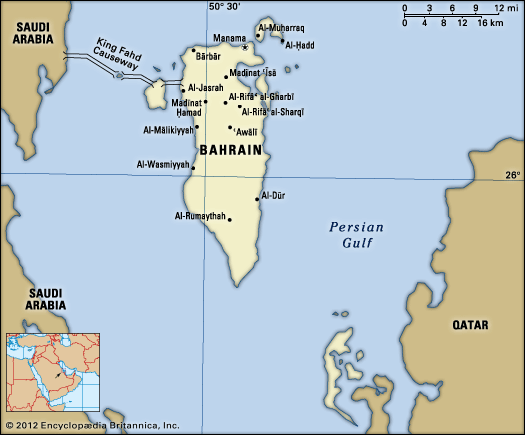
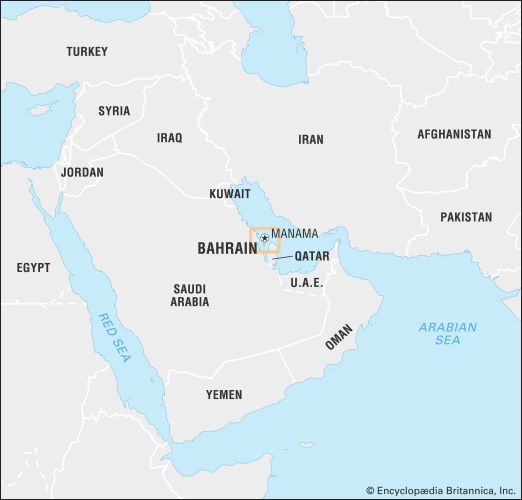
Bahrain is an archipelago situated in the Persian Gulf, with Saudi Arabia located to its west and the Qatar peninsula to its east. The country is connected to the Saudi mainland by the 15-mile (24 km) King Fahd Causeway.14
The state comprises two primary island groups that span approximately 30 miles (50 km) from north to south and 10 miles (16 km) from east to west. The main island, Bahrain Island, constitutes seven-eighths of the total land area and is surrounded by smaller islands, including Al-Muḥarraq and Sitrah. The second group consists of the Ḥawār Islands, located southeast of the main island.14
In total, Bahrain covers a land area of 304 square miles, making it slightly larger than Singapore.1514
What role does Bahrain play in the geopolitics of the Persian Gulf region?
Bahrain plays a pivotal role in the geopolitics of the Persian Gulf through its strategic military alliances and regional integration. A founding member of the Gulf Cooperation Council (GCC), Bahrain collaborates closely with neighboring Arab states on economic and defense initiatives, such as the deployment of the Peninsula Shield Force to maintain regional stability.1617
The country serves as a critical hub for Western security interests, most notably as the headquarters for the United States Navy’s Fifth Fleet States](https://www.britannica.com/place/United-States) Navy’s Fifth Fleet. This long-standing defense cooperation, formalized after the Persian Gulf War, provides a significant counterweight to regional tensions, particularly regarding Iran. Relations with Iran remain strained due to Tehran’s territorial claims, its influence over Bahrain’s Shiʿi community, and its opposition to the American military presence.16171
Furthermore, the King Fahd Causeway has solidified Bahrain’s bilateral ties with Saudi Arabia, often aligning its foreign policy with the kingdom while maintaining its status as a key commercial and financial center in the region.1618
Sources
- Bahrain - Economy — Encyclopædia Britannica
- Bahrain - Cultural life — Encyclopædia Britannica
- Bahrain - The arts — Encyclopædia Britannica
- list of World Heritage sites - Bahrain — Encyclopædia Britannica
- Bahrain - Manufacturing — Encyclopædia Britannica
- Arabia - Economy of Arabia — Encyclopædia Britannica
- Bahrain - Cultural institutions — Encyclopædia Britannica
- Dilmun — Encyclopædia Britannica
- Bahrain - Services — Encyclopædia Britannica
- History of Bahrain - 1999–2010: Reforms of Sheikh Hamad ibn ʿIsa Al Khalifah — Encyclopædia Britannica
- Bahrain - 1999–2010: Reforms of Sheikh Hamad ibn ʿIsa Al Khalifah — Encyclopædia Britannica
- Bahrain - Daily life and social customs — Encyclopædia Britannica
- Bahrain - Settlement patterns — Encyclopædia Britannica
- Bahrain: Country Facts — Encyclopædia Britannica
- Bahrain - Land — Encyclopædia Britannica
- History of Bahrain - Domestic and foreign relations since independence — Encyclopædia Britannica
- Bahrain - Domestic and foreign relations since independence — Encyclopædia Britannica
- Bahrain - Resources and power — Encyclopædia Britannica
- Bahrain - Security — Encyclopædia Britannica
Published on · 3 min read