Aleutian Trench
The Aleutian Trench is a deep-sea submarine trench located in the North Pacific Ocean, stretching from the Gulf of Alaska to the Kamchatka Peninsula near the…
What is Aleutian Trench?
The Aleutian Trench is a deep-sea submarine trench located in the North Pacific Ocean, stretching from the Gulf of Alaska to the Kamchatka Peninsula near the Komandor Islands.12
Geologically, the trench is associated with a subduction zone, where an oceanic plate slides beneath an overriding plate. It is classified as a marginal trench in its eastern section, while its western portion is more accurately described as an island arc trench.2
The trench reaches a maximum depth of 26,604 feet (8,109 metres). While it is quite deep in the west, the eastern portion near Kodiak Island is largely buried by sediments derived from the Alaskan continent, resulting in a relatively smooth and flat ocean floor in that area. Like other major trenches, it is associated with significant seismic activity.12
What is an island arc?
An island arc is a long, curved chain of oceanic islands characterized by intense volcanic and seismic activity. These features typically form at convergent margins where two oceanic lithospheric plates collide.34
Formation and Structure
When two oceanic plates converge, the denser plate subducts into the mantle. As it descends, heat and volatile components trigger partial melting in the overlying mantle wedge, creating magma that rises to form a line of volcanoes.4
- Configuration: Island arcs often consist of two parallel rows: an inner row of explosive volcanoes and an outer row of nonvolcanic islands.3
- Trench Association: A deep-sea oceanic trench almost invariably exists along the convex side of the arc.34
- Seismicity: These regions are prone to frequent, deep-focus earthquakes that occur at depths of up to 370 miles (600 km).3
While most island arcs are found in the western Pacific Ocean, similar volcanic processes occur on continents, such as the Andes, where magma rises through thicker continental crust.34
How do subduction zones cause earthquakes?
Subduction zones are regions where tectonic plates converge and one slab of oceanic lithosphere descends into the Earth’s mantle. Earthquakes occur in these zones primarily due to the buildup and sudden release of stress as these plates interact.567
Mechanisms of Seismic Activity
- Plate Interaction: As the cold, dense oceanic slab descends, it experiences significant frictional drag against the overriding plate. This interaction creates immense stress and strain within the rock masses.67
- Elastic Rebound: According to the elastic rebound theory, rocks accumulate strain until the resulting stress exceeds their strength. When the rocks finally fracture and slip, they release stored energy in the form of seismic waves, causing the ground to shake ](https://www.britannica.com/science/seismic-wave), causing the ground to shake.6
- Wadati-Benioff Zone: The path of the descending slab is marked by a plane of earthquakes known as the Wadati-Benioff zone. These earthquakes, often resulting from compression, can occur at depths of 300 to 700 km, indicating that the subducting crust retains some rigidity as it descends.6
These processes are responsible for some of the most powerful earthquakes on record, such as those generated by the subduction of the Nazca Plate beneath South America.8
What are some other major deep-sea trenches in the Pacific?
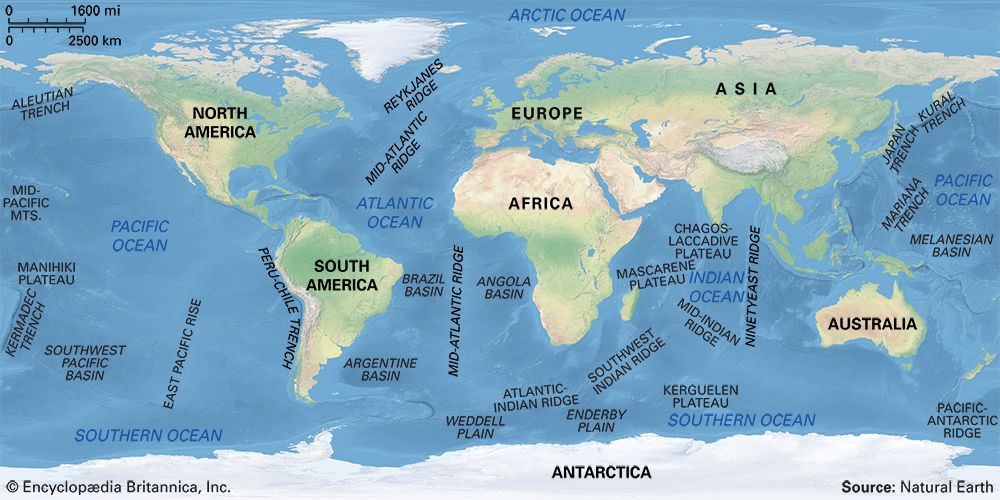
The Pacific Ocean basin contains 17 of the Earth’s 20 major deep-sea trenches, which are primarily associated with subduction zones along its margins. Beyond the well-known Mariana Trench, several other significant trenches define the Pacific floor:9
- Peru-Chile Trench: The longest trench in the world, extending approximately 5,900 km (3,700 miles) along the western coast of South America.9
- Aleutian Trench: Stretches from the Gulf of Alaska to the Kamchatka Peninsula, transitioning from a marginal trench in the east to an island arc structure in the west.9
- Kuril Trench: Located east of the Kamchatka Peninsula and the Kuril Islands, this 2,900 km (1,800 mile) long trench marks the convergence of the Pacific Plate with plates to the west.10
- Tonga and Kermadec Trenches: These form a structural arc extending south from the Fiji Islands toward New Zealand.119
- Other Western Pacific Trenches: The region also features the Japan Trench, Philippine Trench, Java Trench, and the New Hebrides Trench.9
Sources
- Aleutian Trench — Encyclopædia Britannica
- deep-sea trench - Types — Encyclopædia Britannica
- island arc — Encyclopædia Britannica
- plate tectonics - Island arcs — Encyclopædia Britannica
- earthquake - Tectonic associations — Encyclopædia Britannica
- How do earthquakes occur? — Encyclopædia Britannica
- plate tectonics - Subduction zones — Encyclopædia Britannica
- Nazca Plate — Encyclopædia Britannica
- Pacific Ocean: Top Questions — Encyclopædia Britannica
- Tonga Trench — Encyclopædia Britannica
- deep-sea trench - Origin of deep-sea trenches — Encyclopædia Britannica
- Mariana Trench — Merriam-Webster
- Which ocean is deeper: The Atlantic or the Pacific? — Encyclopædia Britannica
- Kuril Trench — Encyclopædia Britannica
Published on · 3 min read