Amakusa Islands
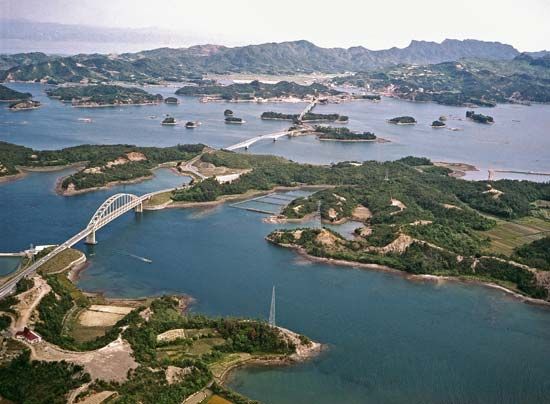
The Amakusa Islands are an archipelago of approximately 100 islands located in the Amakusa Sea off the western coast of Kyushu, Japan. Administered by…
What is Amakusa Islands?
The Amakusa Islands are an archipelago of approximately 100 islands located in the Amakusa Sea off the western coast of Kyushu, Japan. Administered by Kumamoto prefecture, the group is dominated by two primary landmasses: Kami (Upper) Island and Shimo (Lower) Island.1
Due to the region’s rugged, mountainous terrain, agriculture is limited. Instead, the local economy relies on forestry, orange cultivation, and offshore fishing. The islands are connected to the mainland and each other via ferry services and a series of five bridges, and they form part of the Unzen-Amakusa National Park.1
Historically, the archipelago served as a gateway for Western culture and was an early center of Christianity. Following the Shimabara Rebellion in 1637–38, the islands became a significant refuge for Japanese Christians.1
What was the Shimabara Rebellion?
The Shimabara Rebellion (1637–38) was a significant uprising of Japanese Roman Catholics on the Shimabara Peninsula and the Amakusa Islands. Triggered by oppressive taxation and the abuses of local officials, the revolt gained momentum as many peasants, who had been converted to Christianity by European missionaries, were joined by rōnin (masterless samurai).3
The rebels fought with such intensity that the government struggled to suppress them, eventually requiring a Dutch gunboat to bombard their stronghold. The failure of the rebellion had profound consequences: it effectively ended the Christian movement in 17th-century Japan and solidified the government’s policy of national isolation.3
Following the conflict, the government intensified its persecution of Kirishitan, leading to the execution or exile of all known practitioners by 1650. This forced remaining believers into a clandestine movement known as Kakure Kirishitan (“Hidden Christians”), primarily centered in western Kyushu.4
What is the significance of Unzen-Amakusa National Park?
Unzen-Amakusa National Park is significant for its unique combination of geological activity and historical heritage. The park encompasses the Mount Unzen volcanic group, which includes Mount Fugen, a site of major historical eruptions, including the devastating 1792 event and the 1991 activity that reshaped the local landscape. The area is also well-known for the Unzen Hot Spring, which draws on the region’s geothermal activity.
Beyond its natural features, the park preserves areas of profound cultural importance. The Amakusa Islands, which are included within the park’s boundaries, served as a historical gateway for Western influence in Japan. These islands were a center for early Christianity and later became a refuge for practitioners following the Shimabara Rebellion. By protecting both the volatile volcanic terrain of the Shimabara Peninsula and the culturally significant archipelago, the park serves as a testament to both the natural forces and the complex human history of western Kyushu.
How did Christianity first arrive in Japan?
Christianity first arrived in Japan during the mid-16th century, shortly after the initial contact between the Japanese and Europeans. In 1543, Portuguese traders were shipwrecked on the island of Tanega, marking the first arrival of Europeans in the archipelago.6
The formal introduction of Christianity followed in 1549, when the Jesuit missionary St. Francis Xavier arrived in Kagoshima. Xavier and subsequent Jesuit missionaries utilized the trade networks established by Portuguese merchant ships to propagate their faith.678
The religion, known as the Kirishitan sect, gained traction for several reasons:
- Political Strategy: Warlords like Oda Nobunaga protected missionaries to curb the political and military influence of powerful Buddhist institutions military influence of powerful Buddhist institutions.97
- Trade Interests: Local daimyo (feudal lords) encouraged missionary activity to secure access to foreign trade and advanced military technology, such as muskets.68
- Social Appeal: The message of salvation and the provision of medical and social relief work attracted many peasants and commoners.68
By the end of the 16th century, there were an estimated 150,000 to 200,000 converts across Japan.87
Sources
- Amakusa Islands — Encyclopædia Britannica
- list of islands - Japan — Encyclopædia Britannica
- Shimabara Rebellion — Encyclopædia Britannica
- Kirishitan: Top Questions — Encyclopædia Britannica
- Mount Unzen — Encyclopædia Britannica
- To All Nations: 8 Fascinating Jesuit Missionaries - St. Francis Xavier — Encyclopædia Britannica
- Japan - The arrival of the Europeans — Encyclopædia Britannica
- Japanese religion - The dominance of Neo-Confucianism in the Tokugawa period (1603–1867) — Encyclopædia Britannica
- Japanese religion - Social disintegration and religious strife in the Muromachi period (1338–1573) — Encyclopædia Britannica
- 26 Martyrs of Japan - Introduction of Christianity to Japan — Encyclopædia Britannica
Published on · 3 min read