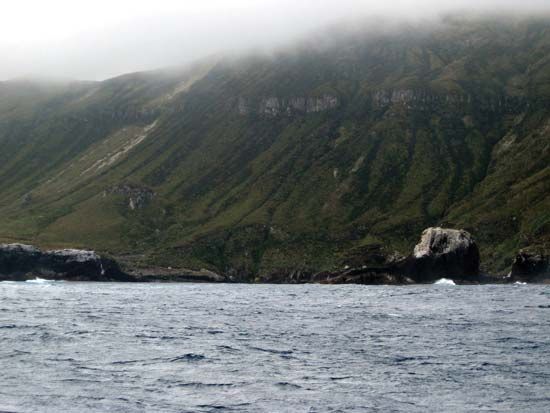
Auckland Islands
The Auckland Islands, an outlying group belonging to New Zealand, are characterized by a climate that is consistently cool, humid, and windy.
What is the climate like on the Auckland Islands?
The Auckland Islands, an outlying group belonging to New Zealand, are characterized by a climate that is consistently cool, humid, and windy.1
Located in the South Pacific Ocean, these volcanic islands experience these harsh conditions year-round, which significantly influence the local environment, including the presence of shrub forests at lower elevations and the overall quality of the soil.1
What is the history of human settlement on the Auckland Islands?
The Auckland Islands have no permanent human population and are presently uninhabited. Unlike the main islands of New Zealand, which were settled by Polynesians in the 13th century, the Auckland Islands lack a history of long-term indigenous settlement.13
European interest in the islands began after their discovery in 1806 by Abraham Bristow, who named them for William Eden, 1st Baron Auckland. Following this, a whaling station was established on the islands, but it was ultimately abandoned in 1852. Later efforts to utilize the land for agriculture, specifically the introduction of cattle and sheep in the 1890s, met with only limited success and were not sustained. Today, the islands are administered by the New Zealand commissioner for crown lands and serve primarily as a habitat for diverse bird and marine life.1
What is the geographical location of the Auckland Islands?
The Auckland Islands are an outlying island group belonging to New Zealand. They are situated in the South Pacific Ocean, approximately 290 miles (467 km) south of New Zealand’s South Island.
The group consists of six islands and several islets of volcanic origin, covering a total land area of 234 square miles (606 square km). These islands are also recognized as part of the New Zealand Subantarctic Islands, which were designated a World Heritage site in 1998.16
How were the Auckland Islands formed geologically?
The Auckland Islands are of volcanic origin, comprising a group of six islands and several islets that rise from the seafloor in the South Pacific Ocean. While the broader geological history of the New Zealand region is complex—involving hundreds of millions of years of plate tectonics, mountain-building episodes, and sedimentary deposition—the Auckland Islands specifically are characterized by their volcanic formation.18
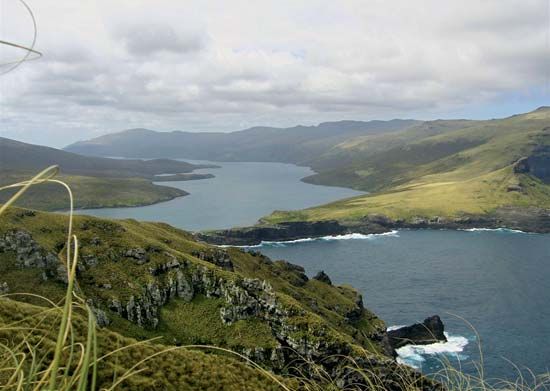
The largest island in the group, Auckland Island, rises to an elevation of approximately 2,000 feet (600 meters) and features a steep east coast marked by significant indentations, such as Carnley Harbour and Port Ross, which are remnants of the islands’ volcanic structure.1
Sources
- Auckland Islands — Encyclopædia Britannica
- New Zealand - Climate — Encyclopædia Britannica
- New Zealand - Discovery — Encyclopædia Britannica
- history of New Zealand - Discovery of New Zealand — Encyclopædia Britannica
- Pacific Ocean - Early exploration and settlement — Encyclopædia Britannica
- list of islands - New Zealand — Encyclopædia Britannica
- South Island — Encyclopædia Britannica
- New Zealand - Relief of New Zealand — Encyclopædia Britannica
Published on · 2 min read