Atafu
Atafu is a coral atoll located in Tokelau, which is a territory of New Zealand situated in the South Pacific Ocean.
What is Atafu?
Atafu is a coral atoll located in Tokelau, which is a territory of New Zealand situated in the South Pacific Ocean.1
The atoll consists of 19 islets that reach a maximum elevation of 15 feet (5 metres) and surround a lagoon measuring approximately 3 miles by 2.5 miles. First discovered by British navigator John Byron in 1765—who originally named it Duke of York Island—the atoll was later Christianized in 1858 by the London Missionary Society.1
Life on the atoll is characterized by a reliance on coconuts and marine resources for subsistence, as fresh water remains scarce despite significant rainfall. The local government is managed by a Taupulega (Council of Elders), which includes family group heads and two elected representatives. With a total area of 1.4 square miles, the atoll faces logistical challenges due to a lack of suitable anchorages for shipping.1
What are the other atolls that make up Tokelau?
Tokelau is a territory of New Zealand in the South Pacific Ocean composed of three coral atolls arranged in a southeast-to-northwest line. In addition to Atafu, the other two atolls are:2
- Nukunonu: This atoll comprises 30 islets encircling a lagoon that measures 8 miles by 7 miles. Historically named Duke of Clarence Island, it has a land area of 1.8 square miles (4.7 square km) and its inhabitants were converted to Roman Catholicism in the mid-19th century.32
- Fakaofo: Consisting of 61 islets, this atoll covers 1.5 square miles (4 square km) and surrounds a large closed lagoon. Also known historically as Bowditch Island, it serves as one of the administrative centers for the territory, managed by a local Taupulega (Council of Elders).42
Each of these atolls functions with its own administrative center, and they collectively participate in the territory’s governance through the General Fono and the Tokelau Council.2
How does the Council of Elders govern the island?
On each of the three atolls in Tokelau, local administration is managed by the Taupulega, or Council of Elders.23
The composition and function of the Taupulega include the following:
- Membership: The council is comprised of the heads of family groups residing on the atoll, along with two elected officials: the faipule (village leader) and the pulenuku (village mayor).23
- Governance Role: The Taupulega holds authority over local affairs on its respective atoll.3
- Regional Representation: The three faipule and three pulenuku from the three atolls collectively form the Tokelau Council, which manages territorial duties when the General Fono (the national legislative assembly) is not in session.3
What are the main challenges of living on a coral atoll?
Living on a coral atoll presents several significant environmental and logistical challenges due to the unique geological and geographical nature of these islands.
Water Scarcity
Because atolls are small, low-lying sandbanks, they lack rivers or streams. Residents must rely on limited freshwater sources, specifically a thin lens of rainwater that permeates the coral and sits above the heavier saltwater. This requires careful conservation through the use of wells and storage tanks.67
Environmental Vulnerability
- Instability: Atolls are low-lying, often only a few meters above sea level, making them inherently unstable. They are susceptible to damage from cyclonic storms, which can reshape the land or destroy it entirely.7
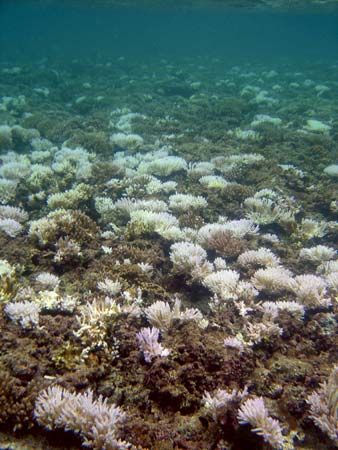
- Climate Change: Rising sea levels and increasing ocean temperatures pose an existential threat. Higher temperatures can lead to coral bleaching, which destroys the reef ecosystems that provide food and habitat for marine life.8
- Ocean Acidification: Changes in seawater chemistry can further degrade the reef structures that form the foundation of the island.8
Limited Resources and Access
The small land area restricts agricultural potential, and the passage through reefs into lagoons can be perilous, complicating transportation and trade. Despite these hardships, these islands have supported human populations for centuries through traditional seafaring and fishing skills.69107
Sources
- Atafu — Encyclopædia Britannica
- Fakaofo — Encyclopædia Britannica
- Tokelau — Encyclopædia Britannica
- Nukunonu — Encyclopædia Britannica
- Tuamotu Archipelago — Encyclopædia Britannica
- Cook Islands - Relief and drainage — Encyclopædia Britannica
- Coral bleaching — Encyclopædia Britannica
- atoll — Encyclopædia Britannica
- coral reef - Tropical water conditions — Encyclopædia Britannica
- lagoon - The effect of time — Encyclopædia Britannica
- coral reef - Biological factors — Encyclopædia Britannica
- coral island — Encyclopædia Britannica
- lagoon - Coral lagoons — Encyclopædia Britannica
Published on · 3 min read