Anticosti Island
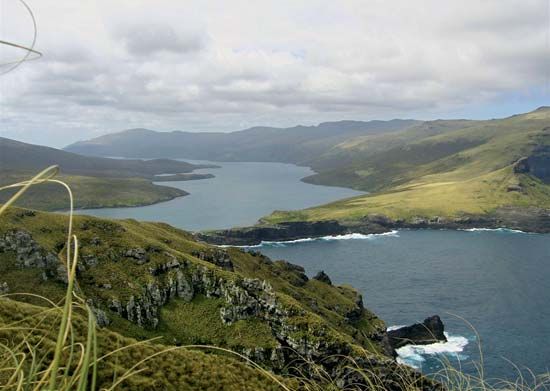
Anticosti Island, located in the Gulf of St. Lawrence, is characterized by a landscape well-forested with spruce, fir, and pine trees. While the island’s…
How has the ecosystem of Anticosti Island evolved over time, and what unique flora and fauna can be found there?
Anticosti Island, located in the Gulf of St. Lawrence, is characterized by a landscape well-forested with spruce, fir, and pine trees. While the island’s name is derived from an Indigenous word meaning “where bears are hunted,” the provided information does not detail the historical evolution of its ecosystem or provide a specific list of unique flora and fauna currently inhabiting the island.1
The island has a long history of human interest, ranging from its discovery by Jacques Cartier in 1534 to its development by French chocolate manufacturer Henri Menier in the late 19th century. Today, the island remains sparsely populated, with Port-Menier serving as its only contemporary settlement.1
What is the history of Anticosti Island, including its discovery and early settlements?
Anticosti Island, situated in the Gulf of St. Lawrence, has a history marked by early European exploration and various attempts at colonization.
Discovery and Early History
The island was discovered in 1534 by the French navigator Jacques Cartier, who named it Assomption. By the 17th century, it became known as Anticosti, a name likely derived from the Indigenous word naticosti, meaning “where bears are hunted.” In 1680, the island was granted to the French explorer Louis Jolliet. Following the Treaty of Paris in 1763, France ceded the island to Great Britain, and it was subsequently annexed to Newfoundland before becoming part of Quebec in 1774.1
Settlement and Development
Early attempts to establish permanent settlements on the island were largely unsuccessful. A significant shift occurred in 1895 when Henri Menier, a French chocolate manufacturer, leased the island to develop its resources. Baie-Sainte-Claire was established as the first permanent settlement. In 1926, ownership was transferred to a Canadian paper corporation. Today, Port-Menier (also known as Baie-Ellis) serves as the island’s only contemporary settlement and functions as a lumber port.1
Where is Anticosti Island located, and what are its geographical features?
Anticosti Island is located in the Gulf of St. Lawrence at the mouth of the St. Lawrence River, within the Côte-Nord region of southeastern Quebec, Canada.1
Geographical Features
The island spans an area of 3,047 square miles (7,892 square km) and features the following characteristics:1
- Dimensions: It measures 140 miles (225 km) in length, with a maximum width of 35 miles (56 km).1
- Topography: The terrain rises to an elevation of 625 feet (191 meters) in the form of hills along the northern coast.1
- Vegetation: The landscape is heavily forested with spruce, fir, and pine trees.1
- Navigation: Due to its location and coastal features, the island is considered a hazard to shipping.1
What role did Henri Menier play in the development of Anticosti Island?
In 1895, the French chocolate manufacturer Henri Menier leased Anticosti Island with the primary goal of developing its natural resources. His efforts were instrumental in establishing the island’s first permanent settlement, Baie-Sainte-Claire. Following his tenure, his brother Gaston transferred ownership of the island to a Canadian paper corporation in 1926, which continued the focus on industrial development, eventually leading to the establishment of the lumber port at Port-Menier (also known as Baie-Ellis).1
Sources
- Anticosti Island — Encyclopædia Britannica
- Anticosti Island — Merriam-Webster
- Jacques Cartier — Encyclopædia Britannica
Published on · 2 min read