Antigua and Barbuda
Antigua and Barbuda has a history shaped by European colonization and the development of a plantation economy. Christopher Columbus visited Antigua in 1493…
What is the history of Antigua and Barbuda, including their colonial past and independence?
Antigua and Barbuda has a history shaped by European colonization and the development of a plantation economy. Christopher Columbus visited Antigua in 1493, and the island was colonized by English settlers in 1632. While initially focused on tobacco, the economy shifted to sugar production in the late 17th century, leading to the widespread use of enslaved labor imported from West Africa.12
Barbuda was colonized in 1678 and later granted to the Codrington family. Although intended as a slave-breeding colony, the enslaved population there lived with greater self-reliance. Following the 1834 emancipation of enslaved people, the islands faced economic challenges, exacerbated by natural disasters. Barbuda eventually became a dependency of Antigua.12
In the 20th century, the islands moved toward self-governance, joining the West Indies Federation in 1958. After the federation dissolved, Antigua became an associated state of the United Kingdom in 1967. Following an independence movement in the 1970s, Antigua and Barbuda achieved full independence on November 1, 1981, becoming a constitutional monarchy within the Commonwealth.12
What are the main industries and economic activities in Antigua and Barbuda?
The economy of Antigua and Barbuda has undergone a significant transformation over time, shifting away from its historical reliance on agriculture.
Primary Economic Activities
- Tourism: This sector is currently the mainstay of the economy, having largely supplanted agriculture as the primary driver of national income.1
- Agriculture: While sugarcane was once the dominant crop on Antigua, its production is now insignificant. Current agricultural efforts focus on the cultivation of fruits and vegetables, including mangoes, citrus fruits, and eggplants.1
- Manufacturing: This sector plays a minor role in the economy. Most manufacturing activity is limited to the processing of agricultural products, the production of clothing and textiles, and the manufacturing of concrete blocks.1
Economic Context
Historically, the islands relied heavily on plantation systems, though Barbuda remained focused on fishing and subsistence farming rather than sugar production. In recent decades, the country has also gained a reputation as a tax haven. However, the economy has faced challenges, including the impact of major financial fraud, such as the Ponzi scheme operated by U.S. financier Robert Allen Stanford, which significantly affected the nation in 2009.15
Where are Antigua and Barbuda located, and what are their main geographical features?
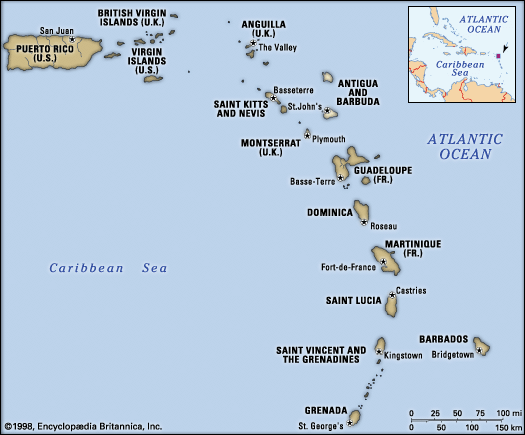
Antigua and Barbuda is an independent state located in the eastern Caribbean Sea, situated at the southern end of the Leeward Islands chain within the Lesser Antilles.6
The nation consists of two primary islands and one dependency:
- Antigua: This island is mostly low and undulating, characterized by an intricate coastline with numerous bays and reefs. Unlike other islands in the region, it lacks mountains and forests. While mostly flat, the west features volcanic rock formations, including Mount Obama, which rises to 1,330 feet (405 metres).6
- Barbuda: Located 25 miles (40 km) north of Antigua, this is a flat, well-wooded coral island. It is significantly drier than Antigua and lacks streams or lakes, with its highest point at Lindsay Hill reaching 143 feet (44 metres).6
- Redonda: A small, uninhabited rocky dependency located 25 miles (40 km) southwest of Antigua, rising sheer to 1,000 feet (305 metres).6
How does Antigua and Barbuda participate in regional and international organizations?
Antigua and Barbuda actively participates in several regional and international organizations to foster economic cooperation, political integration, and global representation. Upon achieving independence on November 1, 1981, the nation secured membership in the United Nations and the Commonwealth.17
Regional Engagement
A significant portion of the country’s international activity is focused on Caribbean integration:
- Caribbean Community (CARICOM): Antigua and Barbuda is a member of CARICOM, an organization dedicated to economic integration, the coordination of foreign policy, and development planning among member states.2
- Organization of Eastern Caribbean States (OECS): The nation joined the OECS upon its formation in 1981. This organization promotes regional cooperation and economic growth, serving as a successor to earlier collaborative frameworks like the West Indies Associated States.18
- Caribbean Court of Justice (CCJ): As a member of CARICOM, the nation utilizes the Caribbean Court of Justice, which serves as the final court of appeal and handles regional trade disputes.2
Sources
- Antigua and Barbuda — Encyclopædia Britannica
- History of Antigua and Barbuda — Encyclopædia Britannica
- slavery - Slavery in the Americas — Encyclopædia Britannica
- West Indies - Plantation slavery — Encyclopædia Britannica
- Saint Vincent and the Grenadines - Manufacturing and trade — Encyclopædia Britannica
- list of islands - Antigua and Barbuda — Encyclopædia Britannica
- Caribbean Community — Encyclopædia Britannica
- West Indies Associated States — Encyclopædia Britannica
Published on · 3 min read