Arabian Sea
The Arabian Sea features a complex marine environment shaped by its unique monsoon climate and geological activity. While the provided information does not…
What are some of the unique marine ecosystems and species found in the Arabian Sea?
The Arabian Sea features a complex marine environment shaped by its unique monsoon climate and geological activity. While the provided information does not detail specific biological species, it highlights significant ecological and physical features:
- Upwelling Zones: During the summer, pronounced upwelling of deeper, nutrient-rich waters occurs along the Somali and Arabian coasts. Near Cape al-Ḥadd, this process results in sediments with high organic content and hydrogen sulfide, creating an area known as a “fish cemetery” due to the abundance of fish remains.12
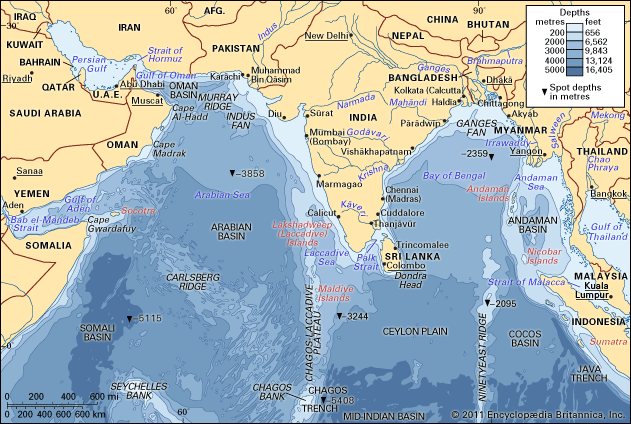
- Geological Features: The sea is divided into the Arabian Basin and the Somali Basin by the Carlsberg Ridge, a seismically active area. The region also contains the Malian subduction zone and a deep submarine canyon carved by the Indus River.2
- Coral Absence: Notably, no true coral reefs are found along the Arabian coast.2
What are the geographical boundaries and characteristics of the Arabian Sea?
The Arabian Sea is the northwestern section of the Indian Ocean, covering approximately 1,491,000 square miles (3,862,000 square km).4
Geographical Boundaries
The sea is bounded by several landmasses and bodies of water:
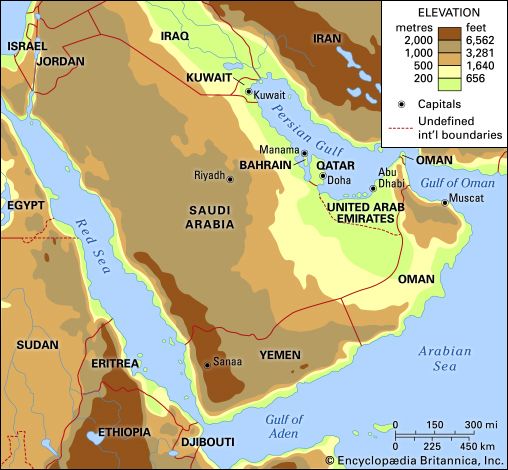
- North: Iran and Pakistan, with the Gulf of Oman providing a connection to the Persian Gulf via the Strait of Hormuz.4
- East: India* East: India.4
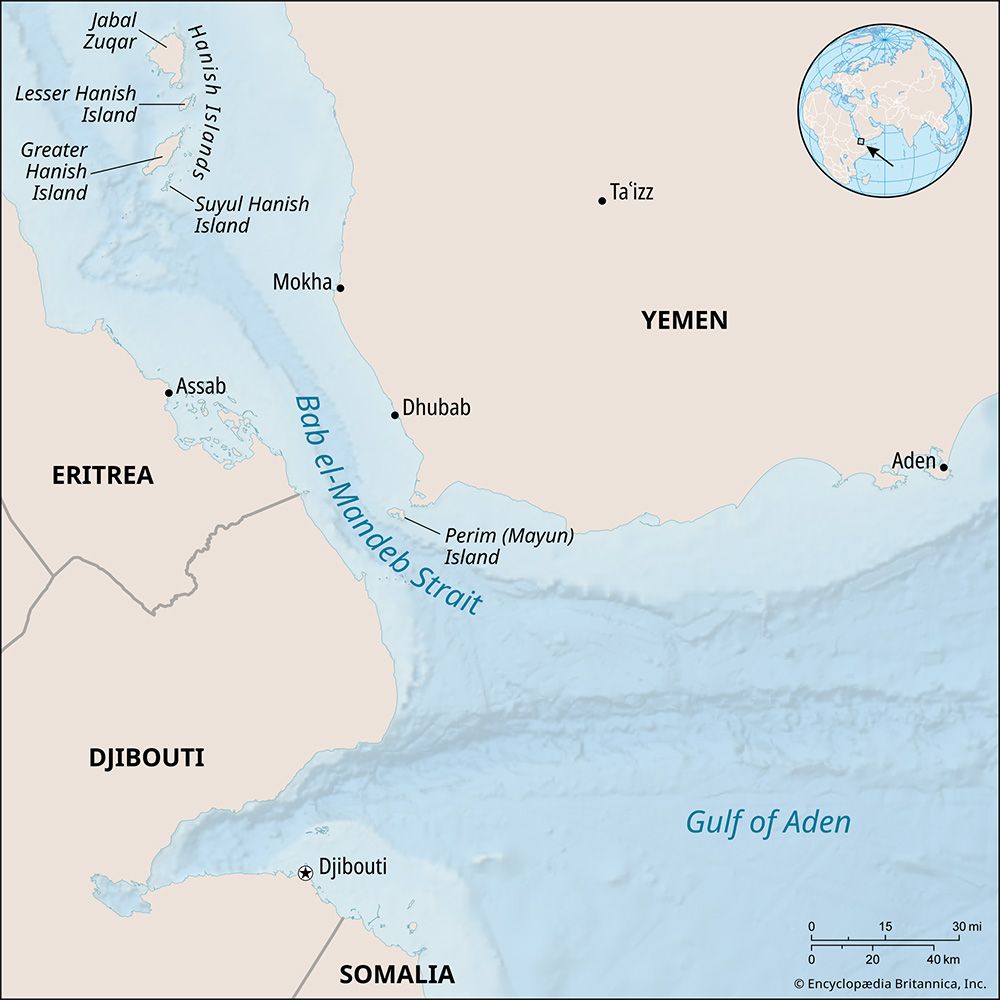
- West: The Horn of Africa and the Arabian Peninsula, with the Gulf of Aden connecting to the Red Sea via the Bab el-Mandeb Strait.4
- South: The remainder of the Indian Ocean.4
Characteristics
- Climate and Hydrology: The region experiences a monsoon climate. Seasonal winds drive a clockwise circulation system, including the Somali Current, which reverses direction based on the monsoon cycle. Evaporation generally exceeds precipitation and riverine input, leading to a net annual water loss.23
- Submarine Geology: Formed by the collision of the Indian subcontinent with Asia, the sea is divided into the Arabian Basin and the Somali Basin by the seismically active Carlsberg Ridge) by the seismically active Carlsberg Ridge. The seafloor features deep submarine canyons and extensive abyssal plains.35
How do monsoons affect the Arabian Sea and its importance to the Indian subcontinent?
The monsoon climate is the defining force of the Arabian Sea, dictating its hydrology, circulation, and historical significance to the Indian subcontinent.
Impact on the Arabian Sea
The seasonal reversal of monsoon winds drives a complex, clockwise circulation system. During the summer (April–November), the southwest monsoon triggers the Somali Current and causes pronounced upwelling along the Somali and Arabian coasts. This process brings nutrient-rich, deeper waters to the surface, which supports a rich fish life but can also lead to oxygen-depleted conditions that occasionally cause mass fish mortality. Conversely, during the winter (November–March), the northeast monsoon reverses these currents and shifts upwelling patterns, notably affecting the western coast of India.2675
Importance to the Indian Subcontinent
The discovery of these seasonal winds was transformative for the Indian subcontinent, as it enabled ships to navigate a direct course across the Arabian Sea. This facilitated extensive maritime trade between India and the West, connecting Indian ports to the Persian Gulf, the Red Sea, and the Roman Empire. Today, the sea remains vital for commercial fishing and the exploitation of petroleum and natural-gas deposits on the continental shelf.86
How does the Arabian Sea influence the climate of surrounding regions?
The Arabian Sea exerts a profound influence on the climate of surrounding regions primarily through its role in the monsoon system. This seasonal wind regime is the dominant factor governing precipitation and temperature patterns across the Arabian Peninsula and the Indian subcontinent.22
Climate Regulation and Precipitation
- Monsoon Impact: The Arabian Sea acts as a moisture source for the southwest monsoon (April to November). In regions like southern and southwestern Arabia, this monsoon can increase annual precipitation fourfold or more, providing essential water to otherwise arid landscapes.2
- Temperature Modulation: The sea’s surface temperatures fluctuate between approximately 75 °F (24 °C) in winter and over 82 °F (28 °C) in summer. These thermal variations influence the air temperature of coastal areas, while the sea’s high evaporation rates—which exceed total precipitation and riverine input—contribute to the high humidity levels observed along the coasts during summer months.92
- Upwelling Effects: During the summer, the Somali Current and associated winds drive the upwelling of deeper, cooler waters along the Somali and Arabian coasts. This process significantly lowers local surface water temperatures, which in turn moderates the climate of the immediate coastal zones.94
Sources
- Arabian Sea - Physical features — Encyclopædia Britannica
- Arabian Sea - Climate and hydrology — Encyclopædia Britannica
- Arabian Sea - Submarine morphology and geology — Encyclopædia Britannica
- Arabian Sea — Encyclopædia Britannica
- Monsoon Current — Encyclopædia Britannica
- India - Contacts with the West — Encyclopædia Britannica
- Arabian Sea - Resources — Encyclopædia Britannica
- Indian Ocean - Upwelling of the Indian Ocean — Encyclopædia Britannica
- Arabia - Climate of Arabia — Encyclopædia Britannica
- Persian Gulf - Hydrology — Encyclopædia Britannica
Published on · 4 min read