Arabia
The discovery of oil in the 20th century fundamentally transformed the Arabian Peninsula, shifting its societies from modest maritime trading and pearling…
How has the discovery of oil impacted the development of the Arabian Peninsula?
The discovery of oil in the 20th century fundamentally transformed the Arabian Peninsula, shifting its societies from modest maritime trading and pearling economies into high-income states integrated into global markets.1
This wealth enabled rapid modernization and urbanization, turning small settlements like Riyadh and Dubai into major metropolitan hubs. Governments utilized hydrocarbon revenues to finance expansive infrastructure, including airports, universities, and cultural institutions, while establishing comprehensive welfare systems. Politically, this wealth reinforced the authority of ruling families within a “rentier state” framework, where state capacity expanded through the distribution of oil income rather than domestic taxation.213
However, these changes brought significant challenges. The region became heavily dependent on foreign workers to sustain its growth, creating unique demographic structures where noncitizens often form the majority. Furthermore, rapid development has raised concerns regarding environmental sustainability, labor rights, and the need for economic diversification away from fossil fuels.21
How have trade routes historically affected the Arabian Peninsula’s importance in global commerce?
Historically, trade routes have been central to the Arabian Peninsula’s role in global commerce, acting as a vital bridge between civilizations. By the 3rd millennium BCE, the region was already integrated into the orbit of western Asian civilizations, with Bahrain serving as a thriving entrepôt between Mesopotamia, South Arabia, and India.6
The domestication of the camel in the 12th century BCE revolutionized desert travel, enabling the rise of prosperous societies like Saba. By the 6th century CE, the Quraysh of Mecca established a sophisticated network of agreements that secured caravan routes from Yemen to the Byzantine Empire and Iraq, as well as maritime routes along the coast.67
The peninsula’s strategic position between the Red Sea and the Persian Gulf facilitated long-distance trade with India, Malaysia, and China. However, this importance fluctuated; for instance, 16th-century Portuguese blockades of these maritime routes caused significant economic damage to the region. Today, the area remains a critical hub for global shipping, particularly for oil transport.891
How has the concept of Arab identity evolved in relation to the Arabian Peninsula?
The concept of Arab identity has evolved significantly, shifting from a geographic or external label to a self-defined ethnic and cultural identity deeply rooted in the Arabian Peninsula.
Historically, the term “Arab” was used by outsiders, such as the Neo-Assyrians and Greeks, to describe nomadic groups in desert regions. It was not until the 7th century CE that the term was adopted as a self-name by the political and military elites of early Islam to distinguish themselves from local converts. Over the following centuries, this identity solidified through shared history, genealogy, and the spread of the Arabic language and script.1314
In the modern era, identity has been further shaped by Pan-Arabism, a nationalist movement that emerged in the late 19th century to emphasize shared culture over religious divides. Within the Arabian Peninsula, particularly in the Gulf Arab states, this identity remains tied to Islamic religious traditions and strong tribal affiliations, even as these nations navigate rapid modernization and large expatriate populations.1315163
What are the main countries that make up the Arabian Peninsula today?
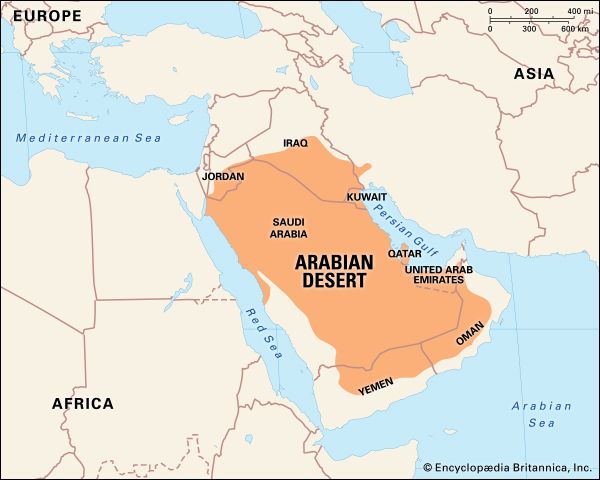
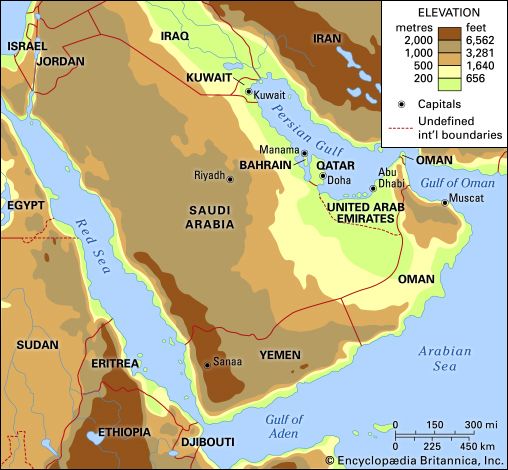
The Arabian Peninsula is home to seven sovereign countries. Listed in order of their land area, from largest to smallest, they are:
- Saudi Arabia
- Yemen
- Oman
- United Arab Emirates
- Kuwait
- Qatar
- Bahrain
These nations share a geographic environment characterized by a vast interior of desert and extensive coastlines. While they maintain distinct national identities and experiences, they are linked by a shared history, the Arabic language, and the profound influence of Islam since the 7th century. In the modern era, their economies have been significantly transformed by the development of petroleum resources and increased integration into global commerce.198
Sources
- Arabia - Economy of Arabia — Encyclopædia Britannica
- Arabia - Tribal relations — Encyclopædia Britannica
- Gulf Arab States — Encyclopædia Britannica
- history of Arabia - Arabia since 1962 — Encyclopædia Britannica
- Saudi Arabia — Encyclopædia Britannica
- history of Arabia - The Mamluks — Encyclopædia Britannica
- history of Arabia - Arabian and Islamic expansion — Encyclopædia Britannica
- Arabia — Encyclopædia Britannica
- Arabian Sea - Study and exploration — Encyclopædia Britannica
- Arabian Sea - Transportation — Encyclopædia Britannica
- Silk Road: Top Questions — Encyclopædia Britannica
- ancient Middle East - Pre-Islamic Arabia. — Encyclopædia Britannica
- Arab - Origin — Encyclopædia Britannica
- Yemen - Ethnic groups — Encyclopædia Britannica
- How was Islam founded? — Encyclopædia Britannica
- Arab - Language — Encyclopædia Britannica
- Pan-Arabism — Encyclopædia Britannica
- United Arab Emirates - Cultural life — Encyclopædia Britannica
- Saudi Arabia - Land — Encyclopædia Britannica
Published on · 3 min read