Aragon River
The Aragon River is a river located in northern Spain. It originates in the central Pyrenees mountains and flows in a generally southwestern direction until…
What is Aragon River?
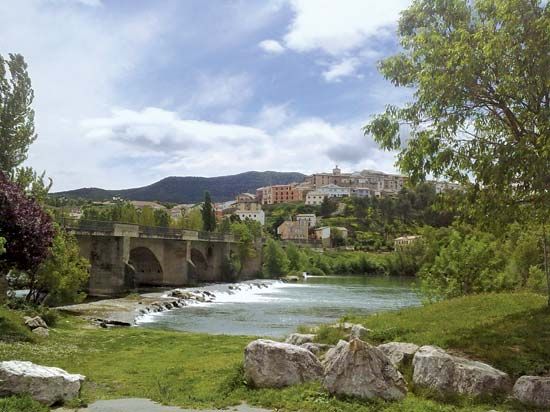
The Aragon River is a river located in northern Spain. It originates in the central Pyrenees mountains and flows in a generally southwestern direction until it joins the Ebro River in the region of Navarra.1
Spanning approximately 80 miles (129 km) in length, the river serves as a vital resource for hydroelectric power generation and regional irrigation. Its primary tributary is the Arga River.1
What are the Pyrenees mountains like?
The Pyrenees are a formidable mountain chain in southwestern Europe, stretching approximately 270 miles (430 km) from the Mediterranean Sea to the Bay of Biscay on the Atlantic Ocean. Forming a high natural wall between France and Spain, the range reaches its highest point at Aneto Peak, which stands at 11,169 feet (3,404 meters).2
Physical Characteristics and Climate
The landscape is defined by a complex structure of massifs and folded ranges, with significant variations in climate. The range acts as a climatic divide:23
- Oceanic Influence: The west experiences milder, wetter conditions, supporting broad-leaved deciduous forests.45
- Mediterranean Influence: The east and southern slopes are drier and sunnier, characterized by evergreen vegetation and continental thermal contrasts.45
- Altitudinal Zonation: Vegetation changes with elevation, transitioning from broad-leaved woods to conifers and eventually to alpine pastures.5
Human and Economic Context
The region is home to diverse peoples, including Basques, Catalans, and Andorrans. While traditionally reliant on agriculture and livestock, the economy has shifted toward hydroelectric power and a growing tourism sector, which draws visitors for skiing, hiking, and pilgrimage sites like Lourdes.67
How does the Ebro River impact Spain?
The Ebro River is a cornerstone of Spain’s geography and economy. As the country’s longest river and largest drainage basin, it is unique among major Spanish rivers for flowing into the Mediterranean Sea rather than the Atlantic.89
Economic and Agricultural Significance
The Ebro is vital for energy and agriculture. Its substantial, relatively constant flow—fed by snowmelt and rain from the Pyrenees—supports extensive hydroelectric power generation through a system of major dams. Furthermore, the river enables intensive irrigation across its arid interior basin, supporting regions like the Rioja Alta, famous for its wine production, and modern agricultural projects in the Monegros and Cinca valleys.89
Environmental Impact
The river’s heavy impoundment has significant ecological consequences. Research indicates that reduced freshwater discharge into the Mediterranean has altered the sea’s hydrological characteristics, leading to increased salinity and modified circulation patterns.10
How is hydroelectric power generated from rivers?
Hydroelectric power is generated by converting the potential energy of water into mechanical energy and, ultimately, into electricity.11
The process typically involves these steps:
- Collection: Water is stored at a higher elevation, often by constructing a dam across a river to create a reservoir.1112
- Conveyance: The water is directed downward through large pipes or tunnels known as penstocks. The vertical distance the water falls is called the head.11
- Conversion: As the water reaches the bottom, its force causes turbines to rotate. These turbines are connected to generators, which convert the mechanical rotation into electrical energy.11
- Transmission: Transformers increase the voltage of the generated electricity to make it suitable for long-distance transmission.11
While this process provides a renewable energy source, it is important to acknowledge that large-scale dams can have significant environmental and social impacts, including the disruption of fish migrations and the displacement of human communities.1112
Sources
- Aragon River — Encyclopædia Britannica
- Pyrenees — Encyclopædia Britannica
- Pyrenees - Climate of Pyrenees — Encyclopædia Britannica
- Pyrenees - Physiography — Encyclopædia Britannica
- Pyrenees - Plant and animal life — Encyclopædia Britannica
- Pyrenees - People and economy — Encyclopædia Britannica
- Midi-Pyrénées — Encyclopædia Britannica
- Ebro River — Encyclopædia Britannica
- Spain - Drainage — Encyclopædia Britannica
- Mediterranean Sea - Impact of human activity — Encyclopædia Britannica
- Did you know? — Merriam-Webster
- hydroelectric power — Encyclopædia Britannica
- turbine - Impulse turbines — Encyclopædia Britannica
- reservoir — Encyclopædia Britannica
Published on · 3 min read