Arlberg
The Arlberg is a mountain pass and tunnel located in the northern Rhaetian Alps of western Austria. Situated at an elevation of 5,882 feet (1,793 meters)…
What is Arlberg?
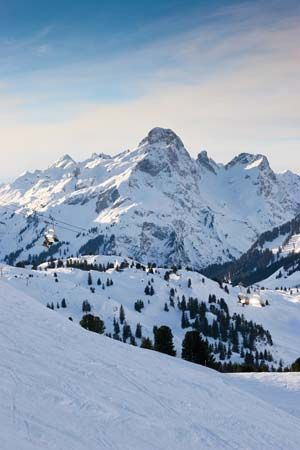
The Arlberg is a mountain pass and tunnel located in the northern Rhaetian Alps of western Austria. Situated at an elevation of 5,882 feet (1,793 meters), the pass serves as a geographic divide between the Rhine and Danube river systems.1
The region is internationally recognized as a premier winter sports destination. It is particularly famous for the development of the Arlberg technique in skiing, which was perfected by Hannes Schneider1. Infrastructure in the area includes a 6.3-mile (10.2-km) rail tunnel completed in 1884 and an 8.7-mile (14-km) road tunnel that opened in 1979, connecting the towns of Langen and Sankt Anton.1
What is the Arlberg technique in skiing?
The Arlberg technique (also known as the Arlberg method) is a foundational downhill skiing style developed by the Austrian instructor Hannes Schneider. First gaining prominence around 1935, this method revolutionized skiing by moving away from the rigid, upright posture of traditional Nordic-style skiing, which was ill-suited for steep Alpine terrain.23
Key characteristics of the technique include:
- Body Positioning: Skiers employ a pronounced crouch with their weight shifted forward on the skis to maintain better control and balance.23
- Turning Mechanics: The method utilizes a combination of turns—specifically the snowplow, stem, and stem Christiania—to navigate slopes efficiently.3
- Movement: Turns are executed by shifting the entire body in the direction of the turn, often incorporating shoulder rotation to facilitate the movement.2
By emphasizing speed and fluid turning, Schneider’s approach transformed skiing from a laborious mode of winter travel into a dynamic sport. He popularized this method globally through his famous school in St. Anton and later in the United States.3
How do mountain passes influence river systems?
Mountain passes play a critical role in shaping regional hydrology by acting as drainage divides. These high-elevation points serve as the boundaries between different drainage basins, effectively determining the direction in which precipitation flows. For instance, the Arlberg pass in Austria functions as a geographic divide that separates the Danube and Rhine river systems.
Beyond acting as simple boundaries, mountain passes and their associated ridges influence the development of river networks. In many mountainous regions, the hydrographic system consists of parallel valleys that descend from high peaks and passes, creating distinct river patterns. While some rivers are forced to follow the structural constraints of the terrain, others—particularly those that predate the uplift of the mountains—may cut through these ranges, creating deep transverse gorges. Over time, competition between adjacent river systems can lead to stream capture, where a more powerful stream diverts the flow of a weaker neighbor, further altering the landscape and the extent of the drainage basins.456
Who was Hannes Schneider and his impact on skiing?
Hannes Schneider (1890–1955) was an influential Austrian ski instructor who fundamentally transformed the sport of skiing. Recognizing that the prevailing Nordic-style technique—characterized by an erect posture and rigid knees—was ill-suited for steep Alpine terrain, he developed the revolutionary Arlberg technique.3
This method emphasized a forward-leaning crouch and utilized a combination of turns, including the snowplow, stem, and stem Christiania, to navigate slopes with greater speed and control.3
Schneider’s impact was profound:
- Innovation: He turned skiing into a dynamic sport by integrating various turning movements into a cohesive system.3
- Global Popularity: He established the internationally renowned Arlberg school in St. Anton, Austria, which became a hub for ski instruction.3
- American Influence: Following his emigration to the United States in 1938 to escape the Nazi regime, he founded a school in North Conway, New Hampshire. This institution became a primary training ground for many American ski instructors, effectively shaping the development of skiing in the U.S.3
Sources
- Arlberg — Encyclopædia Britannica
- Arlberg technique — Merriam-Webster
- Hannes Schneider — Encyclopædia Britannica
- drainage basin — Encyclopædia Britannica
- Pyrenees - Drainage — Encyclopædia Britannica
- Himalayas - Drainage of the Himalayas — Encyclopædia Britannica
- river - Rivers as agents of landscape evolution — Encyclopædia Britannica
- river - Terraces and geomorphic history — Encyclopædia Britannica
- river - Drainage diversion by stream capture — Encyclopædia Britannica
Published on · 3 min read