Askja
Askja is the largest caldera located within the Dyngjufjöll volcanic massif in east-central Iceland. Situated 20 miles north of the Vatnajökull ice field…
What is Askja?
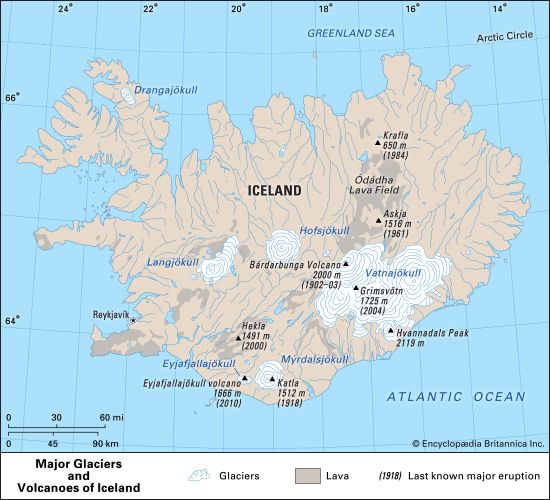
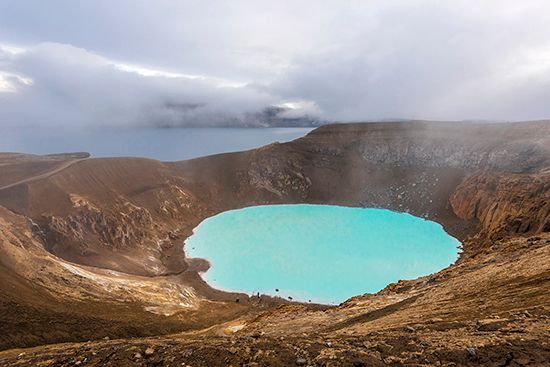
Askja is the largest caldera located within the Dyngjufjöll volcanic massif in east-central Iceland. Situated 20 miles north of the Vatnajökull ice field, the site features rugged peaks reaching elevations of 4,973 feet.1
The caldera itself contains a lake spanning 4.25 square miles and is surrounded by the Ódáðahraun, a vast lava field covering over 1,400 square miles. Historically, the volcano has experienced significant activity, with notable eruptions occurring in 1875 and 1961.1
How is a volcanic caldera formed?
A caldera is a large, bowl-shaped volcanic depression, typically exceeding one kilometer in diameter, formed primarily through the collapse of a volcanic cone or group of cones.23
Contrary to the common misconception that these features are created by the top of a mountain being blown away by an explosion, scientific studies indicate that they form when the removal of magma from an underlying reservoir leaves the ground above without support. This often occurs during voluminous eruptions of pumice and ash that rapidly empty the magma chamber, causing the summit to drop into the resulting void.23
In shield volcanoes, calderas may also form when large rift eruptions or lateral intrusions drain magma from shallow chambers. Following the collapse, the floor of the caldera may be modified by subsequent minor eruptions that build smaller cones, and the depression may eventually fill with water, as seen at Crater Lake in Oregon.342
What makes Iceland’s landscape so volcanic?
Iceland’s intense volcanic activity is primarily driven by its unique geological position atop the Mid-Atlantic Ridge, a major accreting plate boundary that separates the North American and Eurasian tectonic plates. As this boundary pulls apart, it facilitates the rise of magma from the Earth’s interior, resulting in frequent volcanic eruptions, extensive lava fields, and geothermal phenomena like geysers and hot springs.567
The island is geologically young and serves as a rare surface expression of a process that occurs mostly underwater along the global ridge system. This ongoing tectonic activity has shaped the country’s landscape, which is largely underlain by basalt—a dark igneous rock formed from ancient lava flows. With approximately 200 volcanoes of various types, Iceland remains one of the most volcanically active regions on Earth, contributing an estimated one-third of the planet’s total lava flow since 1500.576
What is the difference between a volcano and a lava field?
The terms “volcano” and “lava field” describe different aspects of volcanic activity, though they are closely related through the process of volcanism.
A volcano is defined primarily as the vent in the Earth’s crust through which molten rock, hot gases, and volcanic debris erupt to the surface. The term can also refer to the specific landform built up around that vent by the accumulation of solidified lava and debris, such as a shield volcano or a stratovolcano11.9
A lava field (or lava plateau) is a landform created by the accumulation of extensive lava flows rather than a single volcanic edifice9. These often form from fissure vents—long cracks in the crust—that allow large volumes of fluid basaltic lava to spread over a wide area. While a volcano is the source or the structure built by repeated eruptions, a lava field is the resulting broad, often thick, expanse of solidified rock.91011
Sources
- Askja — Encyclopædia Britannica
- Did you know? — Merriam-Webster
- caldera — Encyclopædia Britannica
- volcano - Calderas — Encyclopædia Britannica
- Europe - Iceland — Encyclopædia Britannica
- Iceland - Land — Encyclopædia Britannica
- Iceland - Relief — Encyclopædia Britannica
- Hekla — Encyclopædia Britannica
- volcano - Fissure vents — Encyclopædia Britannica
- volcano - Lava flows — Encyclopædia Britannica
- volcano — Encyclopædia Britannica
- volcano - Determinants of size and shape — Encyclopædia Britannica
- lava — Encyclopædia Britannica
- volcano - Other volcanic structures and features — Encyclopædia Britannica
Published on · 2 min read