Asian Brown Cloud
The Asian brown cloud is a large atmospheric brown cloud that forms annually from November through May over eastern China and southern Asia. It consists of a…
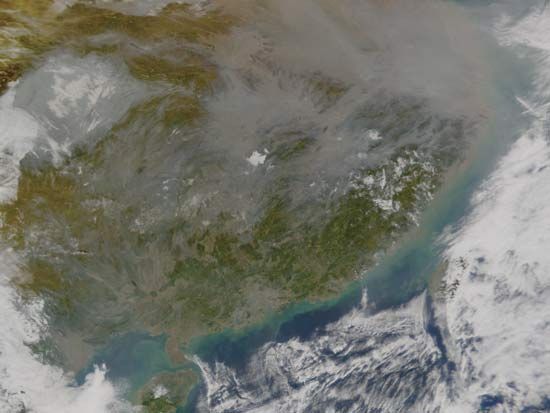
What is the Asian brown cloud and how does it form?
The Asian brown cloud is a large atmospheric brown cloud that forms annually from November through May over eastern China and southern Asia. It consists of a layer of air pollution extending up to 3 km (1.8 miles) above the surface.12
The cloud forms primarily due to the combustion of fossil fuels and biomass, which releases aerosols such as soot, dust, black carbon, and nitrogen dioxide. These particles absorb and scatter solar radiation, creating a brownish haze and causing “dimming” at the Earth’s surface. The phenomenon is exacerbated by a lengthy dry season that prevents these pollutants from being removed from the atmosphere through precipitation.12
This pollution has significant consequences, including reduced monsoon rainfall, declines in agricultural production, and serious risks to human health, such as respiratory and cardiovascular issues.12
How do seasonal weather patterns influence the intensity of the Asian brown cloud?
The intensity of the Asian brown cloud is heavily dictated by seasonal weather patterns, specifically the presence of a lengthy dry season that occurs annually from November through May.12
During this period, the lack of significant precipitation prevents the atmosphere from effectively cleansing itself of pollutants. Because rain is a primary mechanism for removing aerosols—such as soot, dust, and black carbon—from the air, the dry conditions allow these particles to accumulate and persist in a layer extending up to 3 km (1.8 miles) above the surface.2
Conversely, the arrival of the monsoon season typically alters these conditions. The accumulation of these aerosols has been linked to significant shifts in regional climate, including a reduction in summer monsoon rainfall in India and a southward shift of the monsoon in eastern China, which further complicates the cycle of pollution and weather interaction.12
How does the Asian brown cloud affect climate and weather patterns in the region?
The Asian brown cloud significantly alters regional climate and weather patterns through its impact on solar radiation and the hydrological cycle. By absorbing and scattering sunlight, the cloud’s aerosols—such as black carbon and dust—reduce the amount of solar energy reaching the Earth’s surface, a phenomenon known as “dimming.”21
This reduction in surface solar radiation leads to lower surface temperatures, which slows the rate of evaporation. Consequently, the amount of precipitable water in the atmosphere decreases, disrupting regional weather patterns. Specifically, the Asian brown cloud has been linked to a significant reduction in summer monsoon rainfall in India since 1930 and a southward shift of the summer monsoon in eastern China.21
These climatic shifts have profound consequences, including reduced agricultural yields—such as significant losses in rice production—and increased risks to human health due to the presence of hazardous pollutants like ozone and particulate matter.21
How does the Asian brown cloud impact human health and agriculture in affected areas?
The Asian brown cloud poses significant risks to both human health and agricultural productivity in the regions it affects.
Impact on Human Health
The cloud contains hazardous pollutants, including ozone and particulate matter such as soot and dust. Epidemiological studies have linked exposure to these particles to serious health issues, including:
- Respiratory conditions: Ozone irritates lung tissue, reduces lung function, and exacerbates asthma.
- Cardiovascular problems: Fine particulate matter is associated with increased cardiovascular disease and higher mortality rates.21
Impact on Agriculture
The cloud influences regional climate by causing “dimming,” where aerosols scatter and absorb solar radiation, reducing the sunlight reaching the Earth’s surface. This leads to lower surface temperatures and reduced evaporation, which disrupts the hydrological cycle and alters monsoon rainfall patterns. These changes negatively affect crop yields:
- Reduced Output: Changes in precipitation and climate have been linked to significant declines in agricultural production. For instance, one study estimated that air pollution related to the Asian brown cloud reduced Indian rice output by 6.2 million metric tons between 1985 and 1998.
- Ozone Damage: Beyond climate shifts, the presence of ozone itself is known to directly reduce crop yields.21
Sources
- Asian brown cloud — Encyclopædia Britannica
- Atmospheric brown cloud — Encyclopædia Britannica
Published on · 3 min read