Little Ice Age
The Little Ice Age (LIA) was a period of climatic cooling and increased environmental variability that occurred from the early 14th century through the…

What is the Little Ice Age, and when did it occur?
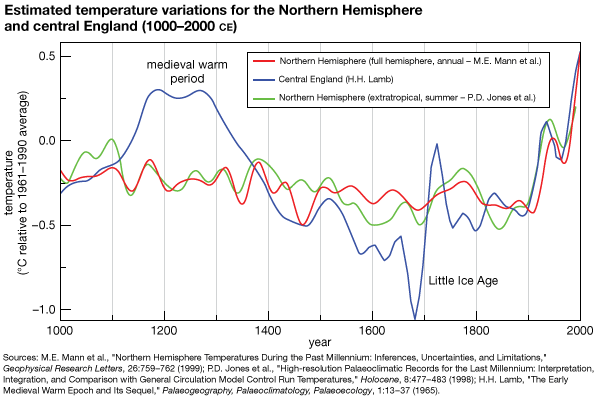
The Little Ice Age (LIA) was a period of climatic cooling and increased environmental variability that occurred from the early 14th century through the mid-19th century (roughly 1300–1850 CE).12
While the term is often associated with cold temperatures, it is more accurately characterized as a time of significant shifts in climate and precipitation patterns globally. During this interval, mountain glaciers expanded in regions such as the European Alps, Alaska, New Zealand, and the southern Andes, and mean annual temperatures in the Northern Hemisphere declined by approximately 0.6 °C (1.1 °F).12
The phenomenon was not a uniform global deep freeze; regional temperature drops were inconsistent, and some areas experienced stable temperatures or severe droughts instead. Climatologists suggest the LIA was likely driven by a combination of reduced solar output, changes in atmospheric circulation—specifically the North Atlantic Oscillation—and increased volcanism.12
How did the Little Ice Age affect different regions of the world?
The Little Ice Age (LIA) was not a uniform global event; rather, it was a period of increased climatic variability that affected regions differently between the 14th and 19th centuries.14
Regional Impacts
- Europe and the North Atlantic: This region experienced some of the most documented effects. Northern and central Europe faced frequent cold winters and cool, wet summers, leading to widespread crop failures and famines. Alpine glaciers expanded, destroying farms and villages. In the North Atlantic, increased pack ice and storminess isolated Norse colonies in Greenland, leading to the collapse of the western colony and the abandonment of the eastern one.15
- North America: Between 1250 and 1500, parts of the upper Mississippi valley and western prairies experienced significant drying, which prompted a shift in Native American cultures from agriculture to hunting.1
- Asia: Japan saw glacier advancement, a drop in mean winter temperatures of 3.5 °C (6.3 °F), and excessive rains that resulted in poor harvests. Conversely, temperatures in eastern China remained relatively stable throughout the period.14
- Other Regions: While some areas experienced cooling, others faced multiyear droughts, such as parts of equatorial Africa, Central and South Asia, and southern Europe.14
What were the potential causes of the Little Ice Age?
The exact cause of the Little Ice Age remains a subject of scientific study, but researchers generally agree that it resulted from a combination of natural factors rather than a single event. The primary drivers identified by climatologists include:
- Variability in Solar Output: During the Little Ice Age, the Earth experienced periods of unusually low sunspot activity, such as the Spörer Minimum and the Maunder Minimum. These periods of reduced solar activity resulted in less energy reaching the Earth’s surface, which likely contributed to cooling, particularly in parts of Europe.16
- Changes in Atmospheric Circulation: Many scientists point to the North Atlantic Oscillation (NAO) as a major factor. A shift toward a persistent “negative mode” of the NAO is thought to have altered storm tracks and wind patterns, drawing cold Arctic air into northern Europe and contributing to the region’s climatic variability.136
- Increased Volcanism: Explosive volcanic eruptions, such as those of Laki and Tambora, injected ash and gases into the stratosphere. These particles reflected incoming solar radiation, leading to temporary but significant global cooling.16
How does the study of the Little Ice Age help us understand current climate change?
Studying the Little Ice Age (LIA) is essential for understanding current climate change because it provides a critical baseline for natural climate variability. By analyzing this period, scientists can better distinguish between natural shifts and the anthropogenic (human-caused) warming observed over the last two centuries.17
Key insights gained from studying the LIA include:
- Model Validation: Climate researchers use the LIA to test the accuracy of theoretical climate models. Because models have successfully reproduced the magnitude and spatial patterns of cooling that occurred between 1400 and 1850, scientists have greater confidence in their ability to predict future climate responses to radiative forcing.7
- Understanding Natural Forcing: The LIA demonstrates how natural factors—such as reduced solar output and volcanic activity—can drive significant regional and global temperature changes. This helps researchers isolate these natural variables when assessing the impact of modern greenhouse gas emissions.871
- Proxy Data Calibration: Because historical weather records are limited, the LIA serves as a testing ground for proxy records (such as ice cores and tree rings). Calibrating these proxies against known historical events allows scientists to reconstruct climate history with greater precision, providing the context needed to confirm that recent warming is unprecedented in the last 1,000 years.83
Sources
- Little Ice Age — Encyclopædia Britannica
- Little Ice Age — Merriam-Webster
- What Was the Little Ice Age? — Encyclopædia Britannica
- North America - The North American Indian heritage — Encyclopædia Britannica
- Climate change - Centennial-scale variation — Encyclopædia Britannica
- North Atlantic Oscillation — Encyclopædia Britannica
- Global warming - Climatic variation since the last glaciation — Encyclopædia Britannica
- Holocene Epoch - “ Medieval ” Cool Period — Encyclopædia Britannica
- Global warming - Theoretical climate models — Encyclopædia Britannica
- Global warming - Prehistorical climate records — Encyclopædia Britannica
Published on · 3 min read