How Do Clouds Form?
Cloud formation is a fundamental process of the water cycle that occurs when moist air ascends into the atmosphere. As this air rises, it encounters lower…
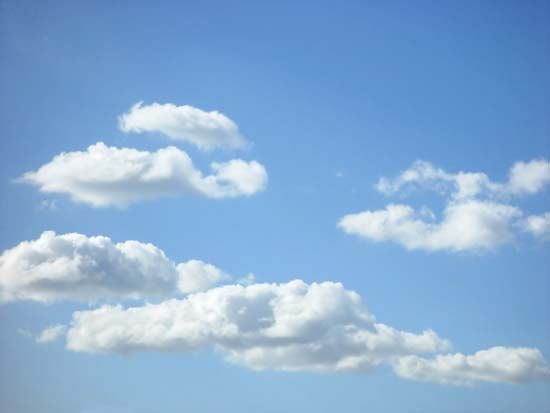
How do clouds form?
Cloud formation is a fundamental process of the water cycle that occurs when moist air ascends into the atmosphere. As this air rises, it encounters lower pressure, causing it to expand and cool.1
This cooling is essential because it brings the air temperature down to the dew point, the temperature at which the air becomes saturated with water vapor. Once saturated, the water vapor begins to condense into tiny liquid droplets or ice crystals. This transition typically requires condensation nuclei—microscopic particles such as dust, salt, or other aerosols—which provide a surface for the vapor to collect upon.123
As the air continues to rise and cool, more vapor condenses, increasing the size and density of the cloud. The specific type of cloud that forms depends on atmospheric conditions like temperature and humidity, which dictate whether the cloud is composed of water droplets, ice crystals, or a mixture of both.1
What is the difference between cirrus, stratus, and cumulus clouds?
Clouds are categorized by their appearance, altitude, and the processes that form them. Here are the primary differences between cirrus, stratus, and cumulus clouds:
Cloud Type
Characteristics
Altitude
Cirrus
Thin, wispy formations composed primarily of
ice
crystals due to the cold temperatures at high altitudes.
High (above 5 km / 3 miles)
Stratus
A broad, uniform “layer” of gray cloud that often covers the sky, frequently resulting in foggy or overcast conditions.
Low (below 2 km / 1 mile)
Cumulus
Puffy, “heaped” formations with a bubbly or turreted appearance, typically associated with fair weather but capable of developing into storm clouds.
Low (below 2 km / 1 mile)
While stratus clouds form when air is mechanically forced upward in a stable layer, cumulus clouds develop through turbulent, upward-moving air parcels. Cirrus clouds represent the high-altitude, wispy end of the spectrum, often signaling different atmospheric conditions than the lower-level, denser stratus or the vertically developed cumulus.14
How does the water cycle contribute to global weather patterns?
The water cycle is a primary driver of global weather patterns, as it continuously circulates moisture and energy throughout the Earth-atmosphere system6.
Atmospheric Moisture and Energy
Water vapor acts as a critical component of Earth’s radiation balance, keeping the surface warmer than it would otherwise be. Because the atmosphere’s capacity to hold water vapor is strongly dependent on temperature, the cycle is highly sensitive to thermal changes. When water vapor condenses into clouds, it releases latent heat, which provides a significant fraction of the energy required to drive global atmospheric circulation.367
Drivers of Weather Patterns
- Evaporation and Transport: The oceans serve as the primary source of atmospheric moisture. Horizontal winds and air mass movements transfer this water vapor from oceans to land, where it may eventually condense and fall as precipitation.839
- Global Circulation: Precipitation and evaporation vary by latitude and are closely linked to global wind belts. For example, trade winds pick up moisture and release it as clouds and rain near the Equator, where rising air facilitates condensation.9
- Climate Anomalies: Interactions between ocean surface temperatures and the atmosphere can create long-term climate patterns, such as the El Niño/Southern Oscillation (ENSO). Small changes in sea surface temperature can significantly alter evaporation rates, influencing storm tracks and regional weather.7
Impact of Global Warming
Global warming is intensifying these processes. As air temperatures rise, the atmosphere’s ability to hold moisture increases, leading to more extreme weather events, including more intense hurricanes, increased flooding in some regions, and more severe droughts in others.106
What happens to water droplets when they become too heavy to stay in the air?
When water droplets within a cloud grow large enough that their weight overcomes the upward air currents sustaining them, they begin to fall toward the ground as precipitation.1112
This transition from a small cloud droplet to a falling precipitation particle occurs primarily through two mechanisms:
- Collision and Coalescence: Droplets are rarely uniform in size. Larger droplets fall faster than smaller ones, colliding and fusing—or coalescing—with the smaller droplets they overtake in their path. This process is common in warmer clouds, such as those in tropical regions, where temperatures remain above freezing.1112
- Cold-Cloud Processes: In clouds where temperatures drop below 0 °C (32 °F), ice crystals form and grow rapidly by absorbing water vapor at the expense of surrounding supercooled liquid droplets. These crystals may grow into snowflakes through aggregation or develop into graupel and hail through riming. As these frozen particles fall into warmer air, they typically melt to become rain.1113
Once these particles reach a sufficient size, they possess enough mass and terminal velocity to survive the journey through the unsaturated air beneath the cloud to reach the Earth’s surface.1112
Sources
- How do clouds form? — Encyclopædia Britannica
- Condensation nucleus — Encyclopædia Britannica
- hydrosphere - Water vapour and precipitation — Encyclopædia Britannica
- What Does a stratocumulus Cloud Look Like? — Merriam-Webster
- Atmosphere - Cloud formation within the troposphere — Encyclopædia Britannica
- Water cycle — Encyclopædia Britannica
- Climate - The ocean surface and climate anomalies — Encyclopædia Britannica
- natural disaster - Frequency and disaster patterns — Encyclopædia Britannica
- Flash flood — Encyclopædia Britannica
- hydrosphere - General nature of the cycle — Encyclopædia Britannica
- Climate - Mechanisms of precipitation release — Encyclopædia Britannica
- Atmosphere - Precipitation of ice — Encyclopædia Britannica
- Precipitation — Encyclopædia Britannica
- Climate - Rain and freezing rain — Encyclopædia Britannica
Published on · 4 min read