Australian Region
The Australian region is one of the world’s six major land areas defined by its unique animal life. It encompasses Australia, Tasmania, New Guinea, New…
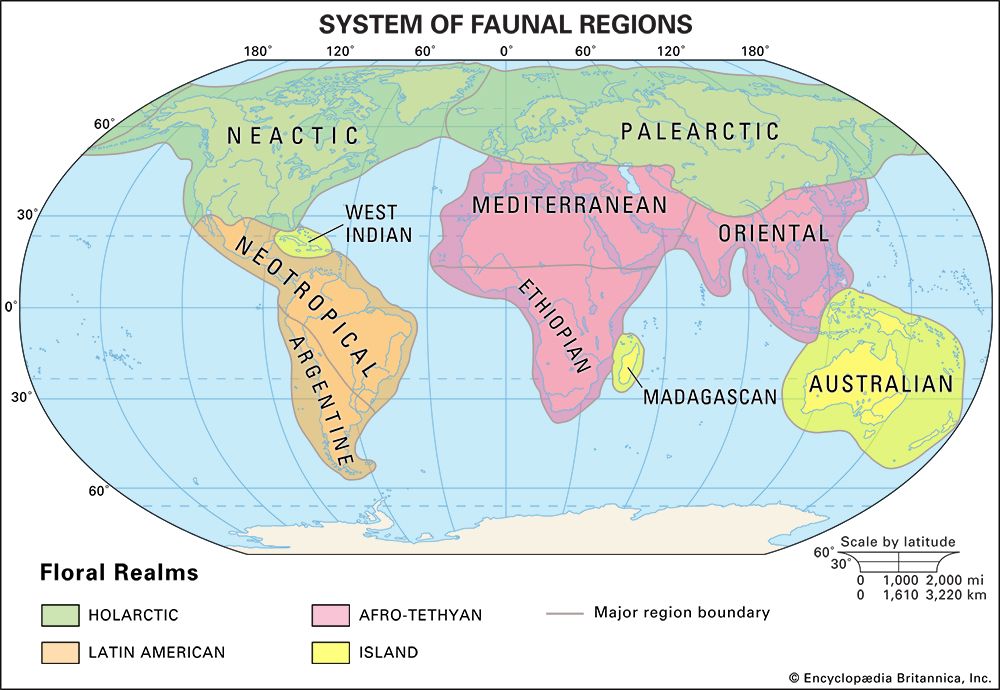
What is Australian region?
The Australian region is one of the world’s six major land areas defined by its unique animal life. It encompasses Australia, Tasmania, New Guinea, New Zealand, New Caledonia, and the islands of Melanesia, Micronesia, and Polynesia.1
This region is characterized by a high concentration of pouched mammals, such as kangaroos, as well as unique species like the duck-billed platypus and spiny anteaters. Its flora, often referred to as the Australian kingdom, is notable for eucalypti, acacias, myrtles, and casuarinas.1
The boundary between the Australian region and the Oriental region has historically been a subject of scientific debate. The Wallace Line was proposed as a demarcation point based on the distinct differences in fauna found on either side of the line. While some zoogeographers now question the utility of this specific boundary, it remains a significant concept in understanding the distribution of major animal groups.23
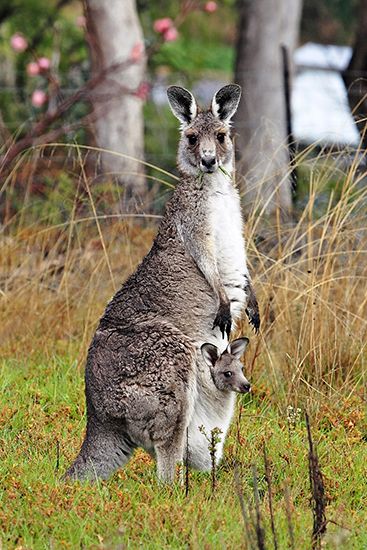
What makes marsupials different from other mammals?
Marsupials are distinguished from other mammals, particularly placental mammals, primarily by their unique reproductive strategy and brain structure.6
Reproductive Differences
Unlike placental mammals, which nourish their young through a complex placenta within the womb, marsupials give birth to young in a highly vulnerable, embryonic state after a very short gestation period (ranging from about 8 to 40 days). Following birth, the young must migrate to the mother’s lower belly to attach to her teats for continued development. While many species possess a marsupium—a flap of skin or pouch that protects the young—this is not universal; some species have exposed nipples or only remnants of a pouch. Once attached, the young may remain fastened to the teat for weeks or months until they are sufficiently developed to survive independently.67
Anatomical and Behavioral Distinctions
- Brain Structure: Marsupial brains are generally smaller relative to body size and lack a corpus callosum, the structure that connects the two cerebral hemispheres in placental mammals.6
- Vocalizations: Marsupials typically exhibit more limited vocal abilities compared to placentals, rarely emitting loud sounds of distress or contentment.6
- Social Organization: Most marsupials lack complex, permanent social structures, with the exception of some species like the lesser gliders.6
Why is the Wallace Line important for understanding animal distribution?
The Wallace Line is a significant concept in biogeography that serves as a boundary between the Oriental and Australian faunal regions. Proposed by the 19th-century naturalist Alfred Russel Wallace, the line extends from the Indian Ocean through the Lombok and Makassar straits, continuing eastward south of Mindanao.2
Its importance lies in its role as an abrupt limit of distribution for many major animal groups. The line highlights a striking biological divide where numerous species of fish, birds, and mammals are abundantly represented on one side but are either poorly represented or entirely absent on the other. While modern zoogeographers may debate its status as a definitive regional boundary, the Wallace Line remains a foundational element in understanding how species are distributed across the Malay Archipelago and provides crucial evidence for evolutionary theories regarding the dispersal of life.29
What are some examples of endemic plants in the Australian region?
Australia’s flora is characterized by a high degree of endemism, with many species having evolved in isolation over millions of years. These plants often exhibit specialized adaptations, such as sclerophylly (hard leaves), to survive in the continent’s unique, nutrient-poor soils.11
Key examples of endemic Australian plant groups and species include:
- Proteaceae Family: This family includes the iconic genera Banksia and Hakea, which are distinctive features of the Australian landscape.11
- Myrtaceae Family: The genus Eucalyptus is perhaps the most recognizable, with over 400 species ranging from small mallees to massive forest giants. The subfamily Leptospermoideae is also a notable Australian development within this family.11
- Xanthorrhoeaceae: This family includes the unique grass trees and blackboys.11
- Haemodoraceae: This family is well-known for the kangaroo paws, which are endemic to the region.11
- Wollemi Pine (Wollemia nobilis): Discovered in 1994, this is one of the world’s oldest and rarest tree species, found in a limited area northwest of Sydney.3
Additionally, Western Australia is a significant biodiversity hotspot where approximately one-third of its 10,000 vascular plant species are endemic to the state.2
Sources
- Australian region — Encyclopædia Britannica
- Wallace Line — Encyclopædia Britannica
- Western Australia - Plant and animal life — Encyclopædia Britannica
- biogeographic region - Australian region — Encyclopædia Britannica
- biogeographic region - Oriental region — Encyclopædia Britannica
- marsupial — Encyclopædia Britannica
- marsupial - Paleontology and recent history — Encyclopædia Britannica
- mammal - Estrus and other cycles — Encyclopædia Britannica
- Alfred Russel Wallace - The career of a naturalist — Encyclopædia Britannica
- biogeographic region - Wallacea — Encyclopædia Britannica
- Australia - Plant life — Encyclopædia Britannica
- endemic species — Encyclopædia Britannica
- New South Wales - Plant and animal life — Encyclopædia Britannica
Published on · 3 min read