Bangweulu
Lake Bangweulu is a shallow lake in northeastern Zambia that, together with its extensive associated swamplands, covers a triangular area of approximately…
How does the size of Lake Bangweulu compare to other lakes in Africa?
Lake Bangweulu is a shallow lake in northeastern Zambia that, together with its extensive associated swamplands, covers a triangular area of approximately 3,800 square miles (9,800 square km).1
When compared to the major lakes of the East African Rift System, Bangweulu’s total area is larger than several of the region’s prominent bodies of water, such as Lake Turkana (2,473 square miles), Lake Albert (2,160 square miles), and Lake Kivu (1,040 square miles). However, it remains significantly smaller than the largest African lakes, such as Lake Victoria, which spans 26,828 square miles, Lake Tanganyika (12,700 square miles), and Lake Nyasa (11,430 square miles).2
It is important to note that Bangweulu is characterized by its shallow nature and vast surrounding wetlands, which distinguish its geography from the deeper, rift-valley lakes.12
What is the ecological importance of Lake Bangweulu and its surrounding wetlands?
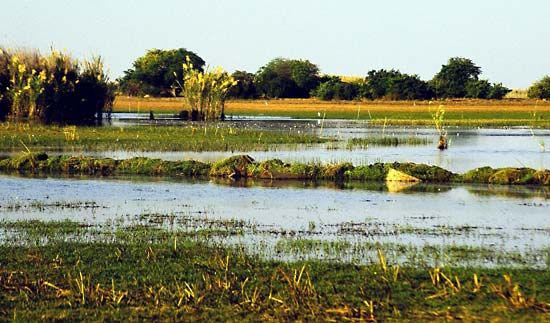
Lake Bangweulu and its associated swamplands are of significant ecological importance as a vital component of the Congo River system. The wetlands function as a natural regulator for the Chambeshi River, acting as a check against annual flooding by capturing excess water and releasing it slowly through a complex network of channels and lagoons before it emerges as the Luapula River.1
The area supports a diverse range of vegetation that defines its unique habitat:
- Water Reeds: Phragmites communis grows just above the mean water level.1
- Papyrus: A distinct zone of papyrus thrives at the water level.1
- Hippo-grass: This floating grass occupies deeper water sections.1
Beyond its hydrological role, the region is a hub for biodiversity. The open grasslands characteristic of these floodplains provide essential habitats for various wildlife, including numerous bird species and mammals. The lake itself is a productive fishery, supporting local livelihoods by providing resources that are processed and exported to nearby regions. Furthermore, the area is known for specific flora, such as the Mukwa (Pterocarpus angolensis), which is valued for its timber.41
Where exactly is Lake Bangweulu located in Zambia, and what are its main geographical features?
Lake Bangweulu is located in northeastern Zambia at an elevation of 3,740 feet (1,140 m). It serves as a key part of the Congo River system.1
Geographical Features
- Dimensions and Area: The lake and its surrounding swamplands cover a triangular area of approximately 3,800 square miles (9,800 square km). The lake itself occupies the northwest corner of this triangle and measures 45 miles (72 km) long by 24 miles (38 km) wide.1
- Hydrology: The lake is fed by the Chambeshi River. The extensive swamplands act as a natural flood-control mechanism, capturing seasonal floodwaters and releasing them slowly through a network of channels and lagoons to form the Luapula River.1
- Topography: The region is characterized by low gradients and significant vegetation, including water reeds (Phragmites communis), papyrus, and floating hippo-grass. The area contains three inhabited islands within the lake and numerous low islands throughout the swamps.1
What is the cultural significance of Lake Bangweulu to the people of Zambia?
The provided search results do not contain information regarding the specific cultural significance of Lake Bangweulu to the people of Zambia. While the lake is noted for its role in supporting local livelihoods through a productive fishery—with products being exported to the copper-mining belt—and as the site where the explorer Dr. David Livingstone died in 1873, the available data does not detail its broader cultural or traditional importance to the local population.1
Sources
- Bangweulu — Encyclopædia Britannica
- East African lakes — Encyclopædia Britannica
- Lake Mweru — Encyclopædia Britannica
- Zambia - Plant and animal life — Encyclopædia Britannica
- Congo River - Physiography — Encyclopædia Britannica
- Bangweulu, Lake — Merriam-Webster
- Luapula River — Encyclopædia Britannica
Published on · 3 min read