Barred Owl
The barred owl (Strix varia) is a large, nonmigratory bird of prey native to North America, ranging from southern Canada through the eastern United States…
What is a barred owl?
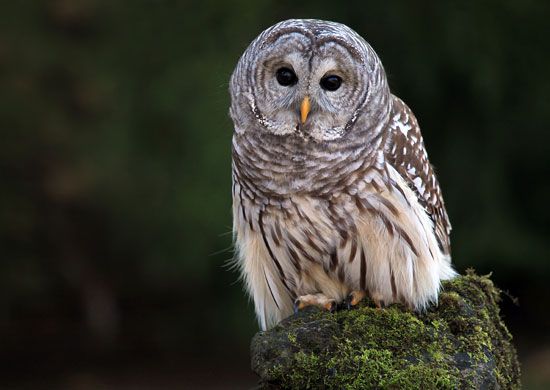
The barred owl (Strix varia) is a large, nonmigratory bird of prey native to North America, ranging from southern Canada through the eastern United States, the Pacific Northwest, and into Mexico. Named for the distinctive brown-and-white barred pattern on its feathers, this species is one of the most common owls in North America.12
Adults typically reach 48 to 51 cm in length and are characterized by a large head, white facial disks, and dark brown eyes. Unlike many other owls, they lack “ear” tufts. They are primarily nocturnal but may hunt during the day, particularly in winter or on overcast days. Their diet is diverse, consisting of small mammals, birds, fish, reptiles, and amphibians, which they often swallow whole before regurgitating indigestible pellets.12
Barred owls are monogamous and typically nest in tree hollows. The species is currently classified as of least concern by the IUCN, with a global population estimated at 3.5 million.1
What does a barred owl look like?
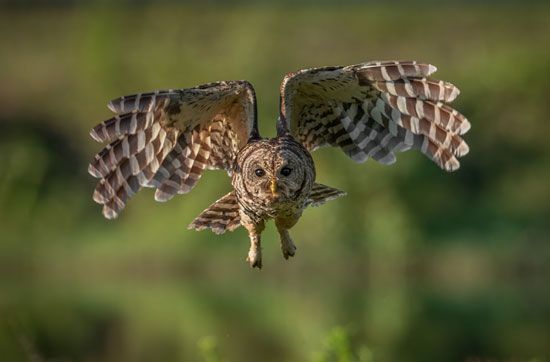
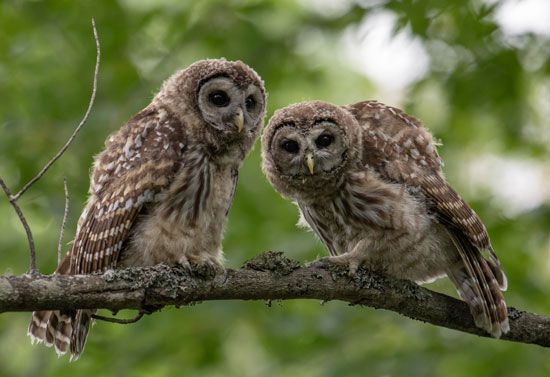
The barred owl (Strix varia) is a large bird of prey easily identified by its distinctive brown-and-white barred feather pattern, from which it derives its common name.23
Physically, these owls reach a body length of approximately 48 to 51 cm (18 to 20 inches) with a wingspan ranging from 107 to 111 cm (42 to 44 inches). They possess a large, rounded head featuring prominent white facial disks and dark brown eyes. Unlike many other owl species, the barred owl lacks “ear” tufts.23
In terms of sexual dimorphism, females are generally larger and bulkier than males, weighing up to 800 grams (28.2 ounces) compared to the males’ average of roughly 630 grams (22.2 ounces). Their appearance is further characterized by a hooked beak and sharp talons, which are essential for hunting their diverse diet of small mammals, birds, and amphibians.2
Where do barred owls live?
Barred owls (Strix varia) are widely distributed across North America, where they are considered one of the most common owl species. Their extensive range includes:2
- Eastern North America: They are prevalent throughout the eastern United States.23
- Canada: They inhabit temperate regions across the country.23
- Pacific Northwest and California: They have established populations in these western regions.23
- Mexico: Their range extends into southern and central parts of the country.23
Barred owls are largely nonmigratory, meaning they typically remain in their established breeding habitat year-round. They are highly adaptable and thrive in a variety of environments, ranging from natural woodlands and forests to human-dominated landscapes. They generally prefer to nest in large tree hollows, though they may occasionally utilize the abandoned nests of other birds or squirrels, and in some instances, they have been known to nest on the ground.2
What do barred owls eat?
Barred owls are opportunistic predators that consume a wide variety of animals. Their diet includes:
- Small mammals: Such as mice, rabbits, and voles.2
- Birds: Including doves and pigeons.2
- Other prey: They also hunt fish, reptiles, amphibians, and various invertebrates.2
These owls typically spot their prey from perches in trees or while flying low through the woods. They use their sharp talons and hooked beaks to capture their food, often swallowing smaller prey whole. Afterward, they regurgitate indigestible materials, such as bones and fur, in the form of pellets.2
Sources
- barred owl — Merriam-Webster
- barred owl — Encyclopædia Britannica
- wood owl — Encyclopædia Britannica
Published on · 3 min read