Amphibian
Amphibians have existed on Earth for approximately 340 million years, first appearing during the Middle Mississippian Epoch. They represent one of the…

How long have amphibians existed on Earth, and how have they evolved?
Amphibians have existed on Earth for approximately 340 million years, first appearing during the Middle Mississippian Epoch1. They represent one of the earliest groups to diverge from ancestral fish-tetrapod stock as animals transitioned from strictly aquatic environments to terrestrial ones.1
Evolutionary Transition
The evolution of amphibians from sarcopterygian (lobe-finned) fishes involved significant anatomical changes over 80 million years. Key developments included:2
- Respiration: The transition from passive buccal (mouth-cavity) ventilation to a muscle-driven buccal pump, alongside the use of lungs for aerial respiration.2
- Locomotion: The transformation of fins into limbs with joints (knees, elbows, ankles, and wrists) to support body weight and provide propulsion on land.2
- Structural Support: The pelvic girdle became firmly anchored to the vertebral column, and the pectoral girdle detached from the skull to allow for a flexible neck.2
- Sensory and Skin Adaptations: Skin became more resistant to desiccation through keratinous tissues, and sense organs adapted for an aerial medium, including the development of sound reception and dual-channel nasal chambers.2
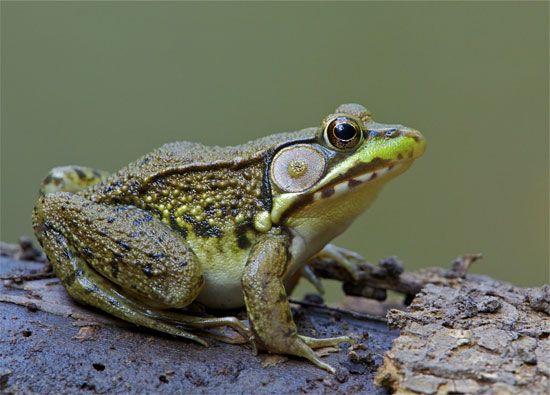
How have amphibians adapted to live both in water and on land?
Amphibians are uniquely adapted to exploit both aquatic and terrestrial habitats through a “double life” strategy, which involves specialized physiological and developmental mechanisms.3
Physiological Adaptations
- Cutaneous Respiration: Amphibians possess a moist integument equipped with a dense network of capillaries. This allows for gas exchange and the diffusion of water and ions directly through the skin, supporting respiration alongside branchial or pulmonary strategies.13
- Buccal Pump: To facilitate breathing, they utilize a buccal pump mechanism, which involves using the mouth to push air into the lungs.1
- Sensory Systems: Their eyes are adapted for terrestrial life with lids, glands, and color vision, while their auditory systems include the papilla amphibiorum for low-frequency sounds and a columella-opercular complex to detect both airborne and seismic signals.1
Developmental Adaptations
Many amphibians undergo metamorphosis, a process where they begin life as aquatic larvae and transition to an adult body plan suited for land. However, they exhibit diverse reproductive strategies; while many are obligate breeders in water, others have evolved to carry eggs on their backs, within the oviduct, or even in the stomach to protect their young.3

How do amphibians reproduce and undergo metamorphosis?
Amphibians exhibit a remarkable diversity of reproductive strategies, reflecting more evolutionary experimentation than any other vertebrate group. While many species are obligate breeders that lay gelatinous eggs in water, others have evolved direct development, where the larval stage is bypassed and juveniles hatch as miniature adults. Some species even exhibit viviparity, giving birth to live young, or carry eggs on their backs or within their bodies.45
Metamorphosis
For species with a larval stage, metamorphosis is the critical process of transforming from an aquatic larva into a terrestrial adult. This transition is controlled by hormones from the thyroid gland, which regulate the necessary morphological and biochemical changes.647
- Anurans (Frogs and Toads): These undergo the most dramatic changes. Tadpoles lose their gills and tails, develop limbs, and undergo significant internal restructuring, including the shortening of the digestive tract and the development of lungs and eyelids.6
- Salamanders and Caecilians: Their transformations are generally less radical. Changes typically include the resorption of gills and caudal fins, the thickening of skin, and the development of adult features like eyelids and specialized glands.6
What are the defining characteristics of amphibians?
Amphibians (class Amphibia) are vertebrate animals defined by their ability to exploit both aquatic and terrestrial habitats. Their name, derived from the Greek for “living a double life,” reflects this dual existence, though some species are exclusively aquatic or terrestrial.1
Key defining characteristics include:
- Physiology: Modern amphibians typically possess moist skin and rely heavily on cutaneous (skin-surface) respiration. They are ectotherms, meaning their body temperature is regulated by external environmental sources.19
- Anatomy: They are characterized by a double-channeled hearing system, green rods in their retinas for color discrimination, and pedicellate (two-part) teeth.1
- Life Cycle: Most amphibians exhibit a biphasic life cycle, beginning as aquatic larvae that undergo metamorphosis to develop an adult body plan. However, they display immense diversity in reproductive modes, including direct development and viviparity1.110
- Diversity: The group is divided into three extant orders: Anura (frogs and toads), Caudata (salamanders and newts), and Gymnophiona (caecilians).1
Sources
- amphibian — Encyclopædia Britannica
- amphibian - Evolution and classification — Encyclopædia Britannica
- amphibian - Common features — Encyclopædia Britannica
- Vertebrate: Top Questions — Encyclopædia Britannica
- amphibian - Metamorphosis — Encyclopædia Britannica
- amphibian - Larval stage — Encyclopædia Britannica
- amphibian - Reproduction — Encyclopædia Britannica
- Hormone - Effects — Encyclopædia Britannica
- Respiratory system - Amphibians — Encyclopædia Britannica
- amphibian - Life cycle — Encyclopædia Britannica
- Ectotherm — Encyclopædia Britannica
Published on · 4 min read