Bat
Bat species exhibit a remarkable adaptive radiation in their feeding habits, occupying diverse ecological niches. Their diets include:
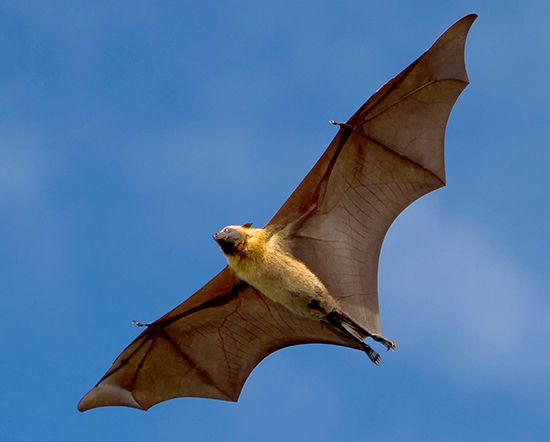
What are the different types of diets found among bat species?
Bat species exhibit a remarkable adaptive radiation in their feeding habits, occupying diverse ecological niches. Their diets include:1
- Insectivores: Most bats feed on flying insects, which they track using echolocation. Some also consume ground-dwelling arthropods like spiders and scorpions.2
- Frugivores: Many Megachiroptera and phyllostomid bats feed on a variety of fruits.21
- Nectarivores: Certain species, such as those in the subfamily Macroglossinae, specialize in consuming nectar and pollen from flowers.2
- Carnivores: Some bats are carnivorous, preying on small vertebrates including rodents, shrews, birds, lizards, and even other bats.23
- Piscivores: A few species in the genera Noctilio and Myotis are specialized to catch small fish and crustaceans using large, clawed hind feet.21
- Sanguivores: The three species of vampire bat are the only bats that feed exclusively on blood, utilizing specialized teeth and saliva to lap blood from mammals or birds.23
How do bats’ wings differ from birds’ wings, and how does this affect their flight?
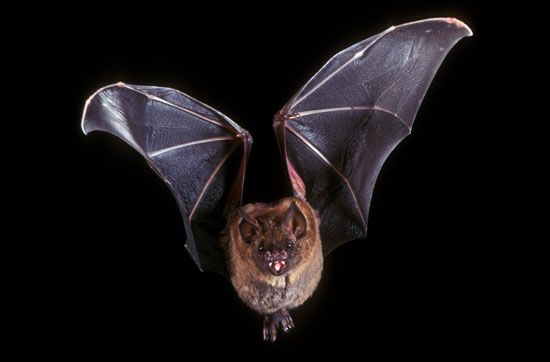
While both birds and bats use modified forelimbs for flight, their wing structures differ significantly in anatomy and evolutionary origin, leading to distinct flight capabilities.56
Structural Differences
- Composition: Bird wings rely on primary flight feathers attached to a reduced number of digits to create propelling force and lift. In contrast, bat wings consist of a thin, elastic membrane of skin stretched over slender, greatly elongated arm and hand bones, specifically the fingers (excluding the thumb).567
- Control: A bat’s wing membrane contains blood vessels, nerves, and muscle fibers that allow for precise, individual control over the posture of each finger. This enables bats to adjust the shape, extension, and angle of their wings with high sensitivity.78
Impact on Flight
These anatomical differences influence how each animal maneuvers:
- Maneuverability: Because bats can independently manipulate their finger and arm postures, they possess exceptional control over their flight path, allowing for complex actions like hovering, diving, and sharp turning.8
- Flight Patterns: While both groups primarily utilize propulsive flight, wing shape—governed by the relative lengths of the forearm and fingers—varies among bat species to suit specific needs, such as high-speed travel in open spaces or slow, agile hovering to pick prey from vegetation.789
What are some unique social behaviors observed in bat colonies?
Bat colonies exhibit several distinct social behaviors and organizational patterns, though many aspects of their social lives remain subjects of ongoing study. Key observations include:
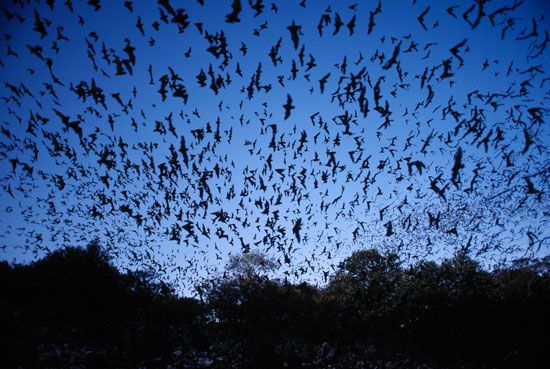
- Roosting Dynamics: Many bats are colonial, often forming dense clusters where individuals press against one another to share warmth, while others maintain wider spacing. These colonies can range from small groups to massive gatherings numbering in the hundreds of thousands, such as those seen in flying foxes.11
- Sexual Segregation: Bats frequently organize themselves by sex. Pregnant females often congregate in specialized nursery roosts to raise their young until they are independent. In mixed-sex roosts, individuals may arrange themselves in specific patterns, such as females occupying the center of a cluster while males remain on the periphery.12
- Foraging Patterns: Social structure can extend beyond the roost, with some species exhibiting sexual segregation even during foraging activities.12
- Migratory Meetings: For species that migrate over long distances, such as the Mexican free-tailed bat, social interaction between the sexes may be limited to brief annual encounters.12
How do bats hibernate, and why is this important for their survival?
To survive the winter, many temperate-zone bats undergo hibernation, a state characterized by the suspension of most activity and the absence of temperature regulation for extended periods.13
The Process of Hibernation
- Preparation: In the fall, bats reach their nutritional peak and increase their body weight by 50 to 100 percent through fat storage. They migrate to suitable sites, such as caves, that remain cool and humid without freezing.13
- Physiological Changes: During hibernation, bats experience significant adaptations in circulation, respiration, and renal function. They effectively “turn down the thermostat,” allowing their body temperature to drop to that of their surroundings.13
- Reproductive Timing: Hibernation is deeply integrated into the reproductive cycle. Many species mate in the fall, and females store sperm in their reproductive tracts throughout the winter. Fertilization occurs only after they emerge in the spring, ensuring that birth coincides with favorable environmental conditions and abundant food.1415
Importance for Survival
Hibernation is critical for survival because it allows bats to conserve energy during periods when their primary food source—insects—is unavailable. By reducing their metabolic rate, they can survive for months on stored fat. However, this state leaves them vulnerable to disturbances, such as white nose syndrome, which can cause premature arousal and fatal energy depletion.131516
Sources
- bat - Food habits — Encyclopædia Britannica
- Bat-loving flowers — Encyclopædia Britannica
- vampire bat — Encyclopædia Britannica
- mammal - Food habits — Encyclopædia Britannica
- Wing — Encyclopædia Britannica
- bat - Anatomical specializations — Encyclopædia Britannica
- bat - Locomotion — Encyclopædia Britannica
- Locomotion - Wings of birds and bats — Encyclopædia Britannica
- homology — Encyclopædia Britannica
- bat - General features — Encyclopædia Britannica
- bat - Roosting — Encyclopædia Britannica
- bat - Social interactions — Encyclopædia Britannica
- bat - Thermoregulation — Encyclopædia Britannica
- Dormancy - Reproductive cycles — Encyclopædia Britannica
- white nose syndrome — Encyclopædia Britannica
- bat - Life cycle — Encyclopædia Britannica
Published on · 4 min read