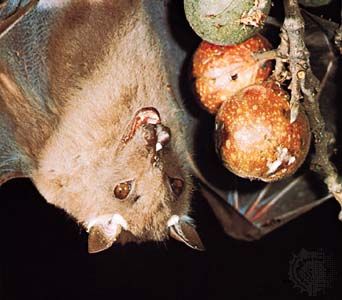
Phyllostomidae
The available information from the Britannica knowledge base does not contain details regarding the specific evolutionary history or the ancestral origins of…
What is the evolutionary history of the Phyllostomidae family?
The available information from the Britannica knowledge base does not contain details regarding the specific evolutionary history or the ancestral origins of the Phyllostomidae family.
Current records confirm that Phyllostomidae, commonly known as American leaf-nosed bats, comprise approximately 150 to 160 species distributed across the New World, ranging from the United States to Argentina. They are characterized by a diverse range of diets—including insects, fruit, nectar, and blood—and are distinguished by a spear-shaped nose leaf on the muzzle. While their taxonomy is well-documented, the specific timeline and evolutionary lineage of the family are not addressed in the provided search results.12
What are some of the most interesting or unusual species within the Phyllostomidae family?
The Phyllostomidae family, or American leaf-nosed bats, is remarkably diverse in both form and behavior. Here are some of the most interesting and unusual species within this group:
- Spectral Bat (Vampyrum spectrum): As the largest member of the family and the largest bat in the New World, it boasts a wingspan of 90 cm (35 inches) or more. Despite being called a “false vampire,” it is a carnivore that uses its size and long canine teeth to capture small prey rather than feeding on blood.18
- Common Vampire Bat (Desmodus rotundus): A member of the subfamily Desmodontinae, this species is uniquely adapted for a diet of blood. It possesses heat sensors in its face to detect prey and razor-sharp teeth to make incisions. It is also exceptionally agile on the ground, using its long thumbs to hop and leap into the air for takeoff.9
- Tent-making Bat (Uroderma bilobatum): These bats exhibit fascinating architectural behavior. They modify palm and other plant leaves by biting across them, causing the ends to hang downward to create a sheltered roost. They are also easily identified by their distinctively striped faces.1
- Nectar-feeding Bats (Tribe Glossophaginae): These species have evolved specialized long snouts and tongues, allowing them to efficiently feed on nectar and pollen from flowers.1
How do different species within the Phyllostomidae family vary in their diets and feeding habits?
The Phyllostomidae family, or American leaf-nosed bats, exhibits a remarkable range of dietary specializations, reflecting a broad adaptive radiation within the New World tropics and subtropics. Their feeding habits are highly diverse, with different species occupying distinct ecological niches.182
- Insectivores and Carnivores: Some species, such as the little big-eared bats (Micronycteris), are primarily insect eaters. Larger forms within the family have evolved to be carnivorous, utilizing their size and specialized teeth to capture and consume small vertebrates, including other bats.128
- Frugivores and Nectarivores: Many phyllostomids feed on fruit, nectar, or pollen. Species in the tribe Glossophaginae are specifically adapted for nectar feeding, possessing elongated snouts and tongues that allow them to reach deep into flowers.12
- Sanguivores (Vampire Bats): The subfamily Desmodontinae consists of three species of vampire bats that feed exclusively on blood. These bats possess specialized dentition for making tiny incisions and heat sensors in their faces to locate prey. They also produce anticoagulants in their saliva to facilitate blood consumption.10
This dietary variety is a result of evolutionary interplay between the bats’ structural characteristics and the ecological opportunities available in their habitats.11
How have Phyllostomidae bats been portrayed in various cultures and mythologies?
The portrayal of bats, including those within the Phyllostomidae family, varies significantly across different global cultures.
In many Western traditions, bats have frequently been the subject of unfavorable myths, often associated with darkness, fear, and the supernatural. This negative perception is heavily influenced by the existence of vampire bats, which are members of the Phyllostomidae family (subfamily Desmodontinae). Because these specific bats feed on the blood of mammals and birds, they have become synonymous with the folklore of the “vampire,” a creature that sustains itself by consuming the life force of others.81314
Conversely, in many parts of the Orient, bats are viewed quite differently. Rather than being symbols of dread, they are often regarded as auspicious creatures representing good luck, long life, and happiness.8
While the biological reality of these animals involves essential ecological roles—such as pollination, seed dispersal, and insect control—their cultural reputation remains a complex blend of scientific observation and deep-seated mythological interpretation.8
Sources
- Phyllostomidae — Encyclopædia Britannica
- leaf-nosed bat — Encyclopædia Britannica
- Phyllostomatidae — Merriam-Webster
- Phyllostomidae — Merriam-Webster
- phyllostome — Merriam-Webster
- Phyllostomus — Merriam-Webster
- caddisfly - Annotated classification — Encyclopædia Britannica
- vampire bat — Encyclopædia Britannica
- bat - General features — Encyclopædia Britannica
- Feeding behaviour - Types of food procurement — Encyclopædia Britannica
- neuropteran - Ecology — Encyclopædia Britannica
- mammal - Food habits — Encyclopædia Britannica
- vampire bat — Merriam-Webster
- bat - Importance to humans — Encyclopædia Britannica
Published on · 3 min read