Black-and-yellow Mangrove Snake
The black-and-yellow mangrove snake (Boiga dendrophila), also known as the gold-ringed cat snake, is a species of colubrid native to Southeast Asia, ranging…
What is Black-and-yellow mangrove snake?
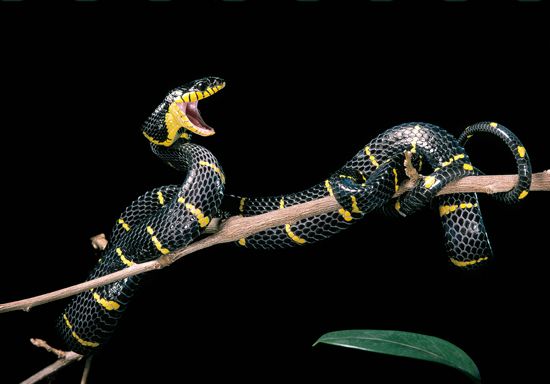
The black-and-yellow mangrove snake (Boiga dendrophila), also known as the gold-ringed cat snake, is a species of colubrid native to Southeast Asia, ranging from the Malay Peninsula to the Philippines.123
This arboreal snake is named for the distinctive yellow bands across its black body. It typically reaches lengths of 2 meters (6.6 feet), though some specimens grow to 2.5 meters (8.2 feet). Like other members of the Boiga genus, it features elliptical pupils, earning it the nickname “cat-eyed snake”.32
The species is weakly venomous, utilizing a neurotoxin called denmotoxin. This toxin is highly lethal to birds—the snake’s primary prey—by causing paralysis, but it is only mildly toxic to mammals, typically causing only swelling and skin discoloration in humans. Found in mangrove swamps and tropical lowland forests, these snakes are primarily nocturnal hunters. While currently classified as a species of least concern, their habitats face risks from human development.123
How does the ‘pterygoid walk’ mechanism help snakes swallow large prey?
The “pterygoid walk,” or “walk-feeding,” is a specialized mechanism that allows snakes to consume prey significantly larger than their own heads. This process relies on the extreme mobility of the snake’s skull, which features multiple joints and independent jaw arches held together by flexible ligaments rather than rigid bone structures.45
In this method, the snake’s four jaw arches—the left and right sides of both the upper and lower jaws—operate independently. To advance over the prey, the snake disengages one jaw arch and moves it forward, while the other three arches remain anchored to the prey to maintain a secure grip. By repeating this sequence—typically moving the upper left, upper right, lower left, and lower right arches in order—the snake effectively “walks” its mouth over the prey, gradually pulling it into the throat.45
This process is further facilitated by the snake’s needle-sharp, recurved teeth, which prevent the prey from escaping and ensure that it moves only in the direction of the digestive tract.4
What makes the brown tree snake a dangerous invasive species?
The brown tree snake (Boiga irregularis) is considered one of the world’s most aggressive invasive species due to its devastating impact on ecosystems where it has been introduced, most notably on Guam.7
Several factors contribute to its status as a dangerous invasive species:
- Voracious Predation: These snakes are highly efficient hunters capable of consuming up to 70 percent of their body mass daily. They have few natural enemies in their introduced ranges, allowing their populations to reach extreme densities.7
- Ecological Destruction: Since their accidental introduction to Guam via military cargo after World War II, they have decimated native wildlife. They are responsible for the extinction of several endemic bird and bat species, which has triggered a cascade of negative effects, including reduced seed dispersal and the decline of native plants.7
- Adaptability: Their slender bodies allow them to climb trees and hide in small spaces, enabling them to thrive in diverse environments, including urban ecosystems.7
- Reproductive Strategy: Females can store sperm for several years, which facilitates the colonization of new areas even when few individuals are present.7
We could dive deeper into the specific conservation efforts currently being used to manage or eradicate these snakes on affected islands.
Why are some snakes referred to as ‘cat-eyed’ snakes?
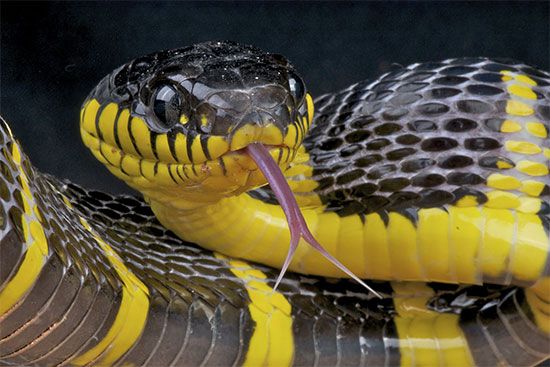
Some snakes are referred to as “cat-eyed” because they possess vertically elliptical pupils that resemble those of felines.9
This pupil shape is a common adaptation among nocturnal snakes, as it allows the eye to function effectively in varying light conditions. During the day, these pupils contract into narrow vertical slits to protect the sensitive, dark-adapted retina from bright light. As night falls, the pupils expand to a nearly circular shape, maximizing the amount of light that enters the eye to enhance vision in the dark.910
While the term “cat snake” is often used for various arboreal or semiarboreal species in the family Colubridae, the specific group known as “cat-eyed snakes” (Leptodeira) refers to species found in the New World tropics that share these same feline-like ocular characteristics.9
Sources
- Black-and-yellow mangrove snake: Top Questions — Encyclopædia Britannica
- mangrove snake — Encyclopædia Britannica
- Black-and-yellow mangrove snake — Encyclopædia Britannica
- snake - Skull and sense organs — Encyclopædia Britannica
- How do snakes swallow large prey? — Encyclopædia Britannica
- reptile - Skull and dentition — Encyclopædia Britannica
- brown tree snake — Encyclopædia Britannica
- brown tree snake — Merriam-Webster
- cat snake — Encyclopædia Britannica
- reptile - Sight — Encyclopædia Britannica
Published on · 3 min read