Footman Moth
The footman moth (subfamily Lithosiinae) belongs to the tiger moth family, Arctiidae, within the order Lepidoptera. The name "footman" likely refers to the…
What is footman moth?
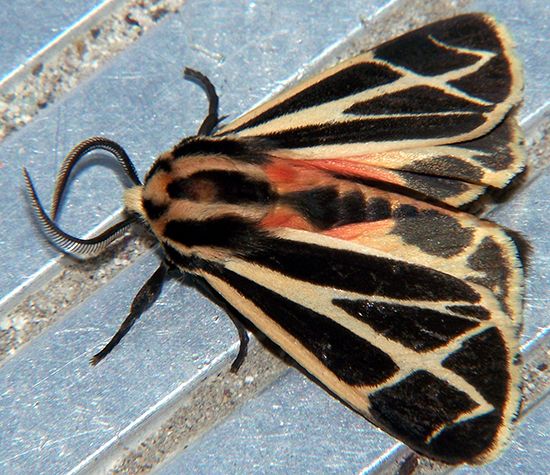
The footman moth (subfamily Lithosiinae) belongs to the tiger moth family, Arctiidae, within the order Lepidoptera. The name “footman” likely refers to the insect’s stiff, elongated posture, as adults typically hold their narrow wings against their bodies, resembling a servant standing at attention.1
These moths generally have a wingspan ranging from 2 to 5 cm (4/5 to 2 inches). While many species are characterized by drab shades of gray and brown, others exhibit vibrant patterns, such as the scarlet lichen moth (Hypoprepia miniata) with its pink and gray stripes, or the black-and-yellow lichen moth (Lycomorpha pholus). The larvae are distinguished by long, sparse hairs growing from wartlike tubercles and primarily feed on lichen.1
What are the main differences between tiger moths and other moth families?
Tiger moths (family Arctiidae) are distinguished from other moth families by several unique physical and behavioral characteristics:
Physical Characteristics
- Appearance: Tiger moths are known for their thick, furry bodies and broad wings, which are often marked with striking geometric patterns, stripes, or spots in colors like red, orange, white, or green.23
- Larvae: Their caterpillars are typically covered in dense hair, earning them the common name “woolly bears.”23
- Resting Posture: When at rest, tiger moths fold their wings rooflike over their bodies.2
Defensive Mechanisms
Tiger moths have evolved specialized strategies to avoid predation that differ from many other moth families:
- Chemical Defense: Many species are distasteful to predators. They possess glands on the prothorax that secrete repellent drops, and some species exhibit reflex bleeding from their joints when disturbed.4
- Acoustic Warnings: Unlike many other moths that rely solely on camouflage, some tiger moths use timbal (drumlike) organs to produce high-pitched, ultrasonic grating sounds. These sounds serve as an acoustic warning to bats that the moth is inedible, or they may interfere with the bats’ echolocation.4
- Warning Coloration: Their bright, aposematic coloration serves as a visual signal to predators that they are toxic or distasteful.24
Why do footman moth caterpillars specifically eat lichen?
Footman moth caterpillars (subfamily Lithosiinae) have evolved to feed on lichen as a primary food source, a specialized dietary habit that distinguishes them from many other moth larvae. This adaptation is closely tied to their ecological niche, as lichens—which are symbiotic organisms consisting of fungi and algae or cyanobacteria—are abundant in the habitats where these moths thrive, such as tree trunks, rocks, and walls.1
By consuming lichen, these caterpillars gain access to a stable, year-round food supply that is often avoided by other herbivores due to its tough texture and the presence of secondary metabolites. This specialized diet is also thought to contribute to the chemical defenses of the moths; many species in the tiger moth family sequester toxins from their food sources, which may help protect them from predators throughout their life cycle.1
How does the life cycle of a moth differ from that of a butterfly?
Both moths and butterflies belong to the order Lepidoptera and share a four-stage life cycle: egg, larva (caterpillar), pupa, and adult (imago). While the larval stage is fundamentally similar for both—serving as the primary feeding phase—there are distinct differences in how they transition to adulthood.678
Key Differences in Metamorphosis
- Pupation: The most significant difference occurs during the pupal stage. Most moths build protective, fibrous cocoons made of silk to enclose themselves, often in soil, leaf litter, or under bark. In contrast, most butterflies pupate “naked,” with their own hardened bodies forming a chrysalis. While a few butterfly groups, such as satyrs, do construct cocoons, this is the exception rather than the rule.69
- Support: Butterfly chrysalises are often suspended from a silk pad by a stalk called a cremaster or supported by a silk girdle, whereas moth pupae are typically concealed within their cocoons or buried in the ground.9
Sources
- footman moth — Encyclopædia Britannica
- tiger moth — Encyclopædia Britannica
- moth — Encyclopædia Britannica
- Lepidoptera - Protection against danger — Encyclopædia Britannica
- Arctiidae — Merriam-Webster
- What’s the difference between moths and butterflies? — Encyclopædia Britannica
- Lepidoptera - Larva, or caterpillar — Encyclopædia Britannica
- Lepidoptera - Pupa , or chrysalis — Encyclopædia Britannica
- Lepidoptera - Distinguishing taxonomic features — Encyclopædia Britannica
- Lepidoptera — Encyclopædia Britannica
Published on · 3 min read