Bedstraw
The name "bedstraw" is derived directly from the historical practice of using these plants as stuffing for mattresses.
How does the name ‘bedstraw’ relate to the historical use of this plant?
The name “bedstraw” is derived directly from the historical practice of using these plants as stuffing for mattresses.12
Members of the genus Galium, which belong to the madder family, were commonly gathered and dried for this purpose. Beyond their use in bedding, various species have historically served other practical functions: the roots of several Galium species were used to produce a red dye, while lady’s bedstraw (G. verum) has been utilized in Europe to curdle milk and provide color for cheese. Additionally, the dried shoots of sweet woodruff, also known as sweet-scented bedstraw, are valued for their hay-like fragrance and are used in sachets, perfumes, and to flavor beverages.1
What is bedstraw and which plant family does it belong to?
Bedstraw is a genus of approximately 400 species of low-growing annual or perennial herbs known scientifically as Galium. These plants belong to the madder family, also known as Rubiaceae.13
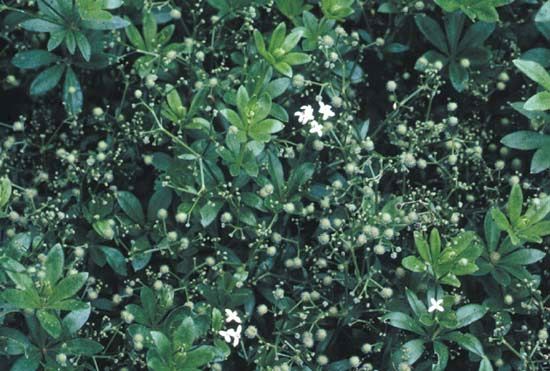
Characterized by square or rounded stems and finely toothed, often needle-shaped leaves arranged in whorls, bedstraw plants are found globally in damp environments such as swamps and along stream banks. They produce small green, yellow, or white flowers and reproduce through rhizomes and stolons.1
The genus includes several notable species, such as:
- Northern bedstraw (G. boreale)1
- Common marsh bedstraw (G. palustre)1
- Goosegrass (G. aparine)1
- Sweet woodruff (G. odoratum), valued for its hay-like scent1
- Lady’s bedstraw (G. verum), historically used to curdle milk and color cheese1
What are some ways to identify bedstraw in the wild, and are there any look-alike plants to be aware of?
To identify bedstraw (Galium) in the wild, look for these key botanical characteristics:
- Stems: The plants typically feature square or angled stems that are often trailing in habit.142
- Leaves: Look for needle-shaped or finely toothed leaves arranged in distinct whorls of four to eight around the stem.1
- Flowers: They produce clusters of small, inconspicuous flowers that are generally green, yellow, or white.14
- Fruit: The fruit consists of two small, rounded nuts joined together, which are frequently covered in hooked bristles designed to cling to animals for dispersal.1
- Habitat: These herbs are commonly found in damp environments, including woods, swamps, and along stream banks.1
Regarding look-alike plants, the provided search results do not contain specific information identifying common botanical mimics or look-alikes for the Galium genus. Because of this, I cannot provide a list of plants to be cautious of when foraging or identifying bedstraw in the field.
How do bedstraw plants reproduce and spread in their environment?
Bedstraw plants (Galium) utilize both asexual and sexual methods to reproduce and spread throughout their environments.
Asexual Reproduction
Bedstraw plants commonly reproduce asexually through the growth of rhizomes and stolons. These structures allow the plant to spread vegetatively, enabling it to colonize new areas near the parent plant without the need for seeds.1
Sexual Reproduction and Dispersal
For sexual reproduction, bedstraw produces small flowers that develop into fruits consisting of two rounded nuts joined together. These fruits are highly adapted for dispersal via epizoochory, a process where seeds are inadvertently transported by animals.156
- Hooked Bristles: The fruits are frequently covered in hooked bristles or barbs. These act as “hitchhikers,” clinging tenaciously to the fur of passing terrestrial mammals.156
- Animal Transport: As animals move through the environment, they carry these hooked fruits to new locations, effectively spreading the plant’s seeds far from the original site.56
Sources
- Bedstraw — Encyclopædia Britannica
- bedstraw — Merriam-Webster
- Rubiaceae — Encyclopædia Britannica
- Galium — Merriam-Webster
- Seed dispersal - Mammals — Encyclopædia Britannica
- Seed - Dispersal by animals — Encyclopædia Britannica
- Seed - Self-dispersal — Encyclopædia Britannica
Published on · 3 min read