Blind Snake
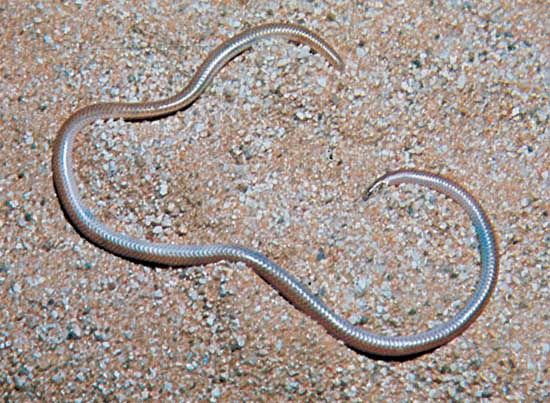
Blind snakes, which belong to the infraorder Scolecophidia, are distinguished from other snakes by several unique physical and behavioral characteristics:
What are the main characteristics that distinguish blind snakes from other snake species?
Blind snakes, which belong to the infraorder Scolecophidia, are distinguished from other snakes by several unique physical and behavioral characteristics:
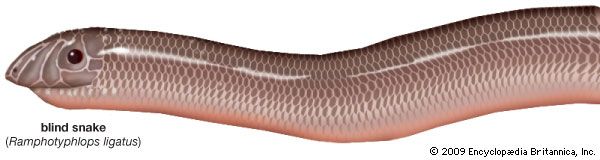
- Degenerate Eyes: Their eyes are significantly reduced, often appearing only as black spots beneath opaque head scales, reflecting their fossorial (burrowing) lifestyle.12
- Body Structure: They are typically small with blunt heads, cylindrical bodies, and short tails, all covered in smooth, shiny scales.1
- Feeding Habits: Unlike many snakes that consume large vertebrate prey, blind snakes primarily feed on the eggs and larvae of ants and termites. Consequently, they possess highly reduced dentition and may lack teeth in one jaw entirely.12
- Feeding Mechanism: They utilize an inertial-feeding mode, a primitive method where both the upper and lower jaws are engaged forward over their prey, contrasting with the more advanced walk-feeding methods seen in other snake groups.2
- Habitat: They are almost exclusively subterranean, frequently found in ant or termite nests, though they may emerge at night or after heavy rains.1
How do blind snakes hunt and what do they primarily eat?
Blind snakes, which belong to the infraorder Scolecophidia, are specialized for a subterranean lifestyle, primarily inhabiting ant and termite nests. Because they occupy these environments, they have evolved specific behaviors and physical traits to secure their food.41
Hunting and Feeding
Blind snakes do not hunt in the traditional sense of pursuing elusive prey. Instead, they rely on their tongue and Jacobson’s organ to detect and recognize their food sources. Because their prey—typically soft-bodied and defenseless—is found within the nests they inhabit, they do not require complex sensory equipment like facial pits or venom glands.1
Their feeding mechanism is described as “inertial-feeding,” a primitive method where both the upper and lower jaws are engaged forward over the prey items. Due to their specialized diet, they have significantly reduced dentition and may lack teeth in one jaw entirely.21
Diet
Blind snakes primarily feed on the eggs and larvae of termites and ants. In addition to these, they also consume other soft-bodied arthropods and their eggs.4
What is the average size range of blind snakes?
Blind snakes are generally small, though their size varies by family:
- Anomalepids and Leptotyphlopids: These groups are typically slender and rarely exceed 30 cm (12 inches) from snout to vent, reaching a maximum total length of about 40 cm (16 inches).1
- Typhlopids (True Blind Snakes): Most species are small, with adults typically ranging from 14 to 30 cm (5.5 to 12 inches) in total length. Some species are even smaller, measuring less than 10 cm (4 inches) when fully grown, while a few exceptional individuals can reach nearly 1 metre (3.3 feet) in length.17
How do blind snakes reproduce, and what is unique about their reproductive process?
All blind snakes reproduce by laying eggs. While most snakes rely on internal fertilization—typically involving the male using hemipenes to deposit sperm into the female’s cloaca—some blind snakes exhibit a unique reproductive strategy.18
The most notable exception is the flowerpot snake (Ramphotyphlops braminus), which reproduces through parthenogenesis. In this process, the eggs are self-activated and do not require fertilization by male sperm to develop. Because R. braminus is an all-female species, a single individual is capable of founding an entirely new population. Since no male chromosomes are involved, the offspring are genetically identical to the mother, lacking the genetic recombination that occurs during sexual reproduction. This unique ability has allowed the flowerpot snake to achieve a widespread distribution across many oceanic islands and continents.18
Sources
- blind snake — Encyclopædia Britannica
- snake - Skull and sense organs — Encyclopædia Britannica
- reptile - Sight — Encyclopædia Britannica
- snake - Specializations for securing food — Encyclopædia Britannica
- Feeding behaviour - Types of food procurement — Encyclopædia Britannica
- scorpion - Internal features — Encyclopædia Britannica
- reptile - Size range — Encyclopædia Britannica
- reptile - Courtship and fertilization — Encyclopædia Britannica
Published on · 3 min read