Boa Constrictor
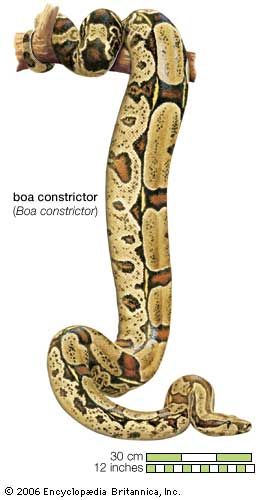
The boa constrictor (Boa constrictor) is a large, thick-bodied snake belonging to the Boidae family. Native to regions ranging from northern Mexico to…
What is boa constrictor?
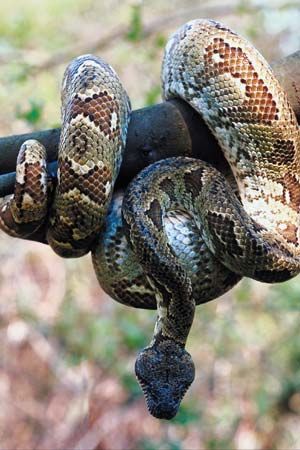
The boa constrictor (Boa constrictor) is a large, thick-bodied snake belonging to the Boidae family. Native to regions ranging from northern Mexico to Argentina, these snakes inhabit diverse environments, including tropical rainforests, savannas, and scrublands.123
Typically reaching about 10 feet (3 meters) in length, they are primarily terrestrial but are capable of climbing trees to hunt birds. They are nonvenomous and kill their prey—a variety of birds and mammals—by constriction, coiling around the animal to cut off blood flow. Unlike pythons, which lay eggs, boa constrictors are ovoviviparous, meaning they incubate eggs internally and give birth to live young. Due to their mild temperament, they are often kept by farmers to control rodent populations and are popular as exotic pets.123
How do boa constrictors kill their prey without using venom?
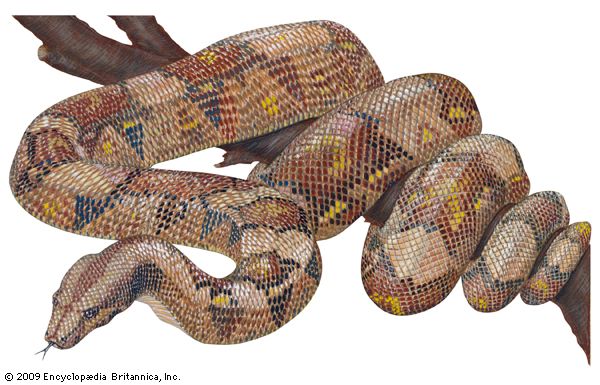
Boa constrictors are nonvenomous snakes that rely on a specialized hunting method known as constriction to secure their food.12
When hunting, the snake first strikes and grasps its prey with its teeth. It then rapidly throws a series of body coils around the animal. These coils are tightened to exert significant pressure, which prevents the prey from breathing, leading to suffocation. Additionally, this intense constriction effectively cuts off the prey’s blood flow, which can cause organ failure within seconds. Contrary to common belief, this process very seldom results in broken or crushed bones.42
What are the main differences between boa constrictors and pythons?
Pythons and boa constrictors are both large, muscular snakes, but they differ significantly in their biology and behavior:
Physical Traits and Sensory Abilities
- Size: Pythons are generally larger, with some species like the reticulated python reaching lengths of up to 10 meters (33 feet). Boa constrictors typically measure about 3 meters (10 feet), though some can grow to 5.5 meters (18 feet).
- Heat Sensing: Pythons possess heat-sensing pits between their lip scales that allow them to detect the infrared radiation of warm-blooded prey. This feature is absent in boa constrictors.
Geography and Habitat
- Distribution: Pythons are found in the Old World tropics and subtropics, including Africa, Asia, and Australia. Boa constrictors are native to the New World, ranging from northern Mexico to Argentina.
Reproduction
- Method: Pythons are oviparous, meaning they lay eggs. Females often coil around their eggs to protect and regulate their temperature through muscle contractions. In contrast, boa constrictors are ovoviviparous; they incubate eggs internally and give birth to live young.
How do boa constrictors give birth to live young?
Boa constrictors reproduce through a process called ovoviviparous development. Unlike many other snakes that lay eggs in external nests, female boa constrictors retain their eggs within their oviducts throughout the incubation period.61
During this time, the embryos develop inside the mother’s body, where they are protected from external environmental hazards. While they do not establish a placental connection like mammals, there is evidence of material exchange between the mother and the developing fetuses across their highly vascularized, contiguous membranes. Once the incubation is complete, the eggs hatch internally, and the female gives birth to live young that typically measure between 1 to 2 feet (0.3 to 0.6 meters) in length. A single litter can range from one to several dozen offspring.631
Sources
- boa constrictor — Encyclopædia Britannica
- What are the differences between anacondas and boa constrictors? — Encyclopædia Britannica
- What are the differences between pythons and boa constrictors? — Encyclopædia Britannica
- snake - Specializations for securing food — Encyclopædia Britannica
- python — Encyclopædia Britannica
- snake - Egg formation and laying — Encyclopædia Britannica
Published on · 3 min read